

I have stayed in more Holiday Inn Express properties than I can easily count at this point, across business trips, road journeys, airport overnights, and the odd budget city break. When I say Holiday Inn Express, I am talking about the typical limited service hotels in this chain: the places that promise a clean, reliable room, free breakfast, and not much else.
Over time I have formed a pretty clear picture of what this brand does well, where it falls short, and when it is actually worth choosing over the many competing mid-range options out there. This is my honest take, based on real stays in multiple cities, not a promotional overview.
What Holiday Inn Express Promises vs What I Actually Got
Holiday Inn Express sells a simple promise: a modern, functional room, a good bed, a hot shower, free Wi‑Fi, and an included breakfast that gets you out the door quickly. It is not meant to be a resort or a full service hotel. In theory, the brand is consistent, so that if I book a Holiday Inn Express in a random city along the interstate or next to a major airport, I should know exactly what I am getting. In practice, the consistency is better than some chains, but there is still a meaningful gap between the marketing and the reality on the ground.
Across my stays, the most reliable part of the promise has been the basics: the room almost always feels reasonably modern, the mattresses tend to be on the firm side but comfortable enough for a night or two, towels are serviceable, and the hot water works. Wi‑Fi has been free and functional in nearly every property I have used, usually fast enough for email, video calls, and streaming. I have had only one stay where the Wi‑Fi cut out repeatedly in the evening, which the front desk blamed on heavy usage. It was irritating but not catastrophic.
Where expectations and reality diverge more often is in the details: noise insulation, maintenance, cleanliness in corners rather than surfaces, and the free breakfast setup. Some Holiday Inn Express hotels I stayed in felt nearly brand new and well looked after, with spotless rooms and quiet halls. Others clearly needed a refresh, with scuffed walls, stained carpets, and that slightly stale hallway smell that says housekeeping is doing a quick pass rather than a deep clean. Front desk staff also varied in professionalism and warmth, from genuinely helpful to going through the motions.
The other thing that surprised me is how much the experience changes depending on location: a suburban or highway Holiday Inn Express can feel relaxed and easy, while one right by a busy airport or in the center of a city can feel crowded, noisy, and borderline chaotic at peak times. So while the brand promises uniformity, my real experience has been that Holiday Inn Express is consistent enough for the basics, but still a gamble in terms of ambience and finer points of comfort.
Rooms, Beds and Noise: The Stuff That Matters at Night
The room itself tends to be the strongest part of my Holiday Inn Express stays. The design language is fairly standard across locations: neutral colors, a bed with a firm mattress and a choice of soft or firm pillows, a small desk, plenty of outlets, and blackout blinds that usually do a decent job of keeping light out. I like the straightforward, uncluttered layout. It feels more practical than charming, but that is exactly the point of the brand.
In most of the properties where I stayed, the beds were comfortable enough that I did not wake up with a sore back, which I honestly cannot say about every mid-range brand. Linens were clean and generally in good condition, though never luxurious. I did notice some variation in pillow quality: in newer hotels the pillows felt fuller and more supportive, while older ones had flatter, lumpy pillows that clearly needed replacing. I would not come here expecting hotel bedding that feels indulgent, but for a business or road trip, the standard has been acceptable to good.
Noise is where my experience gets more mixed. Interior noise insulation seems to be the chain’s weak spot. I have had stays where I barely heard anyone and slept through the night, but I have also had several where hallway noise was very noticeable. Door slams echoed, children ran up and down the corridor, and I could hear conversations outside my room clearly. In one airport location, early morning departures meant doors banging starting well before 5 a.m., which made a full night’s sleep impossible without earplugs. Exterior noise is hit or miss too. Some properties near highways or busy roads had surprisingly solid windows, others let in a steady rumble of traffic.
If you are sensitive to noise, the brand does not consistently protect you. I learned to request a top floor room away from the elevators and ice machine, which helped quite a bit. When I forgot to make that request or checked in late at night, I usually paid for it with more interruptions. For me, this is one of the biggest trade-offs with Holiday Inn Express: good value on paper, but only if you are in a decently quiet room.
Cleanliness and Maintenance: Mostly Fine, Sometimes Frustrating
Cleanliness is always where I tend to be strict, and my Holiday Inn Express experiences ranged from “no complaints at all” to “this should have been caught.” On the positive side, most rooms were clearly cleaned between guests: fresh sheets, vacuumed carpets, wiped surfaces, and tidy bathrooms. I rarely saw obvious dirt on high-touch points like door handles or light switches, and I did not encounter any pests, which is a baseline I do not take for granted anymore.
Where things slipped more often was in the details and the older properties. I found wear and tear in several locations that staff seemed to be ignoring: peeling wallpaper, noticeable stains on the carpet, chipped paint around door frames, and discolored grout in bathrooms. One room had a cracked basin that had been clumsily patched, another had rust at the bottom edge of the tub. None of these issues made the room unusable, but they contributed to a “tired” feeling that clashed with the brand’s image of fresh, modern simplicity.
In one stay, my first room had a lingering smell of stale smoke, despite the hotel being non-smoking. When I mentioned it at the front desk, the agent moved me to another room with no fuss, which I appreciated. In another, the air conditioning unit rattled loudly whenever it cycled on. Maintenance was not available until the next day, and I ended up sleeping with earphones in to drown it out. Again, staff were polite, but the fix was slow in coming.
Day-to-day housekeeping during longer stays was reliable but not especially thorough. Beds were made, trash was emptied, towels replaced if I left them on the floor, but surfaces were not always fully dusted and the bathroom sink sometimes had water spots from previous use. To be fair, this is pretty typical for the mid-range category now, and the brand is very open about being limited service. Still, if you are someone who notices the small things, you will occasionally wish they aimed a bit higher on the maintenance side.
The Famous Free Breakfast: Convenience Over Quality
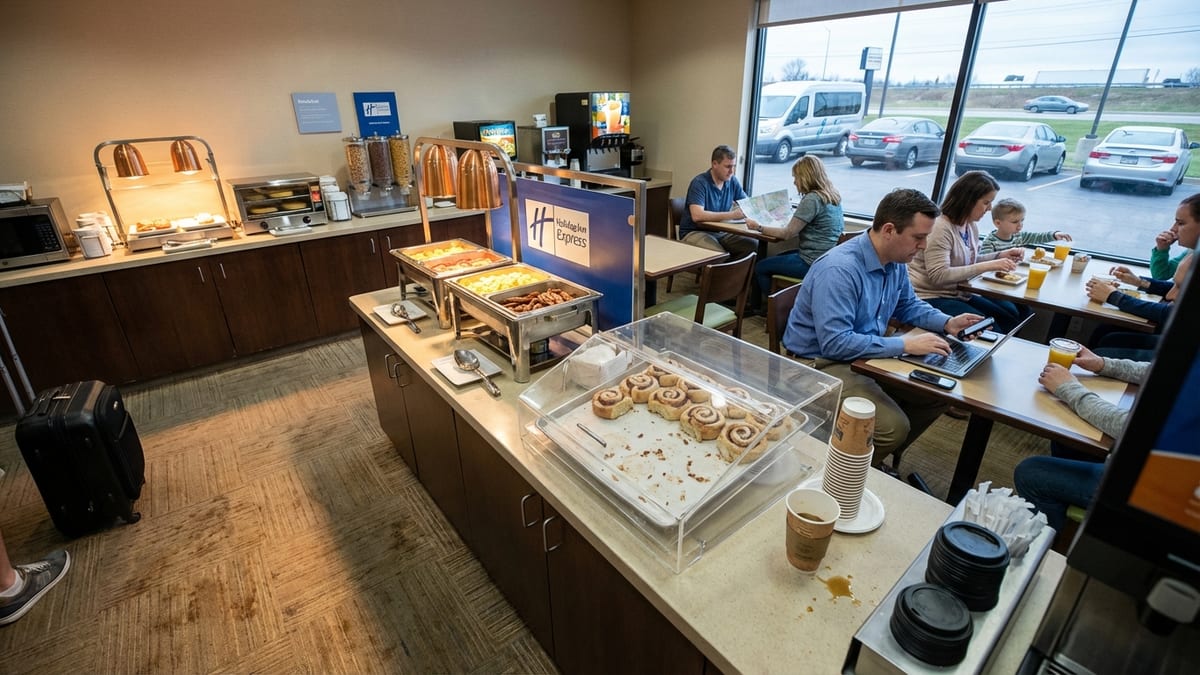
The free breakfast is one of the biggest advertised perks of Holiday Inn Express. In theory, it saves money compared to grabbing food outside every morning, and I have absolutely taken advantage of that. My honest verdict: it is convenient and sometimes surprisingly decent, but it rarely rises above functional, and at busy locations it can be a frustrating experience.
The typical spread I encountered included scrambled eggs, some form of breakfast meat (bacon or sausage), a pancake or waffle option, cereal, yogurt, fruit, bread and pastries, and the chain’s signature cinnamon rolls. Coffee, tea, and juices are standard. On days when I just needed calories before an early meeting or a long drive, this setup did exactly what it was supposed to do. I appreciated not having to think about where to eat, or spend extra time and money hunting down a café.
Quality, however, is squarely in the “mass-produced hotel buffet” category. The eggs often tasted powdered or overcooked, the breakfast meat ranged from decent to rubbery, and the pastries were usually industrial, not fresh. The cinnamon rolls were consistently the highlight, but they are more of a guilty sugar bomb than a balanced breakfast. Coffee quality varied a lot by property. In some locations it was surprisingly drinkable, in others it was weak and bitter enough that I ended up walking to a nearby coffee shop afterward.
The bigger issue for me has been crowding and layout. At airport and city locations in particular, breakfast turned into a chaotic scramble between about 7 and 8:30 a.m. Seating was limited, families and business travelers competed for tables, and the self-serve area became a tight weaving of people. Hot items ran out and took time to be replenished. In one hotel, I did two loops of the breakfast room before giving up and eating in my room with what I could grab. On quieter days or in smaller towns, the same breakfast felt much more relaxed. So, while the free breakfast is definitely a financial and logistical plus, I would temper expectations on both quality and ambiance.
Check In, Staff and “Limited Service” in Real Life
Holiday Inn Express positions itself as limited service, and you feel that as soon as you arrive. There is generally a small front desk, maybe a tiny lobby seating area, a corner market with snacks and drinks, and not much else. There is usually no full restaurant, no dedicated bar, and sometimes no concierge, just front desk staff handling all guest interactions. Whether this works for you depends mostly on how self-sufficient you are as a traveler and how much extra service you expect from a hotel.
My check in experiences have ranged from smooth and warmly efficient to mildly indifferent. At some properties, I was greeted with a smile, given clear information about breakfast hours, Wi‑Fi, parking, and late checkout options, and offered a bottle of water or small welcome gift as a loyalty member. At others, the interaction felt rushed and transactional, with minimal eye contact and no proactive information. I do not need over-the-top hospitality, but those small touches genuinely change how welcomed I feel after a long day of travel.
Service limitations also appear when something out of the ordinary comes up. When I needed an extra blanket late at night, one front desk attendant cheerfully brought it up personally in under ten minutes. In another hotel, I was told housekeeping had gone home, and I would have to come down and collect it myself. When I asked about local restaurant options beyond the obvious chains, only a few staff members across all my stays seemed to know the neighborhood well enough to suggest anything interesting. This is the trade-off with a lean staffing model: payroll is kept low, and that often means less local knowledge and fewer hands available for requests.
Check out has usually been fast, especially if I settled the bill in advance or used express checkout options. I have not had billing surprises. Still, there is a definite ceiling to how personalized the service can feel. Holiday Inn Express is designed for travelers who mainly need a place to sleep, shower, and grab breakfast. If you like staff to remember your name, proactively offer help, or arrange extras, you may find the brand emotionally flat.
Location, Access and Practical Details That Actually Matter
One reason I keep ending up at Holiday Inn Express is simple: the chain tends to place hotels exactly where I need them for practical trips. I have used them near major highways on road journeys, adjacent to airports for early flights or late arrivals, and in secondary business districts where meetings were scheduled. In many American cities and towns, there always seems to be at least one Holiday Inn Express near the main retail strip or close to the interstate exit, which makes life easier when I am driving.
Access and parking are usually straightforward. At suburban and highway locations, self-parking has typically been free and plentiful, with no valet required. In busier urban areas, I have paid nightly parking charges that added a noticeable extra cost to the stay. This is one of those details that can quickly change the value equation: a room that looks affordable at booking becomes less so once you add parking, taxes, and optional late checkout fees. On airport properties, I have sometimes been able to leave my car parked for a short trip with a “park and stay” rate, which can be good value if flights are early.
In terms of public transport, the brand is less predictable. Airport hotels often provide a shuttle, but the frequency and reliability vary by property. I have waited less than ten minutes at some airports and almost half an hour at others, usually standing outside in a crowded pickup zone. In city center locations, access to public transit has occasionally been excellent, with subway or bus stops within a short walk, but just as often the hotel is a few blocks further than I would like from main transit lines, which matters when I am carrying luggage or walking late at night.
The lack of on-site restaurants is another practical factor. When I arrive late, my only options are usually delivery apps, the lobby market fridge, or nearby fast food. In suburban and highway areas, that often means getting back in the car if I want anything halfway decent. This is not a unique issue to Holiday Inn Express, but if you are used to full service hotels, you will feel the difference. I have learned to check what is within walking distance before booking, especially when I know I will be arriving tired or without a car.
Price, Value and How It Stacks Up Against Competitors
Whether Holiday Inn Express is “worth it” really comes down to value, and that can only be judged against what alternatives are available in the same area for the same dates. Across my bookings, I have seen nightly rates that ranged from very reasonable to surprisingly high for what is essentially a limited service hotel with free breakfast. During quiet periods or in smaller markets, the chain can be one of the best value options: modern rooms, breakfast included, and often a better sense of reliability than cheap independent motels.
During peak travel seasons, large events, or at airport and city locations, prices can climb to the point where I start questioning the proposition. I have seen rates at some Holiday Inn Express properties that rival full service hotels with restaurants, bars, and more amenities. When that happens, the free breakfast and slightly more predictable experience are not enough to justify the price, and I would rather pay a little more or the same amount for a hotel that offers a richer stay.
Loyalty points can tilt the equation if you stay with the parent brand frequently. I have redeemed points for free or discounted stays at Holiday Inn Express, which felt like a fair trade for past nights at sister properties. The earn-and-burn cycle is straightforward enough. However, if you are not loyal to a specific chain, you will find comparable and sometimes better mid-range competitors offering similar rooms and amenities at equal or lower prices. Brands that offer free evening socials, more generous room layouts, or slightly higher quality breakfasts sometimes edge out Holiday Inn Express in my mental comparison chart.
Still, when I zoom out and look at cost per night versus what I actually used, Holiday Inn Express usually lands in the “reasonable” category. I am not paying for facilities I do not intend to use, such as spas, fancy lobbies, or full restaurants. I get a room, Wi‑Fi, and breakfast, and that is mostly what I need on working trips and simple stopovers. Where it loses me is when local pricing inflates due to demand and the brand does not adjust its offering to match the higher rate in any noticeable way.
The Takeaway
After enough stays in Holiday Inn Express hotels across different cities, I have a pretty clear sense of what I am signing up for when I book one. I am buying predictability in the mid-range: a clean enough, modern enough room, a functional bed, free Wi‑Fi, a hot shower, and a basic breakfast that gets me on the road. That core promise has mostly been met, with a few frustrating exceptions tied to noise, aging properties, and crowded breakfast areas. I have rarely been delighted, but I have also rarely been truly let down.
I do not think Holiday Inn Express is the right choice for every kind of trip. If I am planning a special weekend away, a romantic break, or any stay where the hotel itself is part of the experience, I usually look elsewhere. The brand simply does not offer the atmosphere, amenities, or staff attention that make a hotel feel memorable. Similarly, if rates are high due to an event or seasonality and a full service hotel is only slightly more expensive, I tend to upgrade. The free breakfast and modest convenience are not compelling enough to justify paying near-premium prices.
Where Holiday Inn Express remains very much worth it for me is in three scenarios: business travel where I only need a reliable place to sleep and work; road trips where location near a highway exit and free parking matter more than ambience; and airport overnights when my only priorities are proximity, shuttle access, and a quick breakfast before heading out. In those contexts, the compromises feel acceptable, and the brand’s straightforward formula makes life easier instead of adding decisions.
If you go in expecting a solid, utilitarian base rather than a destination in itself, Holiday Inn Express can still be a smart choice. Just be realistic about the trade-offs: bring earplugs if you are a light sleeper, check recent guest photos to gauge how up to date the property really is, and look closely at the final price once parking and taxes are added. Under the right conditions, and for the right kind of trip, Holiday Inn Express is worth it. It is not exciting, but it is usually dependable, and sometimes that is exactly what a traveler needs.
FAQ
Q1: Are Holiday Inn Express hotels generally clean?
In my experience, they are usually clean at a basic level, with fresh linens and tidy bathrooms, but older properties can show noticeable wear like stained carpets, chipped paint, and tired fixtures that make them feel less than pristine.
Q2: How comfortable are the beds at Holiday Inn Express?
The beds tend to be firm but reasonably comfortable, good enough for a night or two without back pain, though pillow quality varies and the bedding never feels truly luxurious.
Q3: Is the free breakfast actually worth it?
It is worth it for convenience and saving a bit of money, but the food quality is firmly in the mass-produced hotel buffet category, and peak times can be crowded and chaotic, especially at airport and city locations.
Q4: Do Holiday Inn Express hotels have good Wi‑Fi?
Most of my stays had free Wi‑Fi that was reliable enough for email, video calls, and streaming, though I did encounter the occasional property where the connection slowed or dropped under heavy evening use.
Q5: Are Holiday Inn Express hotels noisy?
Noise is very dependent on the specific hotel and room location; I have had quiet nights and also stays with loud hallway traffic, door slams, and early morning airport departures, so light sleepers should request a top floor room away from elevators and bring earplugs.
Q6: How does Holiday Inn Express compare to similar mid-range brands?
It usually holds its own on room quality and Wi‑Fi, offers similar or slightly better predictability than many independents, but can fall behind some competitors that provide extras like evening socials or more generous breakfasts at similar price points.
Q7: Is Holiday Inn Express good for family travel?
It can work well for families needing simple, predictable rooms and free breakfast, but crowded breakfast areas, limited common spaces, and the lack of on-site restaurants mean it is more functional than family-friendly in a warm, resort-like sense.
Q8: Are the locations generally convenient?
I have found Holiday Inn Express properties to be very convenient for highways, airports, and secondary business districts, though urban hotels sometimes involve extra walking or paid parking that affects overall convenience and cost.
Q9: Is Holiday Inn Express a good choice for a special occasion trip?
For me, no; the limited service model, lack of atmosphere, and basic amenities make it better suited for practical stays than for romantic getaways, anniversaries, or trips where the hotel is part of the experience.
Q10: When is Holiday Inn Express really worth booking?
It is most worth it when you need a reliable, no-frills base near a highway, airport, or business area, when the rate is clearly lower than more full-featured hotels nearby, and when your priority is a solid sleep and quick breakfast rather than amenities or ambience.