

More news on this day
British holidaymakers flying to Europe over the coming months are being urged to prepare for longer queues at airports as the European Union’s new digital Entry/Exit System beds in across Schengen border checkpoints.
Get the latest news straight to your inbox!
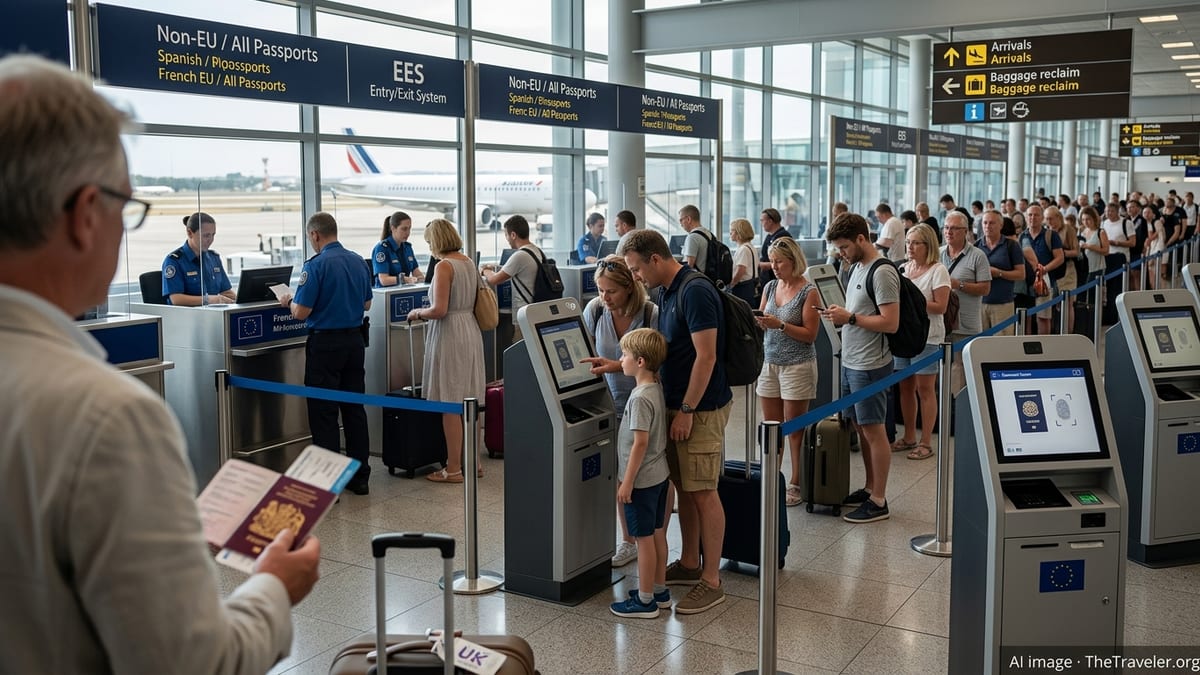
What Is Changing at EU Borders for UK Travellers
The EU’s Entry/Exit System, or EES, is a new bloc-wide digital register that records the movements of non-EU nationals entering and leaving the Schengen area. It replaces the long-standing practice of manually stamping passports for short stays. For British citizens, who are now treated as third-country nationals after Brexit, every trip to most European holiday favourites now falls under this system.
Publicly available information from the European Commission describes EES as a large-scale IT platform that stores a traveller’s name, passport details, biometric data and records of each entry and exit at external Schengen borders. The aim is to automate border checks, curb overstays and strengthen security. In practice, however, the new requirements introduce extra steps at passport control that are already lengthening processing times in some locations.
The system went live on 12 October 2025 and is being rolled out progressively at air, land and sea borders over a six-month period. From 10 April 2026 it is due to be fully operational at all external Schengen crossing points, including major Mediterranean holiday gateways frequented by UK tourists.
Until the rollout is complete, the experience will vary between airports and even between terminals, with some operating the new checks in full and others still relying mostly on manual procedures.
Why Longer Queues Are Expected This Holiday Season
Industry bodies, consultancy briefings and recent media coverage highlight that the first registration under EES is the most time-consuming stage. On a traveller’s first entry into the Schengen area after the system has gone live, border officials must capture facial images, take fingerprints and confirm passport and itinerary details before granting access.
Modelling cited by transport operators and travel industry groups suggests that this initial registration could take several minutes per person, compared with well under a minute for a straightforward passport stamp in the past. At peak holiday times, particularly during school breaks and summer weekends, the cumulative effect of these extra minutes per traveller is expected to translate into significantly longer queues at border control.
Concerns are most acute for airports and ports handling large volumes of British leisure travellers, including Spanish and Portuguese coastal gateways, Greek islands, and key hubs in Italy and France. Reports from late 2025 and early 2026 describe trial periods and early deployments where queues at some airports stretched well beyond usual waiting times as staff and passengers adapted to the new procedures and as kiosks and biometric equipment were fine-tuned.
While EU institutions maintain that EES will ultimately shorten border checks once most frequent travellers are fully enrolled and can use automated gates, transition periods for comparable systems in other regions have typically involved months of disruption before stabilising.
How the New Checks Work at the Airport
For most British holidaymakers arriving by air, the new process begins after they disembark and follow signs for non-EU arrivals. At airports where EES is in place, travellers are directed either to self-service kiosks or to staffed desks where their details are captured for the first time.
The initial enrolment usually involves scanning a passport, answering a small number of basic questions on-screen and providing biometric data such as facial images and fingerprints. Once this is complete, passengers are directed to a border guard who reviews the electronic record, validates the entry and confirms the permitted length of stay, typically up to 90 days in any 180-day period for visa-exempt visitors like most British tourists.
On subsequent trips, border crossings should be faster because the traveller’s biometric and passport data are already stored in the system. Passport control then focuses on verifying identity and checking that the visitor has not overstayed previous allowances. However, if details change, such as a new passport, additional steps may be required, and any technical issues at kiosks can slow the flow of passengers, contributing to intermittent spikes in waiting times.
Operational plans published by several European states indicate that EES is being integrated with existing e-gates at larger hubs, but the balance between automated and staffed lanes, and the availability of multilingual support, will differ from airport to airport during the rollout.
Ports, Eurotunnel and the Risk of Knock-On Disruption
Although most attention is on airports, surface routes popular with British holidaymakers are also affected. At the Port of Dover, the Eurotunnel terminal in Folkestone and the Eurostar terminal at London St Pancras, juxtaposed French border controls mean that outbound EES checks for France and onward Schengen destinations will take place before travellers even leave the UK.
Industry briefings and parliamentary evidence have repeatedly warned that these locations are structurally vulnerable to long tailbacks if processing times increase. Car traffic bound for Calais and beyond typically moves through a limited number of French border booths, and any slowdown can quickly spill back onto UK roads, particularly at busy getaway periods such as Easter, the late May bank holiday and the start of the summer school holidays.
Forecasts prepared for government and industry suggest that, without careful capacity planning, the time needed to process each car at Dover and Eurotunnel could multiply compared with previous years. That, in turn, risks missed ferry sailings, overcrowded terminals and last-minute timetable changes that could ripple through the wider transport network.
Rail passengers on Eurostar services are also expected to notice longer queues at peak times as EES checks are introduced alongside standard passport and security screening, although operators have been investing in more kiosks and staffing to try to limit disruption.
Practical Steps for British Holidaymakers
Travel organisations and public guidance from both UK and EU sources are emphasising preparation and flexibility as the best ways for British travellers to cope with the change. The most consistent advice is to arrive at the airport earlier than before, particularly for flights to the Schengen area during school holidays or other peak travel windows.
Airlines and airports are updating their recommendations, with several now advising passengers to allow additional time at departure for outbound checks when flying from the UK to the EU, as well as for arrival formalities at destination. Travellers transiting through hub airports should also review minimum connection times, as longer queues at passport control could make previously comfortable connections more marginal.
Holidaymakers are being encouraged to carry all necessary documents, including proof of accommodation and return transport, in case they are requested during the border interview. Ensuring that passports are valid well beyond the intended return date and checking entry rules for specific countries in advance can further reduce the risk of last-minute complications at EES kiosks.
For those planning to drive to the continent, monitoring operator updates and real-time traffic information around Dover and Folkestone will be essential in the early phases of the system. Booking the earliest possible slot on busy days, travelling outside the busiest weekend and school holiday peaks where feasible, and allowing generous buffers in onward plans may help offset the impact of any queues caused by the new checks.