

More news on this day
Alaska cruise itineraries for 2026 are being reshaped as Holland America Line removes scenic cruising in Tracy Arm Fjord from its plans, citing unstable ice and geological conditions following a recent landslide that has raised safety questions across the region’s cruise industry.
Get the latest news straight to your inbox!
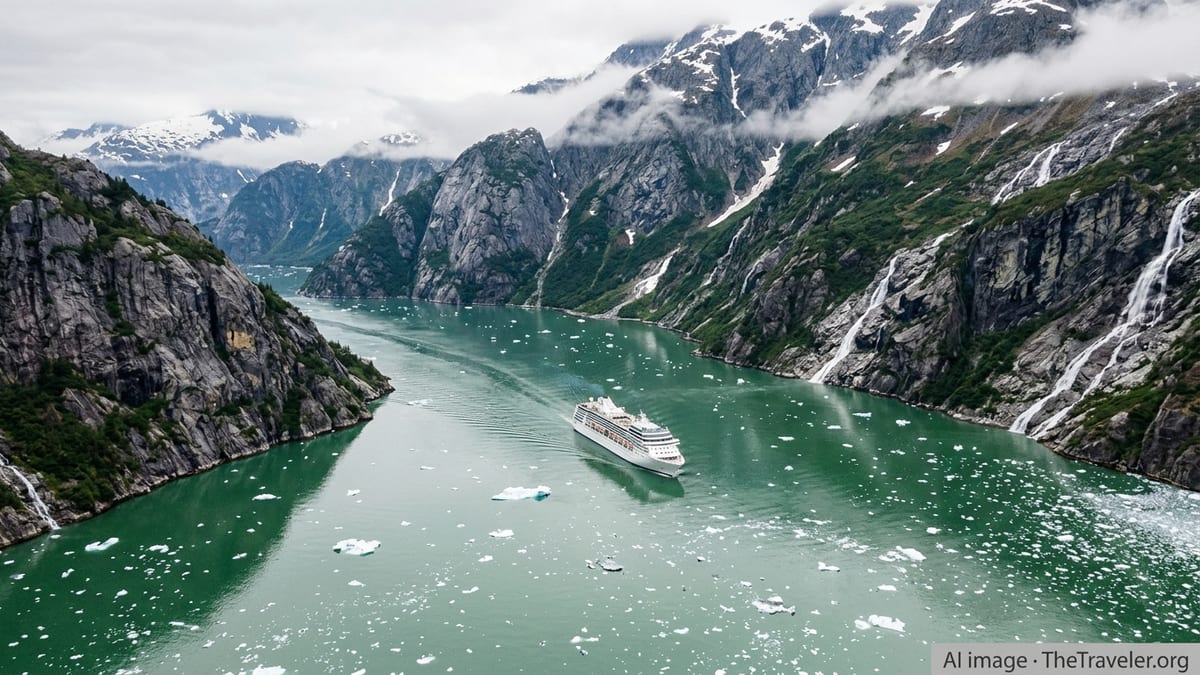
Safety Concerns Rise After Tracy Arm Landslide
Publicly available information indicates that a significant landslide in Tracy Arm in 2025 generated a powerful, localized tsunami within the narrow fjord, triggering fresh scrutiny of how close large vessels should come to steep glacial walls. Geological briefings and cruise industry coverage describe tens of thousands of cubic meters of rock and ice collapsing into the water, a scenario that can create hazardous waves and unpredictable currents in confined spaces.
Analysts note that Tracy Arm’s twin Sawyer Glaciers have long been a marquee draw for Alaska cruises, but the fjord’s narrow channels and towering, fractured cliffs make it inherently susceptible to slope failures as the climate warms and permafrost weakens. That combination of popularity and risk has moved Tracy Arm higher on the agenda for risk assessments by tour operators, insurers, and port agents active in southeast Alaska.
Travel trade reporting shows that cruise lines have already been responding in real time. During the 2025 season, some ships, including vessels from major U.S. brands, bypassed Tracy Arm on short notice when debris and ice were judged too unstable, substituting extended calls in Juneau or alternative scenic cruising instead. The 2026 planning cycle is now locking those ad hoc adjustments into more formal, published itineraries.
Holland America Confirms Shift to Endicott Arm for 2026
In early March 2026, guests booked on Holland America’s 2026 Alaska sailings began sharing notices indicating that all Tracy Arm Fjord Explorer excursions are being cancelled for the season. The language circulated to travelers states that unstable ice and geological conditions currently preclude vessels from entering Tracy Arm and that 2026 departures will instead operate scenic cruising in nearby Endicott Arm Fjord.
Endicott Arm, another branch of Holkham Bay south of Juneau, offers similar carved granite walls, floating ice, and views of Dawes Glacier, and has often served as a backup when Tracy Arm conditions deteriorate. Travel advisors and cruise specialists describe the change as a pivot from one high-profile fjord to another rather than a loss of glacial scenery altogether, even as some repeat Alaska guests express disappointment at losing a specific destination they had sought out.
Holland America’s Alaska planners and brochures for 2026, updated in recent weeks, continue to highlight glacier experiences across the region while gradually phasing out references to Tracy Arm as an excursion option. Third-party itinerary listings for ships such as Zaandam and Koningsdam still show core ports like Juneau, Skagway, and Ketchikan, with the main difference being whether scenic cruising is labeled for Endicott Arm, Glacier Bay, or other glacier areas rather than Tracy Arm itself.
Ripple Effects on U.S. and Canadian Cruise Planning
The recalibration is unfolding against a backdrop of complex coordination between U.S. and Canadian authorities, pilotage organizations, and cruise operators that move ships between Seattle, Vancouver, and Alaska ports each summer. While Tracy Arm lies entirely within U.S. waters, most large-ship itineraries linking Washington State and Alaska must include a Canadian port of call to comply with longstanding passenger vessel regulations, meaning that any gateway change in Alaska can cascade through Canadian port schedules.
Cruise calendars compiled for 2026 by regional agencies show a careful balancing act between Tracy Arm and Endicott Arm calls, with many large ships now favoring Endicott Arm on specific days. Industry observers describe this as part of a broader effort by United States and Canadian stakeholders to sequence ship movements in a way that preserves marquee glacier viewing while reducing congestion and exposure to newly recognized geological hazards.
Planning documents circulated by Cruise Line Agencies of Alaska for the 2026 season list both Tracy Arm and Endicott Arm time slots for a variety of lines, illustrating that access to the fjords is now being managed more dynamically. Some itineraries still include short Tracy Arm windows for select ships, while others, particularly longer voyages and premium brands, are leaning more heavily on Endicott Arm or Glacier Bay. The pattern suggests a shift toward distributing scenic cruising across multiple glacier destinations rather than concentrating traffic in a single narrow fjord.
Guest Experience: Scenic Cruising Reimagined
Despite the removal of Tracy Arm from Holland America’s excursion menu for 2026, most affected cruises are retaining a full day of glacier and fjord scenery, only in a different location. Endicott Arm’s Dawes Glacier, with its broad face and active calving, is frequently cited in travel commentary as a comparable highlight, offering ample opportunities for photography, wildlife spotting, and narration from onboard experts.
Reports from recent seasons suggest that when Tracy Arm was substituted with Endicott Arm or other glacier areas, guest satisfaction remained high, particularly when lines expanded time in ports like Juneau or added onboard programming about glaciology and local communities. Some cruisers have noted that Endicott Arm’s wider approaches can feel slightly less enclosed than Tracy Arm’s sheer granite walls, but the trade-offs often include better maneuvering room and, in some cases, more reliable ice conditions.
With bookings for Alaska 2026 already open, travel agents are advising clients who consider Tracy Arm a must-see to review itinerary fine print carefully and to remain flexible as operators refine routes closer to sailing dates. The evolving situation has reinforced a longstanding reality of Alaska cruising: glacier calls and fjord transits are always subject to last-minute adjustment due to ice, weather, or safety assessments, regardless of what appears in early marketing materials.
What the Shift Signals for Future Alaska Seasons
Holland America’s 2026 decision is being watched closely as a potential sign of how cruise lines may treat narrow glacial fjords in the coming decade. Maritime analysts point out that landslide-generated tsunamis, once considered rare outliers, are receiving renewed attention as retreating glaciers destabilize valley walls in high-latitude regions, including Alaska and parts of British Columbia.
Some industry forecasts suggest that operators will increasingly diversify their glacier offerings, leaning more on broader inlets such as Glacier Bay, Hubbard Glacier, and College Fjord for large ships, while reserving the tightest fjords for smaller vessels or day boats with different risk profiles. That approach would require continued coordination between U.S. National Park units, Canadian coastal communities, and the cruise sector to manage capacity, environmental protections, and passenger demand.
For travelers, the Holland America changes highlight the importance of viewing Alaska itineraries as frameworks rather than guarantees of specific fjords. While Tracy Arm may be off the schedule for many large-ship sailings in 2026, the region’s wider network of glacier vistas ensures that the classic images of blue ice, waterfalls, and snow-covered peaks will remain firmly at the center of the Alaska cruise experience.