

More news on this day
Hong Kong International Airport is preparing to launch a groundbreaking driverless bus service that will connect its new Terminal 2 with key Airport City hubs, marking Hong Kong’s first public autonomous transportation system and reshaping how passengers move around one of Asia’s busiest aviation gateways.
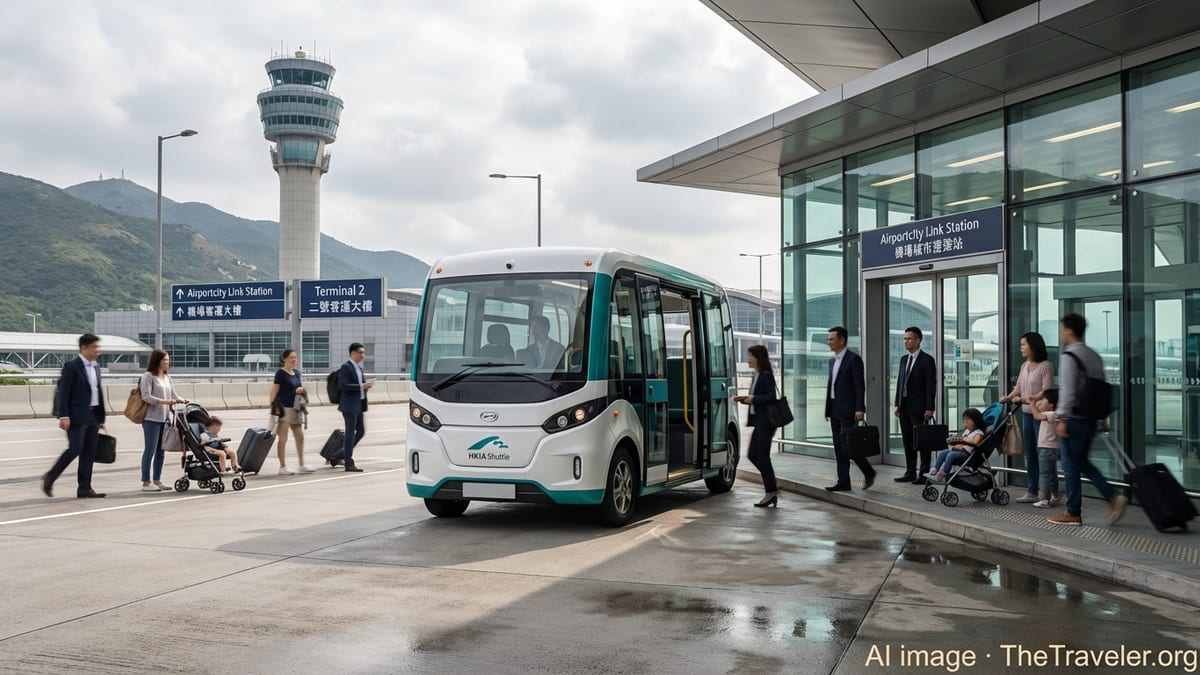
New Driverless Link to Anchor Airport City Vision
The Airport Authority Hong Kong has confirmed that autonomous buses will begin carrying passengers on a dedicated route between the Hong Kong Port of the Hong Kong-Zhuhai-Macao Bridge and the airport island via the Airportcity Link, tying the cross-border hub directly into the expanding SKYCITY commercial district and the soon-to-open Terminal 2 departure facilities. The service is scheduled to go live this year, in parallel with a wider push to position Hong Kong International Airport as a next-generation smart travel hub.
The new line will operate as a frequent shuttle using compact, electrically powered autonomous buses designed specifically for short-hop, high-frequency airport operations. Each vehicle can accommodate around 16 passengers, with capacity forecasts indicating the system will eventually be able to move up to 2,000 people per hour in each direction once fully ramped up from its initial trial operations.
The driverless bus corridor is integral to the Airport City concept, which clusters aviation, retail, entertainment and logistics facilities around the airport island. By offering a swift two to three minute ride between the bridge’s artificial island and SKYCITY’s attractions, the autonomous service is expected to transform the first and last mile for travelers arriving via the mega bridge from Zhuhai and Macao.
Advanced Autonomous Technology Moves Into the Public Realm
While autonomous vehicles have been quietly working behind the scenes in HKIA’s restricted areas for several years, the new bus route marks the first time this technology will be used as a public passenger service in Hong Kong. The system will operate at what international standards classify as highly automated driving, with the vehicles able to handle all key driving tasks within clearly defined operating conditions.
The route is designed as a controlled corridor, combining high-precision mapping, roadside sensors and vehicle-to-infrastructure communications so the shuttles can respond to changing traffic conditions in real time. Redundant braking, steering and power systems are built into each vehicle, and a central control center will monitor movements continuously, able to intervene or halt services instantly if anomalies are detected.
Although the buses are driverless in normal operation, trained safety operators will initially be on board during the trial and early service stages, reflecting Hong Kong’s cautious regulatory approach to autonomous mobility. Their role will be to supervise system behavior, interact with passengers and take manual control if necessary while data is gathered to fine-tune operations and pave the way for more widespread deployment.
Seamless Passenger Experience for a Reimagined Terminal 2
The launch of the driverless bus network comes as HKIA readies its expanded Terminal 2 departure facilities, which are due to open to passengers in late May 2026 with a strong focus on smart, self-service processing and fast connections. Together, the autonomous shuttle and next-generation terminal are expected to deliver a far more seamless ground journey from check-in to boarding.
Passengers arriving at the Hong Kong-Zhuhai-Macao Bridge’s Hong Kong Port will be able to transfer directly onto the autonomous buses for a swift hop to SKYCITY and the airport island, avoiding traditional road congestion on North Lantau. From there, they can connect easily to Terminal 1, the Airport Express station or the new Terminal 2, where biometric-enabled check-in, automated bag drops and streamlined security processes are being introduced.
Airport planners describe the combination of smart terminal infrastructure and autonomous surface transport as a step change in the way the airport manages peak flows. By shifting more journeys onto predictable, high-frequency driverless shuttles, HKIA aims to reduce bottlenecks on surrounding roads, improve on-time performance and offer a more predictable door-to-gate experience for both regional and long-haul travelers.
Partnerships and Regulation Pave the Way
The driverless bus service builds on a series of regulatory and industry milestones across Hong Kong. The government’s autonomous vehicle framework, which introduced a dedicated Road Traffic regulation for AVs in 2024, has enabled the Transport Department to issue pilot licenses for trials on North Lantau, including key roads around the airport. These controlled tests have allowed authorities to gradually extend routes and increase the number of vehicles operating simultaneously.
On the operational side, the Airport Authority awarded the autonomous electric bus project for the Airportcity Link to a consortium led by local operator Kwoon Chung Bus Holdings, working through its smart mobility subsidiary. The company has invested in electric, sensor-rich vehicles tailored to the short, elevated corridor connecting the bridge’s artificial island and SKYCITY, with designs that also make space for a wheelchair user alongside seated passengers.
These developments sit alongside separate autonomous cargo and apron vehicle initiatives at HKIA, which include trials of self-driving electric tractors hauling freight dollies across the airfield. Together, they form a broader ecosystem of connected, automated vehicles that the airport hopes will drive long-term efficiency gains in both passenger and cargo operations.
Positioning Hong Kong as a Regional Smart Mobility Leader
For Hong Kong, the rollout of driverless buses in full public service is about more than just airport convenience. It is being seen as a flagship project in the city’s wider smart mobility strategy, showcasing home-grown expertise in integrating autonomous systems into complex urban transport networks.
Success at the airport is expected to strengthen the case for similar applications in other parts of Hong Kong, from university precincts and innovation parks to cultural districts and dense urban corridors. As data from the airport shuttles accumulates, transport officials and operators will gain a clearer picture of how autonomous fleets perform in real-world conditions that include high passenger churn, shifting peak loads and variable weather.
With Asia’s air travel rebound underway and competition between regional hubs intensifying, HKIA’s move into public autonomous transport is also a branding exercise. By offering passengers a visibly futuristic way to move between terminal, city and cross-border links, the airport is betting that a smoother, more technologically advanced ground journey will become a key differentiator in the region’s fight for travelers and airlines alike.