

More news on this day
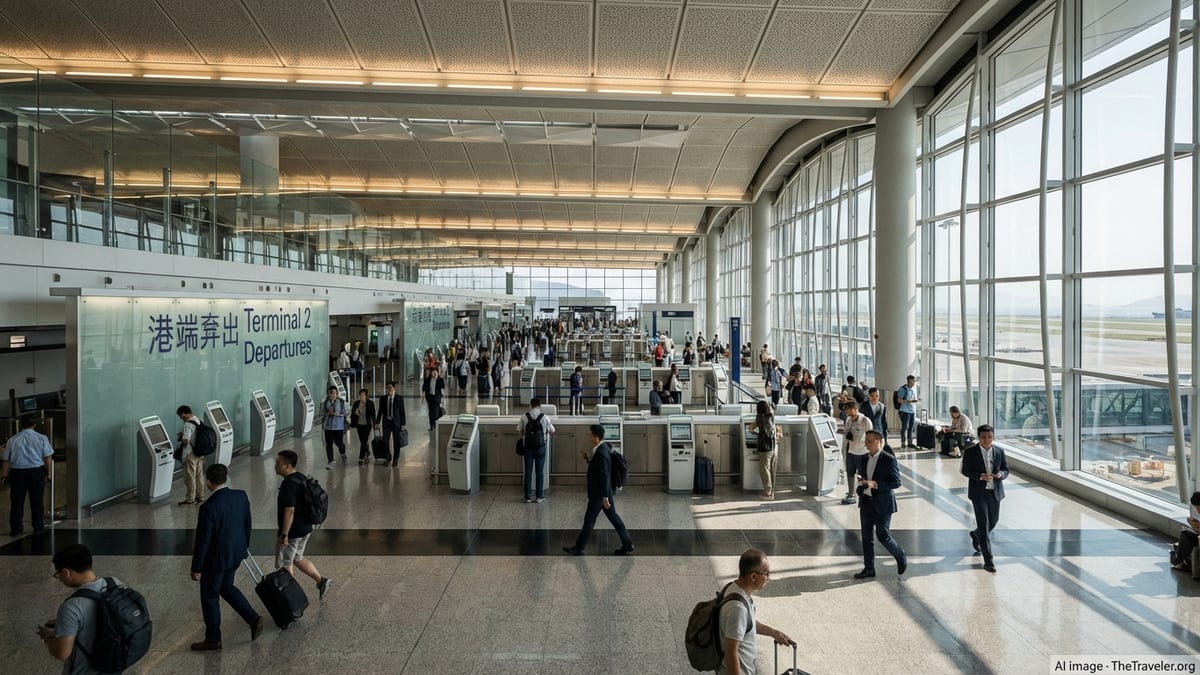
Hong Kong International Airport has confirmed that its newly expanded Terminal 2 will begin handling departing passengers from May 27, 2026, marking a major milestone in the airport’s multiyear three-runway expansion and reshaping how travellers move through one of Asia’s busiest hubs.
Phased Opening Timetable Finalised for Terminal 2
The Airport Authority Hong Kong has locked in May 27, 2026 as the launch date for departure facilities at the revamped Terminal 2, aligning the opening with the anticipated surge in summer holiday traffic. The move follows the September 23, 2025 debut of the new indoor coach hall, which served as the first public phase of the terminal’s return to service after years of construction.
Under the phased programme, surface transport and landside facilities are coming on stream ahead of full passenger processing. Coach and cross-boundary bus operations are being consolidated at Terminal 2 first, followed by the transfer of check in and departure flows in 2026. Arrivals facilities and airside boarding gates linked to the new concourse are slated to follow in stages through late 2026 and 2027, gradually transforming Terminal 2 from a check in annex to a full-service passenger terminal.
Airport executives have stressed that the timetable is calibrated to match the airport’s post-pandemic recovery curve and to avoid over-stretching resources during peak travel periods. Familiarisation visits, staff drills and live simulations are running ahead of the May switchover to ensure ground handling companies, security teams and border agencies are fully prepared for the new operating pattern.
From Check In Annex to Full-Service Passenger Terminal
When Terminal 2 first opened in 2007 it functioned primarily as a check in and retail complex with no boarding gates of its own, funnelling passengers to Terminal 1 for security, immigration and departures. The current expansion programme changes that model completely, with the terminal rebuilt and enlarged to support both departing and arriving passengers, integrated with a new concourse aligned to the three-runway system.
Once all phases are complete, Terminal 2 will feature its own departure and arrival halls, immigration and security zones, and a direct connection to a new airside concourse equipped with additional aircraft stands and gates. For travellers, that will mean the ability to start and finish journeys entirely within the new terminal, rather than using it as a satellite check in hall.
In the early stages after the May 2026 opening, departing passengers will still travel by automated people mover from Terminal 2 to existing gate areas, as airside facilities are brought into service step by step. However, airport planners say the long-term layout is designed so that as new gates, lounges and retail areas open on the Terminal 2 concourse, the passenger journey will become progressively more self-contained and intuitive.
Airlines, Routes and a New Role for Terminal 2
The expanded Terminal 2 is being positioned as a home base for carriers operating mainly short haul and regional services, particularly to destinations across mainland China, Japan, Southeast Asia and the wider Guangdong Hong Kong Macao Greater Bay Area. Around a dozen airlines are expected to move their check in and departure operations to the new building in phases from 2026.
Budget and hybrid airlines such as Hong Kong Express, Hong Kong Airlines and Greater Bay Airlines are among those earmarked to anchor the revitalised terminal. Concentrating point to point and regional traffic under one roof is intended to free capacity in Terminal 1 for long haul routes and complex connection banks, while giving leisure focused travellers a space designed more squarely around their needs.
Airport Authority executives have indicated that Terminal 2 should be capable of handling roughly one fifth of total passenger throughput once operations stabilise. With Hong Kong International Airport’s annual traffic projected to climb back beyond 70 million passengers later in the decade, the new terminal is seen as central to balancing volumes between the two main passenger buildings and smoothing pressure on check in, security and immigration at peak times.
New Smart Check In, Security and Passenger Experience
One of the most visible changes for travellers using Terminal 2 from May 2026 will be an upgraded suite of self service technologies aimed at speeding up the airport experience. The new departure hall has been designed around extensive use of automated check in kiosks and bag drop machines, alongside traditional manned counters, giving airlines flexibility in how they manage queues.
Contactless processing has been built into many of the terminal’s systems, from touch free bag tagging to mobile boarding pass readers. The Airport Authority has also flagged the use of enhanced biometrics for identity verification at certain points in the journey, though deployment details are expected to be refined closer to opening to align with regulatory approvals and technology readiness.
Beyond processing, the expanded terminal places emphasis on a more contemporary and youth oriented environment, with upgraded retail, dining and entertainment options designed to appeal to leisure travellers. Seating zones, charging points and wayfinding have been planned with an eye to shorter dwell times typical of regional traffic, while still providing quiet spaces and family friendly amenities.
Coach Hall and Ground Transport Integration
The first element of the new Terminal 2 to open to the public was its indoor coach hall, which began operations on September 23, 2025. This large enclosed facility provides 41 parking bays for tour buses, cross boundary coaches, limousines and resident shuttle services, consolidating functions that were previously dispersed between Terminal 1’s car parks and curbside areas.
Relocating coach services into a purpose built, climate controlled hall is designed to ease congestion at street level, streamline boarding for group tours and improve links to mainland Chinese cities and towns across the Greater Bay Area. Ticketing counters, waiting areas and boarding points that once occupied scattered corners of the airport estate have been brought together under the Terminal 2 roof, making it easier for passengers to navigate their onward ground transport.
Terminal 2 also maintains a seamless connection to the Airport Express railway platform via walkways and escalators, allowing arriving and departing passengers to step off the train and move directly into the new departure hall. The combination of rail, coach and local bus links centred on the rebuilt terminal is intended to create a more coherent multimodal hub, supporting the airport’s growing role as a regional interchange point.
Capacity Boost Within the Three-Runway System
The reconstruction and expansion of Terminal 2 form a key component of Hong Kong International Airport’s HK$141.5 billion three-runway system programme, which also includes the completed third runway, new taxiways, an extended airfield and a new airside concourse. The three-runway system entered full operation in late 2024, clearing the way for terminal upgrades to be phased in alongside rising flight movements.
Under the master plan, the enlarged Terminal 2 and its associated concourse are expected to add capacity for around 30 million additional passengers per year when fully utilised. Together with enhanced gate infrastructure and airfield layouts, that uplift is intended to support a long term target of handling up to about 120 million passenger trips annually across the airport.
Officials have framed the Terminal 2 project not just as an expansion but as a rebalancing of the entire terminal complex, enabling more efficient use of aircraft stands and boarding positions now distributed across multiple concourses. By pairing a dedicated regional terminal with the three runway configuration, planners hope to shorten taxi times, reduce delays and facilitate more reliable schedules during peak hours.
Operational Readiness and Passenger Transition Plans
In the months leading up to the May 2026 opening, Airport Authority Hong Kong is running a wide ranging programme of operational readiness and transfer activities. These include tabletop exercises, full scale simulations and joint drills with airlines, ground handlers, police, fire services, immigration and customs agencies to test how the new terminal performs under realistic loads.
Airlines moving into Terminal 2 will undertake their own training for frontline staff, focusing on revised check in layouts, boarding processes and use of new equipment. Passenger information campaigns are expected to roll out closer to the launch date, using in terminal signage, public announcements and digital channels to alert travellers to which airlines and flights are operating from Terminal 2 and how to reach the new facilities.
During the early months of operation, Terminal 2 will operate with contingency measures such as additional wayfinding staff, backup check in positions and temporary overflow areas to handle unexpected surges. Airport managers say the focus will be on maintaining service reliability while gathering data on passenger flows, queue times and pinch points, which can then be used to fine tune layouts and staffing patterns ahead of further phases.
Implications for Travellers and Hong Kong’s Hub Status
For travellers, the most immediate impact of the May 2026 Terminal 2 opening will be the need to pay closer attention to terminal designations on tickets and boarding passes, especially for regional flights that may shift from Terminal 1. Those using low cost or leisure focused carriers are likely to be among the first to experience the new check in hall and coach connections.
In practical terms, the additional check in capacity and redistributed passenger load should help shorten queues during busy travel seasons and create more breathing room in Terminal 1. Over time, as Terminal 2’s arrivals areas, gates and lounges come fully online, passengers can expect a more clearly segmented airport experience, with a distinct regional terminal complementing the long haul hub functions of Terminal 1.
Strategically, the project underscores Hong Kong’s determination to reinforce its role as a leading international and regional aviation hub, even as competition intensifies from airports across mainland China and the wider Asia Pacific. With the three runway system now operational and Terminal 2’s departure facilities set to open in May 2026, airport authorities are signalling confidence that traffic will continue to grow and that Hong Kong can sustain a larger, more diversified network of routes and airlines in the years ahead.