

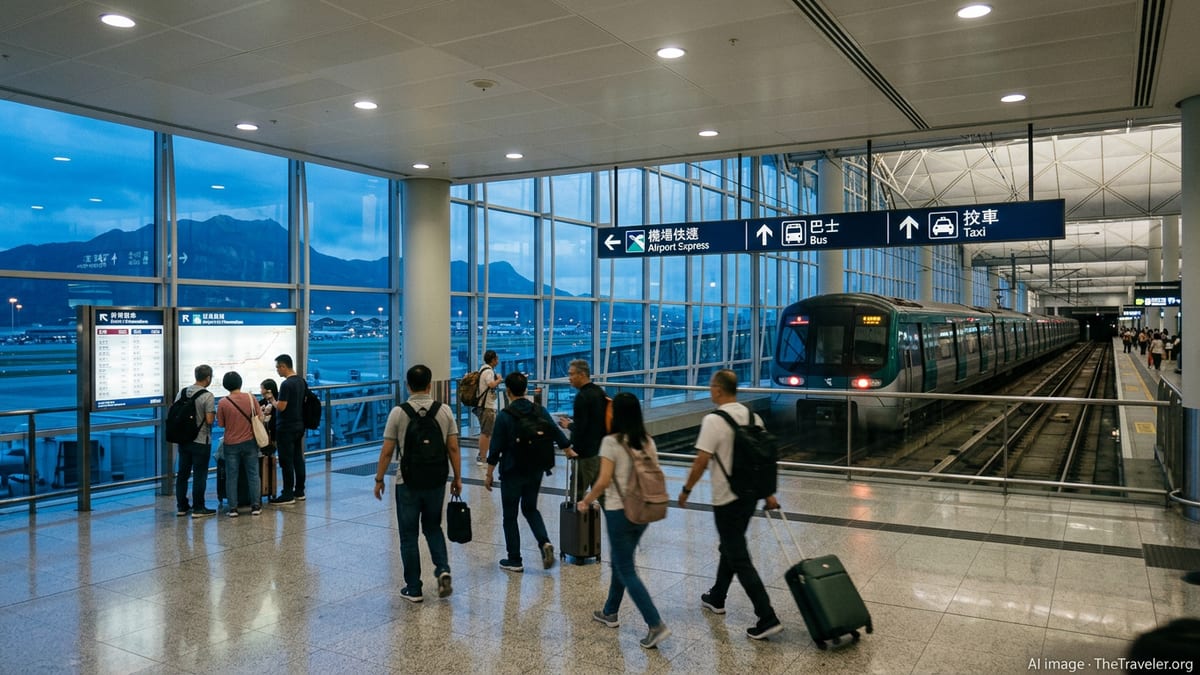
Arriving in Hong Kong can feel intense: bright lights, fast crowds and a vast, modern airport built on its own island. Before you step off the plane, it pays to know exactly how you will get from Hong Kong International Airport into the city. Three main options dominate for most travelers: the high-speed Airport Express train, frequent airport buses and ever-present city taxis. Each offers a different balance of speed, comfort and cost, and the right choice depends on where you are staying, what time you land and how much you want to spend.
Understanding the Journey from Airport to City
Hong Kong International Airport sits on Chek Lap Kok, an island to the west of the main urban areas. Reaching Central on Hong Kong Island, Tsim Sha Tsui in Kowloon or other popular neighborhoods means crossing long bridges and, in many cases, one of the city’s harbour tunnels. The direct distance is not enormous, but traffic, time of day and route choice can have a noticeable impact on your total journey time and stress level.
The Airport Express rail line is the flagship option. It runs from the airport station directly to Hong Kong Station in Central with intermediate stops at AsiaWorld-Expo, Tsing Yi and Kowloon. The full trip from the airport to Hong Kong Station is advertised at around 24 minutes, with trains running roughly every 10 to 15 minutes across most of the day. This speed and reliability make it the benchmark for comparing other modes.
Airport buses provide a slower but cheaper alternative. Several “A” and “E” routes run from the airport to key districts on both sides of the harbour, including Central, Wan Chai, Causeway Bay, Mong Kok and Tsim Sha Tsui. Typical journey times into the city can range from about 45 minutes to well over an hour depending on traffic and the specific route. Buses run late into the night, with overnight “N” services covering common hotel areas when trains are no longer running.
Taxis complete the trio of core options. They are available around the clock from designated ranks at the airport and operate under regulated meters. Travel time by taxi to Central or Tsim Sha Tsui can be similar to or slightly longer than the Airport Express door to door, but the key difference is the convenience of a direct drop-off at your hotel or apartment. Costs vary with traffic and tunnel tolls, but for small groups taxis can be competitive with multiple train tickets.
Airport Express: Fastest Route into Central Hong Kong
The Airport Express is designed to deliver a near-straight line between the terminal and the city’s core business districts. From the airport, trains typically depart around every 10 minutes during most daytime periods and every 12 to 15 minutes at quieter times. The ride to Hong Kong Station takes about 24 minutes, with another few minutes added if you are getting off earlier at Kowloon or Tsing Yi. Trains are air-conditioned, quiet and equipped with luggage racks and power outlets in selected cars, making them comfortable even after a long-haul flight.
Standard one-way fares between the airport and Hong Kong Station have been adjusted in recent years and are now in the low hundreds of Hong Kong dollars when paying with an Octopus card or similar contactless payment. Discounted group tickets and promotional offers are sometimes available, especially for two or more people traveling together. There is also a Morning Express concession from Kowloon and Tsing Yi to Hong Kong Station on weekday mornings that significantly reduces the price for commuters, though this does not apply in the airport direction.
One of the main selling points of the Airport Express is its range of added services. Same-day return deals, free in-train Wi-Fi, charging points and station car parks provide extra value, but two features are particularly relevant for visitors. First is the free MTR connection available to many urban stations for passengers using eligible Airport Express tickets or Octopus cards, which can shave the cost of onward metro travel. Second is in-town flight check-in at Hong Kong and Kowloon stations, offered by several major airlines, allowing you to check in your luggage in the city and travel baggage-free back to the airport later.
For many travelers staying in Central, Sheung Wan or parts of the Western District, a common strategy is to ride the Airport Express to Hong Kong Station, then take a short taxi, walk or MTR hop to their accommodation. Even with this transfer, total journey time is often under 45 minutes from leaving the arrivals hall. However, if your hotel is far from an MTR station or involves a steep uphill walk, building in a budget for that short taxi transfer can turn the Airport Express into an extremely efficient, semi-door-to-door solution.
Airport Buses: Budget-Friendly and Surprisingly Scenic
Public buses are the most budget-conscious way to get from the airport into town without needing to piece together multiple legs. The main airport bus routes, especially those beginning with “A,” are designed for travelers and offer luggage racks, air-conditioning and comfortable seating. Popular services include A11 to North Point via Central and Causeway Bay on Hong Kong Island, and A21 to Hung Hom via Tsim Sha Tsui and Jordan in Kowloon. Typical fares for these routes are in the range of a few dozen Hong Kong dollars, noticeably cheaper than the Airport Express.
Journey times by airport bus into the city are much more sensitive to traffic than the train. In off-peak periods, an A11 bus to Central and Causeway Bay can take about an hour, while at busy times or during adverse weather this can easily stretch longer. The flip side is that buses follow surface streets through major hotel and shopping districts, meaning you may be dropped within a short walk of your accommodation. For solo travelers on a budget, or those whose hotels sit right on an airport bus route, this trade-off can be highly attractive.
Payment is straightforward. Most visitors use the Octopus stored-value card, which you can pick up at the airport and tap on boarding. Exact cash fare is also usually accepted, but no change is given, so Octopus or contactless payment is more practical. Some routes offer same-day half-price return discounts when paying with Octopus. Services typically run from early morning until close to midnight, with all-night “N” buses covering key corridors between roughly midnight and early morning for those arriving on late flights.
Riding the bus also gives a very different first impression of Hong Kong. Instead of diving underground or skimming past the skyline from an elevated railway, you wind along highways, cross the long Lantau Link bridges and then roll through dense, neon-lit streets in Kowloon or past the towers of Central. For travelers not in a hurry, this can be an enjoyable way to orient yourself to the city. Just keep in mind that luggage space is more limited than on the Airport Express, especially if a bus is busy, so very large suitcases or multiple bags can be awkward.
Taxis: Door-to-Door Comfort at a Premium
Hong Kong’s taxis offer the classic door-to-door arrival and are heavily used by both residents and visitors. At the airport, you will find a well-organized taxi queue system with staff on hand to direct passengers to the correct line. Taxis are color-coded by operating area: red taxis serve the majority of urban Hong Kong including Central and Kowloon, green taxis focus on the New Territories and blue taxis operate mainly on Lantau Island. For most city-center destinations you will be taking a red taxi from the airport.
Base fares and incremental charges are set by the Hong Kong government and adjusted every few years. As a ballpark, a standard red taxi trip from the airport to Central or nearby districts on Hong Kong Island often comes in at roughly the mid to high hundreds of Hong Kong dollars once tunnel tolls, any luggage surcharges and potential waiting time in traffic are included. Journeys to core Kowloon areas like Tsim Sha Tsui and Mong Kok are usually somewhat cheaper, while more distant suburbs can cost more. Exact fares vary according to route, time of day and congestion.
In light traffic, a taxi can cover the distance from the airport to Central in around 30 to 40 minutes. During peak hours, particularly weekday evenings or weekends during major events, journey times can lengthen significantly. The greatest advantage is convenience: rather than navigating train transfers or bus stops after a long flight, you can step directly into a cab and be dropped outside your hotel lobby, even in hilly or residential neighborhoods that are not well served by airport buses.
Most taxis in Hong Kong accept cash as standard, while some drivers also support contactless or app-based payment. It is wise to have local currency on hand and to keep the written address of your destination in Chinese, which staff at the airport or your hotel can provide. Tipping is not expected, but rounding up to the nearest dollar is common. Official guidelines require drivers to display a fare table and to provide a receipt on request; if anything about the route or fare seems unclear, you can politely ask the driver or seek help from airport staff before you depart.
Comparing Cost, Time and Convenience
Choosing between Airport Express, bus and taxi largely comes down to three variables: your budget, how much you value time and comfort, and exactly where you are staying. For sheer speed and predictability, the Airport Express is difficult to beat. Even taking into account a short transfer at Hong Kong or Kowloon Station, total time from airport to many central hotels can be under an hour, with almost no risk of traffic delays. This reliability is especially valuable if you are landing in the late afternoon, need to reach a meeting or simply prefer to get to your room as quickly as possible.
From a cost perspective, airport buses are generally the cheapest choice for solo travelers and light packers. The fare for a single ride on a main “A” route is a fraction of the Airport Express cost and dramatically lower than a taxi. Once two or three people are traveling together, the calculus changes. Group or return discounts on the Airport Express can bring down the per-person rate, and a taxi fare split between two to four passengers often becomes respectable value compared with buying multiple train tickets and then paying for onward transport from the station.
Convenience is where taxis excel, but there are nuances. If you are staying in a high-rise hotel directly above Hong Kong Station, the Airport Express is almost door-to-door and far cheaper than a taxi. If your accommodation is in Causeway Bay, Fortress Hill or other areas directly served by an airport bus, stepping onto the right bus at the terminal and stepping off a block from your hotel may be both economical and relatively simple. For apartments up steep hills, in older neighborhoods without direct bus service, or for travelers with mobility issues, a taxi may be the only realistic way to avoid hauling luggage across pavements and up staircases.
Arrival time is another key factor. The Airport Express and most airport buses have long but not 24-hour operating windows. Late-night arrivals after the last train may find that overnight buses and taxis are effectively the only options. Conversely, very early morning flights out of Hong Kong may require you to plan your return journey around the first trains or buses of the day, or to budget for a taxi to the airport if public transport has not yet started. Checking your scheduled landing or departure time against the latest published timetables is strongly recommended.
When Each Option Makes the Most Sense
Certain arrival scenarios naturally favor one mode of transport over the others. Business travelers who need to be in Central or Admiralty quickly, or who value a calm and predictable ride after a red-eye flight, are usually best served by the Airport Express. The climate-controlled carriages, predictable schedule and seamless integration with the city’s wider MTR network create a low-stress start to a busy day. For those whose offices lie within walking distance of Hong Kong or Kowloon stations, the train is almost always the logical choice.
Backpackers, students and budget-conscious visitors often gravitate towards airport buses. The significantly lower fare leaves more money for food and attractions, and the buses’ routes through popular neighborhoods can make for an easy arrival when your hostel or guesthouse is close to a major bus stop. Travelers with time on their hands may even enjoy treating the ride in as a first, slow-motion tour of the city, particularly in the evening when neon signs and harbour views are at their most atmospheric.
Taxis come into their own for families with children, older travelers and anyone handling multiple heavy bags. Not needing to maneuver luggage on and off trains, through busy stations or onto escalators is a genuine relief after a long flight. Door-to-door service is also ideal if you are arriving late at night, in poor weather or to an address that is awkwardly located. For groups of three or four, the per-person cost may not be far above that of the Airport Express, particularly if the alternative would require a taxi transfer from the station anyway.
Hybrid strategies can also work well. One common approach is to use the Airport Express into the city on arrival for speed, then take a bus or taxi back to the airport when departing, depending on traffic conditions and the time of day. Others might opt for the bus with carry-on luggage but choose a taxi when departing with heavier bags and souvenirs. The flexibility and density of Hong Kong’s transport network mean you can mix and match according to changing needs during your stay, rather than committing to a single mode throughout.
Practical Tips for First-Time Arrivals
Before you land, it is helpful to have a rough plan for your onward journey but also to stay flexible. Flight delays, weather conditions or unexpected queues at immigration can all affect which option makes the most sense in the moment. Checking estimated train and bus operating hours for your arrival date, and having a backup mode in mind, can prevent last-minute stress. Many travelers choose to decide between the Airport Express and a taxi only after they see the current time and how tired they feel.
Consider picking up an Octopus card in the airport arrivals area if you plan to use public transport during your stay. This stored-value card is widely accepted across the MTR, buses, some taxis and even in many convenience stores and restaurants. Having one card to tap for Airport Express, buses and onward metro travel simplifies the entire process and can slightly speed up boarding, especially when buses are busy. You can always top up at MTR stations or convenience stores later.
Luggage is another important consideration. If you are traveling with several large suitcases, the Airport Express offers generous luggage racks and generally easy platform access via lifts and wide escalators. Airport buses have luggage areas but can become crowded, particularly around shift-change times for airline and airport staff. Taxis are straightforward for one or two suitcases per traveler, but large groups with many bags may need to split between more than one cab or consider sending some passengers by train or bus instead.
Finally, always allow extra time on your return journey to the airport, regardless of transport mode. Even though Hong Kong’s transport is usually reliable, delays can occur due to congestion, accidents or severe weather. A conservative rule of thumb is to aim to arrive at the airport two to three hours before an international flight’s departure time, then choose your transport mode and departure time accordingly. For example, you might board an Airport Express train at least an hour before you want to be at check-in, or step onto a bus or into a taxi with an ample buffer for possible traffic.
The Takeaway
There is no single “best” way to travel from Hong Kong International Airport into the city; instead, there is a best option for your specific circumstances. If speed and predictability are your top priorities, the Airport Express is the standout choice, linking the terminal with Central and Kowloon in under half an hour of travel time and integrating smoothly with the wider MTR network. For solo travelers and those on tighter budgets, the airport bus network provides excellent value, connecting major hotel and shopping districts at a fraction of the cost of a taxi or train.
Taxis fill the crucial gap of flexibility and direct access, especially for families, older travelers, night-time arrivals and those staying in less central neighborhoods. When split between multiple passengers, a taxi may even be cost-competitive with the Airport Express once onward transfers are taken into account. By weighing your arrival time, group size, luggage and hotel location, you can choose the option that will transform your first journey into Hong Kong from a logistical chore into a smooth and even enjoyable introduction to the city.
Whichever mode you select, Hong Kong’s transport system is designed to handle large volumes of visitors and is well signposted in English as well as Chinese. With a little advance thought and realistic expectations about cost and travel time, your trip from the airport to the city can be efficient, comfortable and stress-free, leaving you free to focus on exploring one of Asia’s most dynamic urban destinations.
FAQ
Q1. Is the Airport Express worth the price compared with buses and taxis?
The Airport Express is usually worth it if you value speed and reliability, especially when heading to Central or Kowloon and you have light to moderate luggage.
Q2. How long does it take to get from Hong Kong Airport to Central on the Airport Express?
The train journey from the airport to Hong Kong Station is advertised at around 24 minutes, not including any onward transfers from the station to your hotel.
Q3. How much does a taxi from Hong Kong Airport to Central typically cost?
A standard red taxi to Central often costs in the mid to high hundreds of Hong Kong dollars once tunnel tolls and any luggage surcharges are included, depending on traffic.
Q4. Are airport buses in Hong Kong comfortable for travelers with luggage?
Yes, main airport bus routes have luggage racks and air-conditioning, but space can be limited at busy times, so very bulky or numerous bags may be awkward.
Q5. Do the Airport Express and buses run all night?
The Airport Express does not run 24 hours; it has early morning to late-night service, while overnight “N” buses and taxis cover the hours when trains have stopped.
Q6. Should I buy an Octopus card on arrival at Hong Kong Airport?
Buying an Octopus card is recommended if you plan to use public transport, as it makes paying for the Airport Express, buses and MTR more convenient and faster.
Q7. What is the best option for a family with young children and lots of luggage?
For families with several bags, a taxi is often the simplest door-to-door choice, though the Airport Express combined with a short taxi ride can also work well.
Q8. Are there any discounts for groups on the Airport Express?
Group and promotional fares are often available, particularly for two or more people traveling together, so it is worth checking current offers before you arrive.
Q9. How do I decide between an airport bus and the Airport Express?
Consider cost, time and hotel location: choose the Airport Express for speed and easy rail connections, and buses if your hotel is on a bus route and budget matters most.
Q10. Is it easy to find my way to transport options in Hong Kong Airport?
Yes, the terminal is well signed in English and Chinese, with clear directions to the Airport Express station, bus terminals and taxi ranks, plus staff to assist if needed.