

More news on this day
Hong Kong is accelerating a billion-dollar pivot toward 3D technology and immersive mega events, using digital attractions and diversified experiences to reposition itself as a global test bed for the future of tourism.
Get the latest news straight to your inbox!
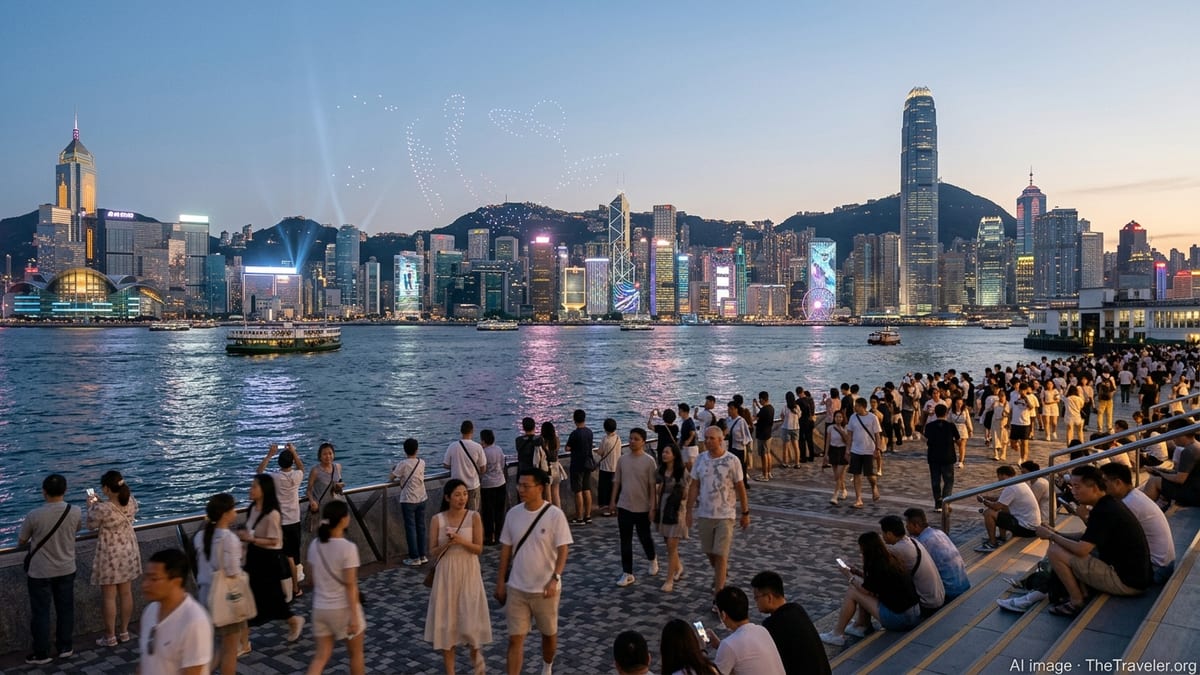
From Light Shows to Living City: A New Tourism Blueprint
Publicly available budget and policy documents indicate that Hong Kong is reshaping its tourism model around an "events plus tourism" vision, where technology-enabled experiences are designed to pull visitors out of transit lounges and into neighborhoods. A recently updated development blueprint for the tourism industry highlights smart tourism, immersive attractions and experiential travel as core priorities for the rest of the decade.
The shift is backed by substantial public funding. The city has committed large-scale investment to mega events, cultural infrastructure and smart tourism platforms, while the latest budget increased funding for the Hong Kong Tourism Board and positioned mega events as a key driver of post-pandemic recovery. Reports indicate that tourism accounted for a modest share of GDP in 2024, but policymakers view higher-spending, experience-focused visitors as a catalyst for broader economic activity.
Data from the first half of 2024 already shows how concentrated events and new experiences can move the needle. Local coverage of government figures notes that around 110 mega events attracted hundreds of thousands of visitors and generated billions of Hong Kong dollars in spending, reinforcing the idea that carefully designed experiences can deliver an outsized economic impact.
This evolving blueprint is not just about bigger festivals or more fireworks. It treats Hong Kong as a programmable canvas for 3D projections, mixed reality performances and data-driven crowd flows, aiming to turn the entire city into a flexible stage that can be reconfigured around cultural seasons, sporting calendars and visiting demographics.
The 3D Turn: Projections, VR Galleries and Smart Harbours
One of the most visible elements of Hong Kong’s new strategy is the pivot from traditional light shows to layered, three-dimensional spectacles. For years, the nightly harbourfront show relied heavily on lasers and building lighting. Budget documents and tourism briefings now point to a gradual retirement of that format in favour of more advanced, projection-led and drone-enhanced experiences that can change theme, storyline and sponsor more easily.
Across museums and cultural venues, 3D and immersive technologies are moving from pilot experiments to core visitor draws. Tourism Board materials for recent and upcoming exhibitions highlight virtual reality tours, multi-sensory galleries and 3D reconstruction projects, including VR-led journeys through European Impressionism at the Hong Kong Museum of Art and mixed-media installations that respond to audience movement. These experiences are promoted as reasons to visit in their own right, rather than simply as add-ons to traditional exhibits.
Along Victoria Harbour, new tourism products have been designed to blend physical vistas with digital overlays. Special event harbour tours have combined skyline views with curated storytelling, sound design and temporary installations, while pop-up art trails use projection mapping to transform facades and public spaces during arts festivals. Reports suggest that overseas promotions increasingly feature these immersive scenes as signature imagery for the city.
The technology underpinning this 3D shift is also being used behind the scenes. Academic research using Hong Kong as a case study has applied large language models and social media data to forecast tourist flows around concurrent events, offering tools that could help planners time 3D shows, manage congestion and target marketing with far greater precision.
Immersive Mega Events as an Economic Engine
Hong Kong’s diversification push is most visible in the calendar of mega events that now spans art, sport, music, gastronomy and business travel. Official tourism reports describe a deliberate strategy to bundle these events with neighbourhood guides, dining offers and themed itineraries, marketed under the "Mega Events plus Tourism" banner to encourage longer stays and higher spending.
The opening of the new Kai Tak Sports Park is a centrepiece of this strategy. The multi-billion-dollar complex, built on the site of the former airport, is designed as both a sports hub and a live entertainment destination, capable of hosting international tournaments, large-scale concerts and multimedia productions. Early events have included major rugby fixtures, mainland and international music tours and multi-day competitions, each used as a platform to promote adjacent dining, retail and waterfront experiences.
Tourism Board annual reports describe how event travellers are nudged into nearby districts through curated content, social media campaigns and on-the-ground offers. For concerts and tournaments at Kai Tak, digital guides highlight photo spots, small businesses and 3D-enhanced attractions, turning a two-hour show into a full-day excursion. Similar tactics are used for art fairs and cultural festivals across the harbourfront and the West Kowloon Cultural District.
The Meetings, Incentives, Conferences and Exhibitions segment is being woven into this event economy as well. Government business environment reports show that MICE visitors alone generated about HK$1.4 billion in spending in a recent period, and new trade shows and industry gatherings are being pitched as gateways to the city’s immersive offerings. Dedicated marketplaces and travel expos at AsiaWorld-Expo are promoted with extended-stay packages that include night-time harbour experiences and 3D-enhanced cultural tours.
Global Partnerships and the Race for Experiential Leadership
Hong Kong’s 3D and immersive ambitions are not unfolding in isolation. Tourism Board disclosures show that the city has pursued a three-year global strategic partnership with Art Basel, extending beyond the local fair to international editions in Basel, Miami Beach and Paris. The collaboration is framed as a way to inject Hong Kong cultural narratives and digital experiences into some of the world’s most visible art stages.
During arts season, this translates into a dense network of exhibitions, public art installations and cross-media projects anchored by Art Basel Hong Kong and the long-running international film festival. Harbour tours curated under the "Arts in Hong Kong" banner are paired with pop-up light works, projection mapping and interactive displays, while satellite venues such as M+ and galleries in Central and Tsim Sha Tsui host multimedia shows that leverage VR, AR and data-driven storytelling.
Overseas promotions reinforce this experiential tilt. Tourism campaigns in Southeast Asia, India, Europe and North America increasingly highlight immersive storylines around food, nature and culture, rather than solely shopping or skyline views. Campaigns described in recent reports feature influencer-led journeys through street-level art, digital installations and neighbourhood festivals, backed by offers that tie flight bookings to specific mega events.
This internationalisation of Hong Kong’s immersive know-how is also visible in the city’s bid to host major future showcases, including a prospective World Expo. Policy materials suggest that the combination of 3D harbour shows, tech-enabled cultural venues and a deep bench of mega events is central to the narrative that Hong Kong can serve as a global laboratory for experience-led urban tourism.
Risks, Refinements and the Next Phase of the 3D Revolution
Despite the momentum, Hong Kong’s 3D and mega-event strategy faces challenges. Local commentary has pointed to occasional event cancellations and debates over what truly qualifies as a "mega" occasion, as well as concerns about whether public subsidies always translate into long-term tourism gains. Instances in which proposed digital art fairs did not secure funding, or high-profile shows were scaled back, have prompted calls for clearer evaluation criteria and more transparent benchmarking.
Officials have responded by refining governance structures. The creation of an interdepartmental Mega Events Coordination Group, referenced in policy documents, is intended to streamline approvals, avoid scheduling clashes and better align cultural, sports and tourism priorities. Funding schemes are being adjusted to favour projects that combine strong artistic content with demonstrable visitor appeal, digital reach and economic impact.
There is also a growing emphasis on sustainability and local inclusion. Tourism reports stress the need to diffuse visitor flows across more districts, protect residential amenity and ensure that smaller creative businesses can plug into large-scale 3D and immersive projects. Neighbourhood-focused programming, from harbourfront art walks to local food festivals connected to major sporting events, is presented as one way to balance visitor numbers with community benefit.
As the city approaches the second half of the decade, Hong Kong’s billion-dollar experiment in 3D and immersive tourism is emerging as a test case for destination managers worldwide. Whether it becomes a template for other urban hubs will depend on how successfully the city can translate spectacle into sustainable value, and how well its digital layers continue to reveal, rather than replace, the depth of its streets, stories and harbour skyline.