

Hong Kong’s street-level transport network is one of the most efficient and fascinating in Asia. Beyond the famous MTR, a dense web of buses, trams and ferries lets you move between skyscraper canyons, hillside neighborhoods and harbourfront promenades at modest cost. For visitors, these services are not just a way to get from A to B, but an essential part of experiencing the city’s energy, views and everyday life.
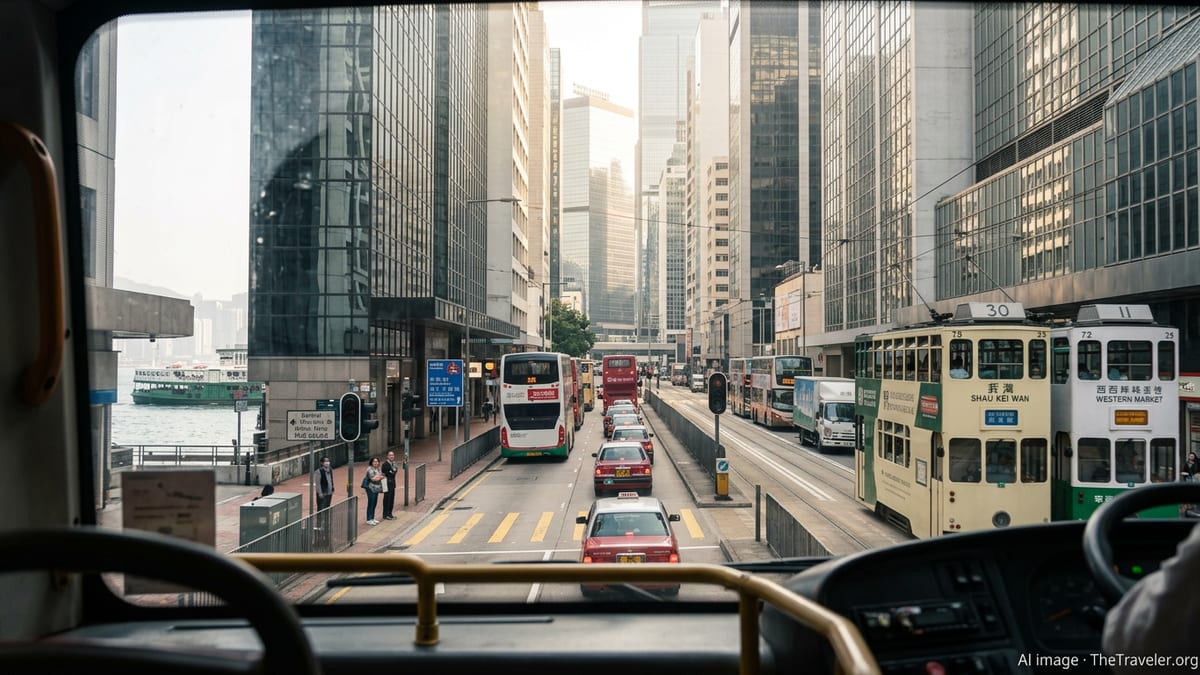
How Hong Kong’s Surface Transport Network Fits Together
At first glance Hong Kong’s mix of double decker buses, vintage trams and busy ferries can feel overwhelming. In reality, the network is highly integrated, with clear signage and multiple payment options that make it accessible even on a first visit. Buses reach almost every corner of the territory, trams offer a slow and scenic east to west ride along the north shore of Hong Kong Island, and ferries knit together island communities and provide classic harbour crossings.
Most services are operated by a handful of major companies. Kowloon Motor Bus and Long Win Bus focus largely on Kowloon, the New Territories and airport corridors, while Citybus is strong on Hong Kong Island and cross-harbour routes. Hong Kong Tramways runs the city’s historic tram line on Hong Kong Island, and several ferry operators including Star Ferry and Sun Ferry handle cross-harbour and outlying island services. Schedules on busy routes are frequent, with peak headways often measured in minutes rather than tens of minutes.
For day to day users, the backbone of the system is the Octopus stored value card, which works across almost all public transport. Increasingly, visitors can also tap contactless bank cards or mobile wallets on many buses and some ferries, and government subsidy schemes help residents manage regular commuting costs. For short-term visitors, the focus is usually on convenience, predictable fares and choosing routes that double as sightseeing.
Even if you rely on the MTR for long hops, it is worth planning several journeys by tram, bus or ferry. These modes keep you above ground, which in Hong Kong often means riding on upper decks through neon corridors, slipping past markets and schools at street level, or gliding across Victoria Harbour with the skyline on both sides. Understanding the basics of routes and fares will help you make the most of that experience without worrying about costly mistakes.
Paying Your Fare: Octopus, Contactless and Visitor Passes
The easiest way to handle buses, trams and most ferries is with an Octopus card, a contactless stored value card widely used across Hong Kong. You pay a small refundable deposit when you buy the card, then load credit in Hong Kong dollars at station machines, convenience stores and many supermarkets. Each time you tap on a bus, tram or ferry gate, the correct fare is deducted automatically, and any transfer discounts or government concessions are applied in the background.
For many visitors, a standard Adult Octopus is sufficient, but there is also a visitor-oriented “Travel Super Pass” that combines an Octopus function with a time-limited bundle of rides across multiple operators. This pass, which has been promoted for inbound visitors since late 2025, includes free or discounted travel on selected routes covering the MTR, major bus companies and key ferry services, while still working as a regular Octopus for small purchases. It can be a good fit if you expect to be on public transport for most of each day, though the exact mix of included routes and perks may change, so it is sensible to check current details on arrival.
Beyond Octopus, the payment landscape is gradually diversifying. Many franchised buses now accept contactless Visa, Mastercard or UnionPay via tap to pay, often through the same reader used for Octopus. Mobile wallets such as Apple Pay and Google Pay linked to compatible cards can also be used on some services. For residents and longer-term visitors, AlipayHK is increasingly integrated with government fare subsidy schemes, effectively allowing people to collect monthly fare rebates without physically using an Octopus card, though this is less crucial for short stays.
If you prefer not to deal with local cards, you can still pay cash on many buses and ferries, but drivers do not give change and fares must be paid with exact coins. In practice, this makes cash the least convenient option. For visitors who plan to keep a transport card as a souvenir, a physical Octopus remains attractive, and any remaining credit plus deposit can usually be refunded at designated locations before departure if you change your mind.
Buses: Coverage, Fares and How to Ride
Hong Kong’s bus network is extensive, with thousands of air conditioned double deckers running through urban corridors, hillside estates and long cross-harbour routes. Kowloon Motor Bus is the largest operator by fleet and route coverage, especially in Kowloon and the New Territories, while Long Win Bus specializes in airport and Lantau routes. Citybus runs many services on Hong Kong Island as well as numerous cross-harbour routes, airport lines and some New Territories connections.
Bus fares are distance-based, with shorter urban hops often costing only a few Hong Kong dollars, and long cross-harbour trips or airport runs priced higher. When you board, you tap your Octopus or contactless card on the reader next to the driver or entry door. On most routes the fare is deducted in full at boarding and there is no need to tap when you alight. However, a growing number of routes use section fares, where the amount you pay depends on how far you travel. On these lines you must tap again at the rear door when you get off to receive a partial refund if you did not ride the full length of the route.
Clear route information is usually displayed on stop poles, shelters and electronic panels at busy interchanges, showing the route number, key stops and first and last departure times. Many stops also show estimated waiting times. For real-time updates, apps from individual bus companies and popular third-party journey planners provide live arrival predictions and route planning across operators. This is particularly useful at night, in the New Territories or on less frequent routes where missing a bus can mean a longer wait.
When choosing where to sit, the front row of the upper deck is a favorite for visitors, offering panoramic views of skyscrapers, markets and harbour crossings. On busy commuter runs, local riders typically queue in an orderly line and fill from the back, but seats tend to free up quickly as people alight. Luggage racks are available on airport and some long-haul routes, and most buses are low-floor, making boarding easier with suitcases or strollers. Air conditioning is strong, so having a light extra layer can be helpful even in summer.
Riding the “Ding Ding” Trams Along Hong Kong Island
Hong Kong Tramways operates a fleet of narrow, double deck electric trams running along the north side of Hong Kong Island between Kennedy Town in the west and Shau Kei Wan in the east, with a branch to Happy Valley. Locals affectionately call the system “Ding Ding”, after the bell trams use when approaching stops and intersections. While buses and the MTR might be faster, the trams offer an atmospheric, window level tour of city life for a flat fare.
As of May 2025, adult tram fares are set at around 3.3 Hong Kong dollars per ride, while children and seniors pay significantly less. The flat fare policy means you pay the same amount whether you travel one stop or the entire length of the line, which makes trams excellent for leisurely sightseeing or hopping on and off within compact neighborhoods like Wan Chai, Causeway Bay and Sheung Wan. Monthly passes are available for heavy users, but for most visitors, simply tapping an Octopus or paying cash per ride is enough.
Boarding and alighting follow a specific rhythm that can surprise newcomers. You always board at the rear door and alight at the front. Payment is made when you get off, either by tapping your Octopus on the reader by the driver or by dropping the exact cash fare into the box. There is no change given. Trams run frequently throughout the day, with headways of only a few minutes on core sections, though journeys are slow because of frequent stops and traffic signals.
For the best experience, aim for the upper deck and grab a seat at the front or by the windows. The ride between Western District and Causeway Bay at dusk is especially memorable, as you pass dai pai dong stalls, neon shopfronts and streams of people crossing narrow streets. The Happy Valley loop offers calmer residential views and a glimpse of the famous racecourse. Trams run until late evening, so they are also a charming way to get home after dinner or drinks, as long as you are not in a particular hurry.
Ferries: Crossing the Harbour and Reaching the Outlying Islands
Ferries remain an essential part of Hong Kong’s transport mix, connecting Hong Kong Island with Kowloon and linking the main urban areas to outlying islands such as Lamma, Cheung Chau and Peng Chau. The most familiar service to visitors is the Star Ferry, whose green and white double deck boats shuttle between Tsim Sha Tsui and Central or Wan Chai. These short harbour crossings provide some of the most iconic skyline views in the city at a modest fare.
Star Ferry fares vary slightly by route, deck and day of the week. Lower deck journeys are typically the cheapest, with weekday fares on the main Tsim Sha Tsui to Central run historically around the mid single digits in Hong Kong dollars, and slightly higher fares on weekends and public holidays. Upper deck tickets cost a bit more in exchange for better views and more shelter from spray. Tickets can be bought with coins at turnstiles, or you can tap an Octopus card directly at the gate, which is especially convenient during busy evenings when the waterfront fills with commuters and tourists.
Beyond the harbour, several operators run ferries from Central or North Point to outlying islands. These routes are generally more expensive than the Star Ferry, reflecting their longer distance, but still represent good value compared to tour boats. Many island ferries offer both ordinary and fast services, with the faster boats charging a premium and cutting travel times significantly. Fares also differ by day type, with higher prices at weekends and on public holidays when demand is strongest. As with buses, Octopus is widely accepted, and printed fare tables at piers keep things clear even if you choose to pay cash.
When planning island trips, factor in sailing frequency and the time of the last departure back to the city. Popular routes such as Central to Lamma or Cheung Chau have multiple sailings per hour at peak times, but late at night or on quieter routes, gaps can be considerable. Weather conditions, especially strong wind signals or typhoons, can disrupt or suspend services. Checking pier notice boards or operator announcements before you set off is a sensible precaution, particularly in summer and early autumn when typhoons are more likely.
Typical Fares, Concessions and Getting Good Value
Public transport in Hong Kong is generally affordable by global standards, but fares can add up over a busy day of sightseeing. Short urban bus rides often cost the equivalent of less than one US dollar, while longer cross-harbour or New Territories runs can be a bit more. Tram rides are among the cheapest options for short hops along Hong Kong Island, thanks to their flat low fare. Harbour crossings on the Star Ferry cost only a few dollars more, especially on the lower deck, making them an excellent budget-friendly experience.
Several schemes help residents keep costs down, and visitors sometimes benefit indirectly. The government’s public transport fare subsidy scheme refunds a portion of monthly spending above a certain threshold to registered users, through Octopus or compatible digital wallets. A separate concession programme allows eligible elderly passengers and people with certain disabilities to travel on many designated routes for a nominal two dollar fare per trip when using specific personalised cards. Although most short-term visitors do not qualify for these concessions, it is worth being aware that the elderly you see in priority seats may be paying a much lower fare through these official schemes.
To maximise value as a visitor, think about how intensively you will use the network. If you expect to take a handful of rides per day, a regular Adult Octopus linked to pay per ride fares is usually enough. For more intensive use, especially if you will be crossing the harbour repeatedly or venturing into the New Territories, time-based passes and visitor products can be attractive, though they are often structured around MTR usage and may only indirectly include buses, trams and ferries. Comparing the up front cost of a pass with a back-of-the-envelope total of likely rides can help you decide.
Watch out for small, avoidable fare surprises. Some cross-harbour bus routes charge the full tunnel-crossing fare even if you board or alight before the tunnel, which can make them disproportionately expensive for short hops. On section fare bus routes, failing to tap your card when alighting means you pay the full route price by default. When in doubt, check the fare display on board or ask the driver before you sit down.
Planning Routes and Navigating Like a Local
Hong Kong’s street network can be confusing, with flyovers, tunnels and steep hillside roads all layered together, but planning a bus, tram or ferry route is easier than it looks. Major interchanges and piers have bilingual signage in Chinese and English, and route maps are displayed at most stops. On board, next stop announcements are typically made in Cantonese, English and Mandarin, and information screens show route progress in real time on many newer buses.
For pre-trip planning, journey planning apps and map services cover Hong Kong comprehensively, including real-time bus and tram arrivals on many routes. Official company apps often give the most accurate predictions for their own fleets, while independent platforms are convenient if you want to compare options across operators and modes. Filtering results by “fewer transfers” or “less walking” can be helpful on hot or rainy days when you may prefer a slightly longer ride to changing vehicles in the open.
In dense districts such as Mong Kok, Causeway Bay and Central, there are often several parallel bus routes heading in broadly the same direction. Locals routinely choose based on which comes first, as long as the route number and destination displayed on the front match their general target. Taking this flexible approach can save time, especially during rush hour. On Hong Kong Island, you can often choose between a bus and a tram for east to west journeys, trading speed for atmosphere.
When heading to outlying islands, build in extra time to reach the pier and buy any supplies you want to bring with you. Central Ferry Piers are numbered, with clear signs to each island service, and small grocery shops and bakeries around the terminal area allow you to pick up snacks and drinks before boarding. On popular weekends, queues can form for fast ferries, so an earlier sailing or slower ordinary ferry may be more comfortable if you dislike crowds.
Practical Tips for a Smooth Journey
A few simple habits will make using buses, trams and ferries in Hong Kong smoother. Always keep your Octopus or payment card ready before you board, as queues move fast and locals expect efficient tapping. On buses, move quickly up the stairs or down the aisle to avoid blocking the entrance, and have a rough idea of where you plan to get off by checking route maps or using a navigation app’s live location function.
Respect for queues and priority seating is taken seriously. At many stops, particularly busy interchanges, passengers line up within marked areas and board in order. Priority seats near doors and staircases are reserved for elderly passengers, pregnant women and people with mobility challenges. Even when the bus or tram is crowded, people will often stand to offer these seats to those who need them, and visitors are expected to do the same.
Weather is another important factor. Hong Kong can be very hot and humid for much of the year, and the contrast between outdoor heat and strong air conditioning on vehicles can be stark. Carrying a light extra layer is helpful, particularly on long bus rides or ferries. During severe weather, including typhoons and heavy rainstorms, bus and ferry services can be reduced or suspended altogether. Local news outlets and operator announcements provide updates, but as a rule of thumb, if higher level weather signals are hoisted, you should expect disruption and consider alternative plans.
Finally, treat every journey as part of the travel experience rather than just a transfer. Sit upstairs at the front of a double decker for the rollercoaster effect through flyovers and tunnels. Ride a tram at night with open windows and listen to the sounds of the city. Take the Star Ferry at least once in each direction to see how the skyline changes with the light. These small choices turn routine transport into memorable moments.
The Takeaway
Buses, trams and ferries are central to how Hong Kong works, and they are among the best ways to understand the city beyond its shopping malls and skyscraper viewing decks. The bus network reaches deep into residential estates and rural corners, the “Ding Ding” trams offer a slow motion portrait of Hong Kong Island’s urban core, and the ferries bring you face to face with Victoria Harbour and the islands beyond.
With a little preparation around fares, payment options and route planning, these services are straightforward to use. Octopus and compatible contactless systems simplify payment, bilingual signage reduces confusion, and frequent departures mean you rarely wait long in the main urban areas. Concessions and subsidy schemes keep the network affordable for residents, while visitor passes and time-based products can add value for heavy users.
For travellers, the real reward comes from staying above ground and on the water. From the upper deck of a cross-harbour bus, the rail of a Star Ferry or the front seat of a tram, you see Hong Kong as locals do: layered, fast moving and endlessly varied. Build these rides into your itinerary, not as an afterthought but as a highlight, and you will leave with a much richer sense of how the city lives and moves.
FAQ
Q1. Do I really need an Octopus card to use buses, trams and ferries in Hong Kong?
While you can pay cash on many services, an Octopus card is strongly recommended because it speeds up boarding, gives you exact fares without needing coins and works across most buses, trams, ferries and the MTR. Contactless bank cards are increasingly accepted on buses, but coverage is not yet as universal as Octopus.
Q2. How much does a typical bus or tram ride cost in Hong Kong?
Short urban bus rides usually cost only a few Hong Kong dollars, with longer or cross-harbour trips priced higher. Tram rides along Hong Kong Island use a low flat fare that is among the cheapest options in the network, making them ideal for short hops and scenic journeys.
Q3. Do I tap my card when getting off a bus in Hong Kong?
On most routes you tap only when boarding and the full fare is deducted at that point. However, on some section fare routes, particularly in the New Territories or on long corridors, you must tap again when alighting to receive a refund for not travelling the entire route. Signs on board and announcements usually explain when this is required.
Q4. How do I pay for the Star Ferry and other harbour crossings?
For the Star Ferry, you can either drop coins into a turnstile or, more conveniently, tap an Octopus card at the gate. Fares vary slightly by route, deck and day of the week but remain low compared with many tourist boat trips. Other ferries to outlying islands also accept Octopus and often have ticket counters where you can pay cash before boarding.
Q5. Is the Hong Kong tram system useful for more than just sightseeing?
Yes. Locals use the trams for daily errands and commuting along the north shore of Hong Kong Island, especially for short trips between neighbourhoods such as Sheung Wan, Wan Chai and Causeway Bay. Services are frequent, and the flat fare makes them practical, though they are slower than buses or the MTR for long journeys.
Q6. What is the best seat on a Hong Kong double decker bus for views?
The front row of the upper deck offers the most dramatic views, especially on cross-harbour routes and elevated highways. From there you can look straight down busy streets and across the harbour, but these seats fill quickly at popular times, so boarding earlier in the route improves your chances.
Q7. Are there special passes for visitors that include buses, trams and ferries?
Visitor products evolve, but in recent years Hong Kong has offered passes that combine MTR access with bundled travel across major bus companies and selected ferries. These are often built on the Octopus platform and marketed as convenient options for intensive sightseeing, so it is worth checking current offerings at the airport or main stations when you arrive.
Q8. How late do buses, trams and ferries run at night?
Many urban bus routes and trams operate until late evening or shortly after midnight, and there are specific overnight “N” bus routes on key corridors. Star Ferry and island ferries generally finish earlier, especially on less busy days, so always check the time of the last sailing when planning a late return from the islands.
Q9. What happens to buses and ferries during typhoons or severe weather?
During strong wind signals and black rainstorm warnings, operators may reduce frequencies, reroute, or completely suspend certain services, especially ferries and exposed hillside routes. Local news and official announcements provide up to date information, and it is wise to avoid tight schedules on days when severe weather is forecast.
Q10. Is it easy to navigate if I do not read Chinese?
Yes. Route information, stop names and most platform signs are bilingual in Chinese and English, and onboard announcements are typically made in Cantonese, English and Mandarin. Combined with mapping and journey planning apps, this makes it straightforward for non-Chinese speakers to use buses, trams and ferries throughout the main urban areas.