

Hong Kong moves at high speed, yet it runs on an intricate set of unspoken rules. From clinking dim sum trolleys and incense-filled temples to crowded MTR trains and boardrooms, etiquette shapes how people share space in this dense, multilingual city. Knowing the basics will not only help you avoid awkward moments, it will also deepen your appreciation of how tradition and modern life blend in Hong Kong.
Understanding Hong Kong’s Cultural Mix
Hong Kong etiquette reflects a blend of Cantonese traditions, broader Chinese customs and decades of international influence. Many residents switch fluidly between Cantonese and English, and have grown used to welcoming visitors, but they still expect basic courtesy and awareness in shared spaces. Respect for elders, politeness in crowded conditions and a preference for harmony over confrontation all underpin day-to-day social norms.
At the same time, Hong Kong is pragmatic and fast paced. Locals value efficiency and clear communication, especially in queues, public transport and business contexts. Visitors are forgiven for small missteps, but ignoring obvious signs, blocking narrow walkways or speaking very loudly will quickly be noticed. If you slow down enough to observe what people around you are doing and follow their lead, you will pick up many rules without needing them spelled out.
Because of the city’s history as a major trading port and financial hub, etiquette is less rigid than in some neighboring regions, but certain areas remain sensitive. Religious sites, ancestral rituals and family gatherings around food still follow customs that stretch back generations. Showing interest and asking politely when you are unsure is welcomed and often opens the door to stories about local life.
Dining and Dim Sum Etiquette
Meals are at the heart of social life in Hong Kong, and many first encounters with local etiquette happen at a dim sum or seafood restaurant. Sharing is the default: dishes are usually ordered for the table and placed in the center on a lazy Susan. As a guest, you generally wait for the host to invite you to start and to take the first piece from any new dish. Reaching in first or grabbing the largest portion can come across as impatient or self-centered.
Chopstick etiquette matters. Avoid sticking chopsticks upright into a bowl of rice or any food, as this resembles incense offered at a funeral altar and is considered inauspicious. Do not spear pieces of food or point at people with your chopsticks. When you are not eating, rest them on the provided chopstick rest or across your bowl, rather than leaving them inside the dish. If there are no communal serving utensils, many locals use the other end of their chopsticks to pick food from shared plates, especially in more traditional settings.
Tea service follows its own quiet script. At dim sum, a pot of tea will appear almost as soon as you sit down. A common gesture of politeness is to pour tea for others before filling your own cup, especially for elders or the host. When someone refills your tea, it is customary to tap two or three fingers lightly on the table beside your cup, a simple sign of thanks rooted in an old Cantonese story about disguised royalty. Keeping an eye on the pot and turning the lid slightly ajar to signal the staff when it is empty is another small but appreciated gesture.
Not every restaurant uses the same ritual for washing utensils. In some older tea houses or eateries attached to wet markets, you may see diners rinsing chopsticks and bowls with the first pour of tea into a spare bowl before discarding that tea. In most mid range and upscale restaurants, utensils arrive clean and this step is unnecessary. When in doubt, discreetly watch what nearby tables do and follow suit rather than assuming every place expects you to rinse your own.
Food Rules at Street Stalls and Casual Eateries
Hong Kong’s dai pai dong stalls, cha chaan tengs and noodle shops come with a more informal atmosphere, but a few house rules still apply. Tables are often small and tightly packed, and it is normal to share with strangers during busy hours. If staff direct you to sit at a table where others are already eating, a brief nod or soft greeting in English or Cantonese is enough. There is no expectation to chat unless others initiate it, and most people focus on their meal and leave promptly once they are done.
Ordering is usually quick. Many local cafes expect you to know what you want within a minute or two, so consider looking at the menu posted outside before you sit down. Staff can come across as brisk or impatient, but this is more about speed than rudeness. Speaking clearly, pointing to menu items and avoiding long negotiations during peak hours keeps the flow moving. If there is a clear ordering queue, respect it, and avoid hovering directly over someone who is still eating to claim their seat.
Cleanliness is a shared responsibility in crowded venues. It is common to stack empty plates and place used tissues neatly on a side plate rather than scattering them on the table. Throwing small trash directly on the floor is generally frowned upon, even at roadside stalls. At self service counters, return trays and wipe up obvious spills if you make them. While tipping is not a strong local custom, rounding up the bill or leaving small change in a casual place is appreciated but not required.
Alcohol often features in dinners with friends or colleagues, but heavy pressure to drink is less common than in some parts of East Asia. If you prefer not to drink, a firm but polite refusal, ideally paired with a toast using tea or a soft drink, is usually accepted. When you do drink, clinking glasses is often part of the ritual; in formal company, it is polite to hold your glass slightly lower than that of a senior or host as a sign of respect.
Temple Etiquette and Religious Spaces
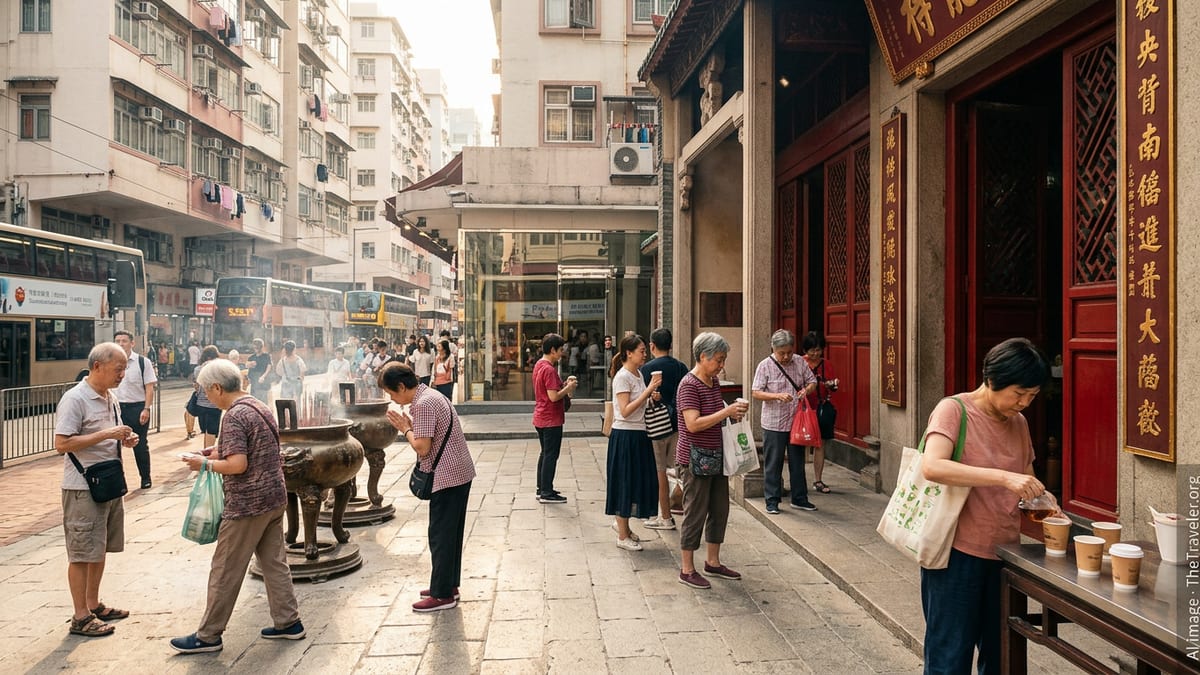
Hong Kong’s temples, shrines and ancestral halls are living places of worship rather than museum pieces, and etiquette here is more conservative than on the street outside. Modest dress is the simplest rule: covered shoulders and knees, closed or low key footwear and clothing without provocative slogans. Removing hats inside main halls is considered respectful. Even in intense summer heat, bringing a light layer to cover up is a wise habit if you plan to visit several temples.
Silence or low voices are expected. Many visitors come to burn incense, draw divination sticks or quietly reflect. Avoid loud phone calls, music from speakers or group conversations that carry across courtyards. Photography is often allowed in outdoor areas, but using flash, taking close ups of people praying or blocking incense paths for a perfect shot is likely to upset worshippers. Some temples post no photo signs inside main halls; when in doubt, assume that interior spaces are for worship rather than photography.
If you choose to take part in rituals, do so thoughtfully. Incense should be lit only at designated burners or braziers, often with clear signs and attendants nearby. Take a small number of sticks provided by the temple rather than large bundles brought from outside, both for safety and to limit smoke. Hold incense upright, avoid waving it close to others’ faces, and step carefully so that hot ash does not fall on the ground where people walk barefoot or in open sandals. Do not stick incense into offerings placed on altars unless you have been shown how by staff or a local friend.
There are also rules about what not to touch. Statues of deities, altar offerings of fruit or food and ritual objects such as drums or bells are not souvenirs or props. Pointing directly at statues, especially with outstretched fingers or chopsticks if you are eating in an adjoining courtyard, is seen as disrespectful. If you are unsure whether a certain practice is allowed, polite questions to staff or donation desk volunteers are welcome. A brief bow or nod before leaving the main hall is a quiet way to close your visit.
Public Transport and Street Etiquette
Few experiences reveal Hong Kong’s unwritten rules more clearly than a rush hour ride on the MTR or a ride on a tram or bus. Priority seats are prominently marked, and there is a strong social expectation that they are given up to elderly passengers, pregnant women, people with disabilities and adults carrying small children. Many locals avoid sitting in these seats altogether to prevent awkwardness. If you sit in one and see someone who might need it, offering your seat promptly, without waiting to be asked, is the polite standard.
Queueing discipline is strong. On MTR platforms, people usually line up beside the train doors, leaving a central space for passengers to exit before others board. Cutting in, blocking doors or standing directly in front of an opening so people must squeeze around you will draw disapproving looks. Eating and drinking are generally not allowed on the MTR, and even where rules are looser, such as on trams or some buses, most people avoid strong smelling food in confined spaces. Volume is another sign of respect; taking calls in a low voice or waiting until you get off the train is the norm.
On escalators, the local habit has shifted somewhat over time, but many people still stand on one side and walk on the other, particularly on long escalators linking MTR concourses and shopping malls. Follow signs and the flow around you rather than imposing a foreign rule. Pedestrian traffic tends to keep to the right more often than the left, but dense crowds and frequent construction mean patterns change from street to street. Remaining aware of your surroundings, not stopping abruptly at the top of escalators or in narrow passages, and stepping aside to check your phone all signal consideration in a crowded city.
Crosswalk etiquette is practical. Jaywalking is common, but visitors are better off following lights and crosswalks, especially in areas with complex multi lane junctions. Cars and minibuses move quickly, and drivers expect predictable behavior. Smoking is restricted in many public areas, including most indoor spaces, covered walkways, many parks and some outdoor plazas, with fines for violations. If you smoke, look for designated zones and ashtrays rather than assuming it is acceptable on any street corner.
Social Norms, Politeness and Everyday Interaction
On the surface, Hong Kong can feel brusque, with short phrases and minimal small talk in shops or on public transport. Beneath that, however, there is a strong concern for face and social harmony. Direct confrontation, raised voices and public criticism are usually avoided. When problems arise, such as a wrong order or a service issue, locals often handle it in a calm but firm tone rather than through visible anger. Visitors who stay measured, state their case clearly and accept compromises will usually find staff willing to help.
Personal space is limited in a city built vertically, so people negotiate it in subtle ways. On a crowded lift or train, making yourself physically compact, avoiding expansive gestures and keeping bags in front of you rather than swinging them over your shoulder shows awareness. Eye contact is brief in public but becomes more sustained in conversation. Smiling politely when making a request, such as asking for directions, makes a stronger impression than attempting to be overly familiar from the start.
Conversation topics follow a flexible but recognizable pattern. With acquaintances and new contacts, safe subjects include food, travel plans, the weather and general observations about the city. Hong Kong’s political life is sensitive, and many locals prefer not to discuss it in depth with strangers, especially in public places. Jokes that touch on stereotypes, historical conflicts or family status can land badly. Showing curiosity about local festivals, neighborhoods or hiking routes, on the other hand, often leads to enthusiastic recommendations.
Punctuality carries different weights depending on context. For work, medical appointments and formal tours, arriving on time or a little early is expected. For social gatherings with friends, there can be more flexibility, but very late arrivals without notice are still considered inconsiderate. Many locals rely on messaging apps to update friends if they are running behind. Adopting this habit, even as a visitor, shows that you understand other people’s time is valued.
Business, Gifts and More Formal Settings
Hong Kong’s role as a financial and logistics hub means many visitors arrive for work rather than leisure. Business etiquette leans conservative and is influenced by both Chinese and international practices. Punctual arrival at meetings is critical, and dress codes skew toward smart and understated. Suits or business smart outfits in neutral colors are common in central districts, with slightly more relaxed styles in creative industries, but overly casual clothing in formal offices is still rare.
Introductions often involve exchanging business cards. Offering and receiving cards with both hands, taking a moment to read the other person’s name and title before putting the card away, and keeping cards in a proper holder instead of a pocket communicate respect. Jumping straight into hard negotiation without a short period of small talk about non controversial topics can feel abrupt. Many professionals in Hong Kong are comfortable with direct discussions of numbers and timelines, but the transition into those topics is usually smooth rather than sudden.
Gift giving in business has become more restrained, partly due to corporate policies and a desire to avoid any hint of impropriety. Modest, well chosen items such as regional specialties from your home country, quality teas or seasonal treats around major festivals are more appropriate than luxurious or very expensive presents. It is common for a gift to be politely declined once before being accepted on a second offer, and for the recipient to open it later rather than in front of the giver. Avoid gifts that carry negative associations, such as clocks or very sharp objects, which can symbolically suggest severing relationships.
Formal dinners tied to business often mirror family banquets, with elaborate menus and toasts. Seating arrangements may reflect hierarchy, so wait to be directed to your place. When proposing a toast, stand or slightly rise, address the table collectively and keep your remarks brief and positive. If senior guests offer you food or pour you a drink, accepting at least a small amount is usually more polite than refusing outright, unless you have dietary or health reasons that you can explain calmly.
The Takeaway
Hong Kong’s etiquette is less about strict ritual for visitors and more about attentive, shared respect in a dense and diverse city. At the dim sum table, in incense filled courtyards, on crowded train platforms and in high rise offices, a few consistent themes appear: awareness of others, care for elders, modesty in sacred places and a preference for calm over confrontation.
By observing how locals behave, following clear signs and asking when you are unsure, you will find that the city is forgiving of honest mistakes and often delighted when visitors show interest in its customs. Learning to tap your fingers after a tea refill, step aside on a narrow escalator or lower your voice at a temple entrance may seem like small details, but together they unlock a deeper, more comfortable connection with Hong Kong and the people who call it home.
FAQ
Q1. Do I have to use chopsticks in Hong Kong restaurants?
Most restaurants provide both chopsticks and Western cutlery. Using chopsticks is appreciated but not required; what matters more is handling whichever utensils you choose neatly and respectfully.
Q2. Is it rude to refuse certain foods when I am a guest?
Local hosts understand that visitors may have dietary restrictions or preferences. It is better to decline gently with a brief explanation than to accept and leave food untouched on your plate.
Q3. Can I take photos inside temples in Hong Kong?
Photography is often fine in outdoor temple courtyards, but indoor halls are more sensitive. Look for signs, avoid flash, and never photograph people while they are praying without explicit permission.
Q4. What should I wear when visiting temples?
Modest clothing with covered shoulders and knees is a safe choice. Closed or low key shoes and removing hats inside main halls show respect, especially during busy festival periods.
Q5. Are tips expected in Hong Kong restaurants?
Many restaurants include a basic service charge in the bill. Small extra tips are appreciated but not mandatory; rounding up or leaving loose change is enough in casual places.
Q6. How strict is MTR etiquette for visitors?
Locals expect everyone, including visitors, to follow basic rules: no eating or drinking, let passengers exit before boarding and offer priority seats to those in need. Observing these norms goes a long way.
Q7. Is it okay to talk about politics with people I meet?
Politics can be a sensitive subject. Unless a local friend raises it first in a private setting, it is usually better for visitors to steer conversation toward neutral topics like food, travel and daily life.
Q8. How early should I arrive for business meetings?
Plan to arrive a little before the scheduled time, allowing for lift queues and security in high rise buildings. Consistent punctuality is an important sign of reliability and respect.
Q9. What is the proper way to handle business cards?
Offer and receive cards with both hands, take a brief moment to read the details, and place them carefully in a card holder. Writing on or bending a card in front of its owner is considered impolite.
Q10. Are there any gestures I should avoid in Hong Kong?
Pointing directly at people or religious statues, sticking chopsticks upright in food and speaking very loudly in confined public spaces are best avoided. When unsure, adopt a calm, low key manner and observe how locals behave.