

To understand Hong Kong, you have to eat it. Nowhere is the city’s history, pace and personality more vividly expressed than at a crowded dim sum table, in the buttery crackle of a just-baked egg tart or in the glossy, mahogany skin of a perfectly roasted goose. These three dishes are far more than tourist checklists. Together they form a living, daily ritual for residents and a delicious roadmap for visitors eager to taste the city at its best.
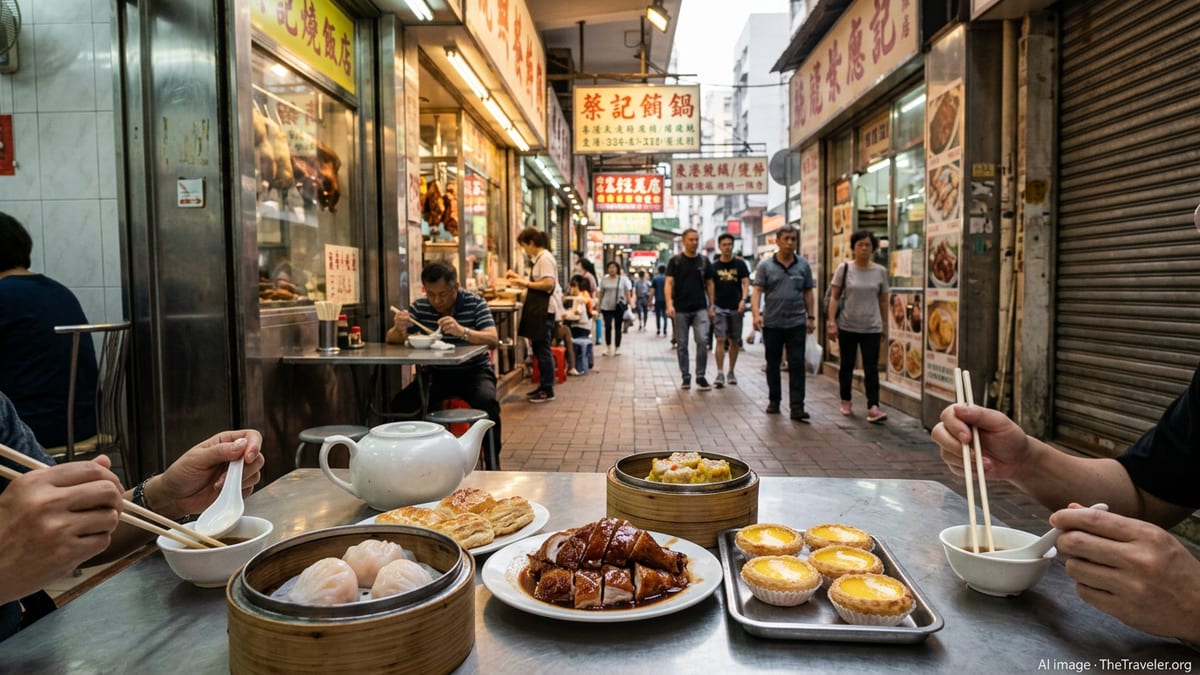
Hong Kong on a Plate: Why These Three Dishes Matter
Dim sum, egg tarts and roast goose sit at the heart of Hong Kong’s food identity. Each has roots in Cantonese cuisine, yet all three have evolved with the city’s particular history as a trading port, British colony and modern financial hub. They are everyday foods for locals, but they also serve as powerful culinary symbols, telling stories about migration, colonial encounters and changing tastes.
Dim sum grew out of the Cantonese tradition of yum cha, literally “drinking tea,” which became a social ritual where hot tea is paired with a constant flow of bite-size dishes. In Hong Kong this custom expanded into everything from steamy neighborhood tea houses to sleek hotel dining rooms, mirroring the city’s mix of tradition and innovation. Today, enjoying dim sum is as much about chatter and clatter as it is about the food itself.
Egg tarts and roast goose add two distinct flavor notes to this picture. Egg tarts embody Hong Kong’s brush with Western baking, blending British-style custard tarts and, later, Macanese Portuguese influences into something unmistakably local. Roast goose spotlights classic Cantonese roasting techniques at their richest and most indulgent, with birds marinated in aromatics, roasted until the skin blisters and served chopped over rice or as a celebratory centerpiece.
Together, these dishes illustrate the way Hong Kong absorbs outside influences and refashions them. Eating them in the city, in crowded dining rooms or at tiny street-side shops, is one of the most immediate ways to connect with its people and rhythms.
Dim Sum and the Art of Yum Cha
In Hong Kong, going for dim sum is called “going yum cha,” and for many families it is a weekly ritual. Historically, tea houses developed along southern China’s trade routes, offering travelers a place to rest and drink tea, with small snacks gradually added to accompany the brew. Over time those snacks grew into the wide repertoire of dumplings, buns and small plates now known collectively as dim sum, while the tea-centered social meal became a defining part of Cantonese culture.
The experience today varies from place to place. Some of the city’s older tea houses still use roaming trolleys stacked with bamboo steamers, where servers call out items and guests flag down what they want. Newer venues often rely on paper checklists or digital tablets, with dishes arriving directly from the kitchen. In both cases, pots of hot tea are central. Diners typically choose from strong black teas like pu’er, lighter tieguanyin or delicate chrysanthemum blends, which cut through the richness of the food and aid digestion.
There is also a quiet etiquette to yum cha that reveals local habits. The person closest to the teapot usually takes responsibility for refilling everyone’s cups, topping up their own last. A gentle tap of two or three fingers on the table is the customary, wordless thank you. This small gesture, repeated across dining rooms every morning, underlines the communal spirit of the meal, where dishes are shared, conversations overlap and the table quickly fills with empty steamers and saucers.
For visitors, understanding that yum cha is as much about atmosphere as any one dish helps set expectations. It can be noisy, service can feel brisk and tables are often shared at busier, more old-school venues. Yet that bustle is part of the charm, and for many travelers, their most memorable Hong Kong moments happen in the middle of this organized chaos.
Must-Try Dim Sum Classics in Hong Kong
While dim sum menus in Hong Kong can run to dozens of options, a few classics form the foundation of the experience. Har gow, or crystal shrimp dumplings, are a benchmark of a restaurant’s skill. The translucent, pleated wrappers should be thin yet resilient, encasing sweet, bouncy shrimp that taste fresh and slightly briny. If the wrapper breaks or the filling is bland, seasoned diners will quietly judge the kitchen.
Shumai, open-topped dumplings packed with minced pork and shrimp, are another staple. In Hong Kong, good shumai are firm but not dense, often topped with a dot of roe or a sliver of mushroom. Cha siu bao, the famous barbecue pork buns, come in both pillowy steamed versions and more contemporary baked forms with sweet, crackly tops. The filling, made from roasted pork glazed in a sticky, slightly smoky sauce, is one of the most beloved flavors in Cantonese cooking.
Beyond these standards, rice noodle rolls, or cheung fun, are a dish many locals refuse to skip. Wide, slippery sheets of rice noodles are rolled around fillings like prawns, beef or fried dough crullers, then doused in a mixture of soy sauce, sometimes sweetened with sugar and fragrant oil. Steamed spare ribs with fermented black beans, silky steamed egg custards and simple yet comforting congee also appear on most traditional menus, offering a range of textures from chewy to spoon-soft.
Hong Kong’s dim sum culture is not frozen in time. Many contemporary restaurants offer playful takes on classics, introducing truffle-scented dumplings, colorful wrappers tinted with beetroot or spinach, and whimsical shapes designed to be photographed. These modern twists coexist with staunchly traditional tea houses, giving visitors the option to explore both ends of the spectrum in a single trip.
From British Bakeries to Portuguese Influence: The Story of Egg Tarts
Egg tarts are one of Hong Kong’s most recognizable snacks, sold in corner bakeries, cha chaan teng diners and upscale hotel patisseries. Their story reflects the city’s layered history. Cantonese cooks drew early inspiration from British-style custard tarts introduced in colonial-era clubs, hotels and Western bakeries, adapting them with local techniques and ingredients to create what is now known as the Hong Kong egg tart.
These early versions typically featured a tender shortcrust base filled with a smooth, lightly sweet egg custard, baked until the surface just set and sometimes blistered slightly. Over the decades, flaky pastry shells made with multiple fat-laminated layers also became popular, adding a delicate crunch at the first bite. By the mid 20th century, egg tarts were firmly embedded in the local bakery scene, appearing alongside pineapple buns and sausage rolls as everyday treats.
In the late 20th century, a new influence arrived from nearby Macau, where a British baker created a version of the Portuguese pastel de nata in 1989, characterized by a caramelized, blistered surface on a rich custard filling. This Macanese style spread rapidly across the region, and spin-offs appeared in Hong Kong, especially in chains and fast-food outlets that brought the darker, spotted tops into the mainstream. As a result, modern Hong Kong offers both classic pale-yellow custard tarts and Portuguese-inspired versions, sometimes side by side in the same display case.
Today, Hong Kong egg tarts are most commonly found in Chinese-style bakeries and casual diners, where trays of fresh tarts are timed to the morning and afternoon rush. For many residents, grabbing a warm egg tart and a cup of milk tea is a weekday ritual. Visitors will find that the best versions share a few traits: the pastry should be fragrant and crisp without greasiness, and the custard should wobble gently, sweet but not cloying, with a clean egg aroma.
What Sets Hong Kong Egg Tarts Apart
Although egg tarts across East Asia may look similar at a glance, Hong Kong’s versions have distinct characteristics shaped by local tastes. The custard tends to be smoother and less spiced than European custard tarts, with little to no nutmeg or vanilla. The emphasis is on a pure egg flavor, balanced by moderate sweetness so they can be eaten at any time of day, from breakfast to late-night snack.
The pastry itself is often a point of debate among enthusiasts. Some swear by the traditional shortcrust shell, which holds its shape cleanly and offers a gentle, buttery crumb that contrasts with the custard. Others prefer the multi-layered, flaky pastry that shatters audibly when bitten, creating a more dramatic textural contrast. In Hong Kong, it is common to see both styles in the same bakery, and asking which one is “correct” usually sparks a friendly argument rather than a clear answer.
Temperature matters as well. Fresh tarts, still warm from the oven, have a slight jiggle and a soft, silky filling that firms up as they cool. Bakeries with steady local followings turn over batches throughout the day so that regulars can time their visits. Travelers who try egg tarts straight from a refrigerated display may find the pastry harder and the filling denser, so it is worth seeking out a warm one when possible.
For visitors looking to taste egg tarts in context, pairing them with a cup of strong Hong Kong-style milk tea is a smart move. The robust black tea, tempered with evaporated or condensed milk, stands up well to the richness of the custard and has its own colonial-era backstory. Together, they capture a side of Hong Kong where British, Portuguese and Cantonese influences mingle on a simple white ceramic plate.
Roast Goose: The Pinnacle of Cantonese Roasting
If dim sum represents Hong Kong at its most convivial and egg tarts show its sweet side, roast goose showcases its mastery of slow, attentive cooking. Known locally as siu ngo, roast goose is part of a broader tradition of Cantonese siu mei, or roasted meats, which also includes char siu pork and crispy roast pork belly. Among these, goose occupies a special place as both an everyday indulgence and a banquet dish.
The preparation is labor-intensive. Whole geese are typically marinated with a blend of ingredients that can include soy sauce, rice wine, sugar, five-spice powder, garlic and fermented bean curd, among other closely guarded additions. The birds are air-dried so the skin can crisp, then roasted in large enclosed ovens, often fueled by gas or charcoal, where cooks constantly monitor temperature and rotation. The goal is a burnished, slightly lacquered skin, a thin layer of rendered fat and succulent, flavorful meat.
Many Hong Kong residents associate roast goose with gatherings and special occasions, particularly around holidays. Yet it is also accessible as a casual meal, sold by the chopped portion in neighborhood siu mei shops where glistening birds hang in rows behind the glass. A standard order might be a plate of goose over steamed rice with a spoonful of pan drippings and a side of greens, or a mixed platter of goose, roast pork and soy sauce chicken shared among friends.
Goose has a deeper flavor than chicken and a different texture than duck, with more pronounced fat that, when properly rendered, delivers a rich juiciness. Even small roadside shops often take pride in their roasting craft, and debates over which place has the most fragrant skin or the juiciest meat are common among locals.
Where and How to Enjoy Roast Goose in Hong Kong
Roast goose has a strong regional association with areas just outside central Hong Kong, particularly along the route to the northwest New Territories and the older village of Sham Tseng, which for decades has been known for specialty roast goose restaurants. While some famous names periodically attract long queues, smaller and less publicized venues across the city also produce excellent birds, often serving mainly neighborhood regulars.
In urban districts, visitors will encounter siu mei stalls inside traditional wet markets and on busy street corners. At these shops, portions are ordered by weight or by “half” and “whole” birds, then chopped into bone-in pieces with a cleaver. Typical accompaniments include a tangy plum sauce for dipping, steamed white rice and sometimes a clear broth made from goose bones. Even with very simple sides, the dish feels generous and filling, thanks to the richness of the meat.
For a more formal experience, some Cantonese restaurants and hotel dining rooms treat roast goose as part of a larger banquet menu, pairing it with seafood, seasonal vegetables and elaborate soups. Pre-ordering may be recommended for whole geese at popular venues, particularly on weekends and during festival periods, to ensure availability. Asking hotel concierges or local contacts for up-to-date recommendations can help, as reputations rise and fall and some long-standing establishments change hands over time.
Wherever you try it, timing matters. Roast geese are often at their best soon after emerging from the oven, and popular shops plan multiple roasting cycles to align with lunch and dinner demand. Arriving during peak hours might mean a short wait, but it also improves the chances of tasting the meat at its juiciest, with the skin still audibly crisp.
Planning a Food-Focused Day: Dim Sum, Tarts and Goose
Structuring a day around these three specialties offers a delicious way to explore the city. A typical sequence begins with dim sum in the late morning, when tea houses are in full swing and the energy is highest. Sharing several baskets among a small group allows you to taste a variety of textures and fillings without feeling overwhelmed. Ordering tea first is expected, and starting with steamed items before moving to fried dishes keeps the palate fresher.
After a few hours of sightseeing, an egg tart break fits naturally into the afternoon. Many bakeries bake throughout the day, and the mid-afternoon lull is a good time to find a seat in a cha chaan teng or café. Trying both a shortcrust and a flaky version side by side is an easy way to experience the diversity within this humble pastry. Adding milk tea or a light lemon tea offers a caffeine boost before heading back out into the streets.
Dinner is the moment to seek out roast goose, whether at a busy neighborhood stall or a sit-down restaurant. Ordering a combination platter that includes goose alongside other roasted meats is a practical strategy for small groups. Pairing the meal with simple sides like blanched choy sum, plain rice and a clear soup keeps the focus on the meats while balancing the richness. For those with smaller appetites, even a single plate of goose over rice with a vegetable side can serve as a satisfying end to the day.
Throughout this kind of food-focused itinerary, it is wise to pace yourself. Portions in Hong Kong, especially at shared meals, can be larger than they first appear, and the pleasure of these dishes often lies in savoring a few excellent bites rather than finishing every plate. Walking between eateries or building in short ferry rides and tram journeys helps balance indulgence with movement, and also reveals more of the city’s neighborhoods along the way.
The Takeaway
Dim sum, egg tarts and roast goose are not just three popular dishes to tick off a list. Together they create a narrative of Hong Kong that spans teeming tea houses, bustling bakeries and steamy street-side roast meat stalls. They capture how centuries-old Cantonese traditions continue to adapt in a modern, fast-paced city while remaining deeply woven into daily life.
By starting a morning with bamboo baskets of dumplings, pausing in the afternoon for a still-warm egg tart and finishing the day with glossy slices of roast goose, visitors can experience the city in a way that no skyline view alone can offer. These flavors carry stories of traders, colonial encounters, regional rivalries and family rituals, all compressed into single bites.
For travelers, seeking out these foods with curiosity and respect is a way of participating, briefly, in Hong Kong’s own routines. Whether you choose a venerable tea house, a modest neighborhood bakery or a humble siu mei stall known only to locals, you will find that each place contributes its own chapter to the city’s larger culinary tale.
FAQ
Q1. What is the difference between dim sum and yum cha in Hong Kong?
Dim sum refers to the individual dishes such as dumplings and buns, while yum cha describes the broader meal and social custom of drinking tea while sharing those dishes.
Q2. When is the best time of day to eat dim sum in Hong Kong?
Dim sum is traditionally a late breakfast or lunch meal, with the liveliest atmosphere in mid to late morning, though many modern restaurants now serve it into the afternoon.
Q3. Are egg tarts in Hong Kong the same as Portuguese pastéis de nata?
They are related but distinct. Hong Kong egg tarts usually have a smoother, less caramelized custard and milder flavor, while Portuguese versions are richer and more blistered on top.
Q4. Is roast goose very different from roast duck?
Roast goose is generally richer and more intensely flavored, with thicker fat under the skin. Proper roasting renders this fat so the meat tastes juicy without feeling heavy.
Q5. Can I find vegetarian or seafood-only dim sum options?
Yes. Many dim sum restaurants in Hong Kong offer steamed vegetable dumplings, rice rolls with mushroom or Chinese doughnut, and seafood-focused dishes such as shrimp dumplings and fish balls.
Q6. How should I eat egg tarts for the best flavor and texture?
They are best enjoyed warm, soon after baking, when the pastry is crisp and the custard is soft and slightly wobbly. Pairing them with milk tea is a popular local habit.
Q7. Do I need to book in advance for famous dim sum or roast goose restaurants?
For well-known or hotel-based dim sum venues and popular roast goose restaurants, reservations or early arrival are recommended, especially on weekends and public holidays.
Q8. Is it acceptable to share tables with strangers at traditional tea houses?
Yes. At older Hong Kong tea houses, sharing large tables with other parties is normal during busy hours, and staff will seat guests together to maximize space.
Q9. What should I order if I want a simple introduction to roast goose?
A straightforward plate of roast goose over steamed rice, with a side of seasonal greens and a small dish of plum sauce, offers a classic and approachable first taste.
Q10. Are these dishes suitable for children or less adventurous eaters?
Often yes. Mild dumplings, plain buns, simple congee, lightly sweet egg tarts and small portions of roast goose can all appeal to children and visitors new to Cantonese flavors.