

More news on this day
Hong Kong has raised an amber outbound travel alert for the United Arab Emirates, as regional conflict, intermittent missile and drone threats, and rolling airspace restrictions across the Gulf disrupt travel plans and increase security risks for visitors and transit passengers.
Get the latest news straight to your inbox!
Heightened Alert Reflects Rapidly Shifting Security Landscape
The amber alert signals that residents are advised to adjust travel plans and exercise extra caution when visiting the UAE, a major hub for global aviation and Hong Kong–bound traffic. The decision follows weeks of military escalation involving Iran, the United States, Israel and regional actors, which has prompted multiple governments to reassess the safety of non-essential travel to Gulf states.
Publicly available security assessments describe a complex threat environment, with projectiles and drones periodically targeting infrastructure across the wider Gulf and reports of interception activity over or near UAE territory. Although daily life continues in cities such as Dubai and Abu Dhabi, the overall risk picture has shifted enough for travel advisories worldwide to be tightened, including from Hong Kong.
Analysts note that the amber designation does not amount to a blanket ban on travel, but it does indicate that conditions are significantly more volatile than during routine periods. Travelers are encouraged by official guidance to track developments closely and be prepared for sudden changes in both security posture and transport availability.
Missile Threats, Airspace Restrictions and Flight Cancellations
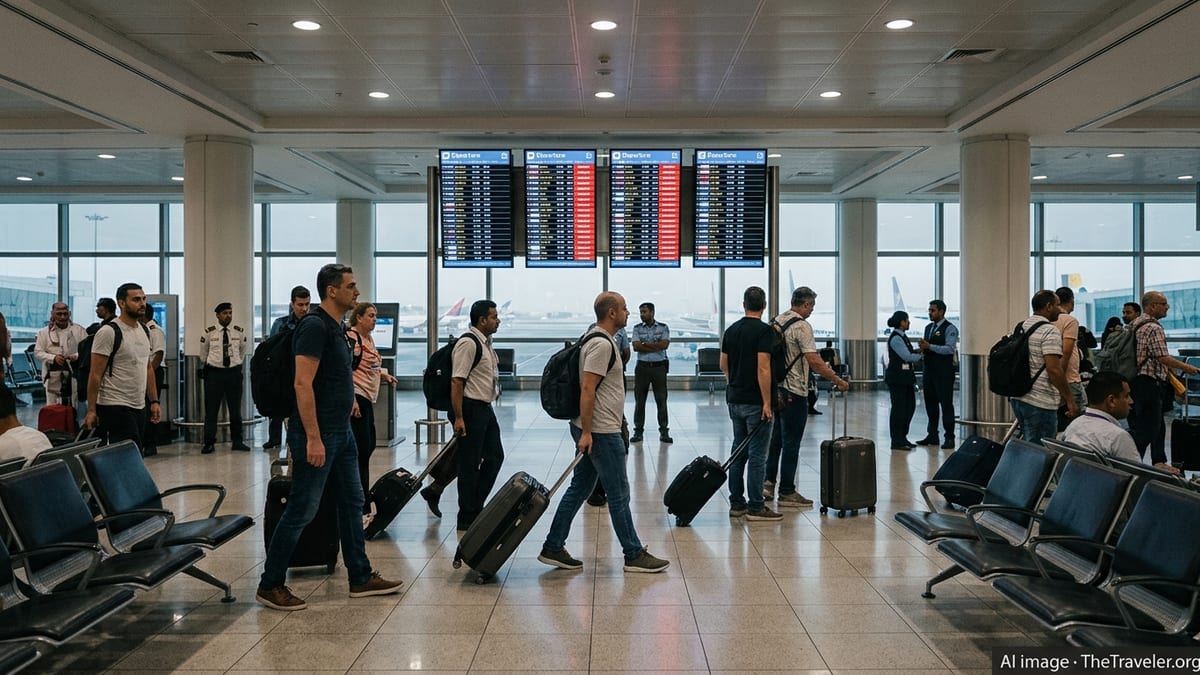
A series of missile and drone incidents linked to the wider regional conflict has had a direct impact on airspace management and commercial aviation across the Gulf. Industry bulletins and aviation advisories describe temporary closures or tight restrictions affecting the skies over the UAE and neighboring states, leading to widespread cancellations, diversions and schedule reductions.
Reports indicate that major Gulf carriers, including Emirates and Etihad, initially suspended large parts of their scheduled services at the height of the airspace shutdowns. As restrictions have eased in phases, airlines have begun operating limited networks, prioritizing selected long-haul routes and repatriation flights while warning that ongoing projectile risks could force last-minute operational changes.
International airlines flying through the region have also adjusted their services. Some have rerouted around high-risk areas, while others have suspended flights to Dubai and Abu Dhabi for specific periods, citing safety considerations and uncertainty around overflight permissions. This fluid situation has left travelers contending with rolling delays, extended layovers and complicated rebooking processes.
Travel management companies and corporate security providers describe a fragile recovery in air connectivity, with partial resumption of traffic but no clear timeline for a full return to normal operations. The Hong Kong alert mirrors that cautious outlook, emphasizing that transport disruption is now an inherent part of planning travel to the UAE.
On-the-Ground Measures and Public Safety Messaging in the UAE
Within the UAE, authorities have introduced a series of civil protection and public information measures designed to manage the security fallout from the regional confrontation. Government communications highlight guidance on sheltering in place during alerts, staying away from windows in the event of explosions, and following official channels for verified updates.
Safety notices also reference the potential for temporary road closures and access controls around sensitive facilities, as well as visible increases in security presence in certain urban areas. While these measures are framed as precautionary, they contribute to a more conspicuous risk environment for visitors who may not be accustomed to operating under such conditions.
At the same time, official UAE statements stress the resilience of core services, indicating that supplies, utilities and essential infrastructure remain functional despite elevated security precautions. Airports across the country have processed large passenger volumes even during the most intense stages of the disruption, underscoring the UAE’s determination to keep key transport and economic arteries open where possible.
For travelers from Hong Kong and elsewhere, this combination of robust contingency planning and intermittent threat activity creates a landscape in which normal tourism and business trips are still feasible, but potentially subject to abrupt changes, heightened screening and periods of localized disruption.
Repatriations, Airline Flexibility and Traveler Challenges
The sharp deterioration in regional security has already prompted large-scale evacuation and repatriation efforts by multiple governments and airlines. Public statements from the UAE’s foreign ministry describe the coordinated return of several thousand UAE nationals from affected locations, achieved through a mix of chartered and commercial flights arranged under time pressure.
Airlines serving the Gulf have introduced temporary flexibility policies, allowing passengers to change dates, reroute itineraries or convert tickets to travel credits without standard penalties. Some carriers have prioritized stranded travelers on repatriation or relief flights, although capacity constraints and complex airspace conditions have limited the speed at which backlogs can be cleared.
Travel forums and passenger accounts highlight the practical difficulties facing travelers caught in the middle of the disruption. Reports describe rapidly changing departure times, long queues at ticket counters, and situations where seats on outbound flights are booked far in advance, leaving limited options for those seeking immediate exit from the region.
Hong Kong’s amber alert explicitly factors in these operational hurdles, signalling that anyone planning to travel to or through the UAE should consider the possibility of extended stays, unexpected stopovers and additional accommodation or transport costs if flights are delayed or canceled.
Guidance for Hong Kong Residents Considering UAE Travel
Under Hong Kong’s outbound alert framework, an amber notice calls for heightened vigilance and a careful reassessment of non-essential trips, rather than an automatic suspension of travel. Residents are encouraged by public information channels to review the necessity of journeys to the UAE, maintain flexible itineraries and ensure that comprehensive travel and medical insurance is in place.
Travel risk specialists recommend registering accurate contact details with consular services where applicable, regularly checking airline and airport advisories, and allowing extra time for connections in case of knock-on delays from rerouted or reduced Gulf operations. Business travelers are advised to update contingency plans, including remote-working options, should meetings or events in the UAE be postponed at short notice.
Experts also emphasize the importance of situational awareness on the ground. Visitors are urged to stay informed through reputable news outlets, follow local guidance on movement and crowd avoidance, and familiarize themselves with the locations of shelters or safe areas in their accommodation or workplace.
As the regional situation continues to evolve, Hong Kong’s amber travel alert for the UAE serves as both a warning and a practical planning tool, underscoring that journeys to one of the world’s busiest transit hubs now carry a higher level of security and operational risk than in recent years.