

Hong Kong’s MTR is fast, clean and remarkably intuitive once you understand how it is organised. Combined with the city’s ubiquitous Octopus card, it allows visitors to move between airport, hotels and attractions with minimal friction. This guide walks you through the key routes, typical fares, and practical ways to use an Octopus card so you can ride the system with confidence from the moment you land.
Understanding the Hong Kong MTR Network
The MTR is the backbone of public transport in Hong Kong, linking Hong Kong Island, Kowloon and the New Territories with a dense web of suburban and urban lines. Core urban routes such as the Island Line, Tsuen Wan Line, Kwun Tong Line and Tseung Kwan O Line connect the main commercial and residential districts, while longer corridors like the Tung Chung Line and Tuen Ma Line stretch towards the outer suburbs and new towns. Separate but integrated systems include the Airport Express to Hong Kong International Airport and the Light Rail network in the northwest New Territories.
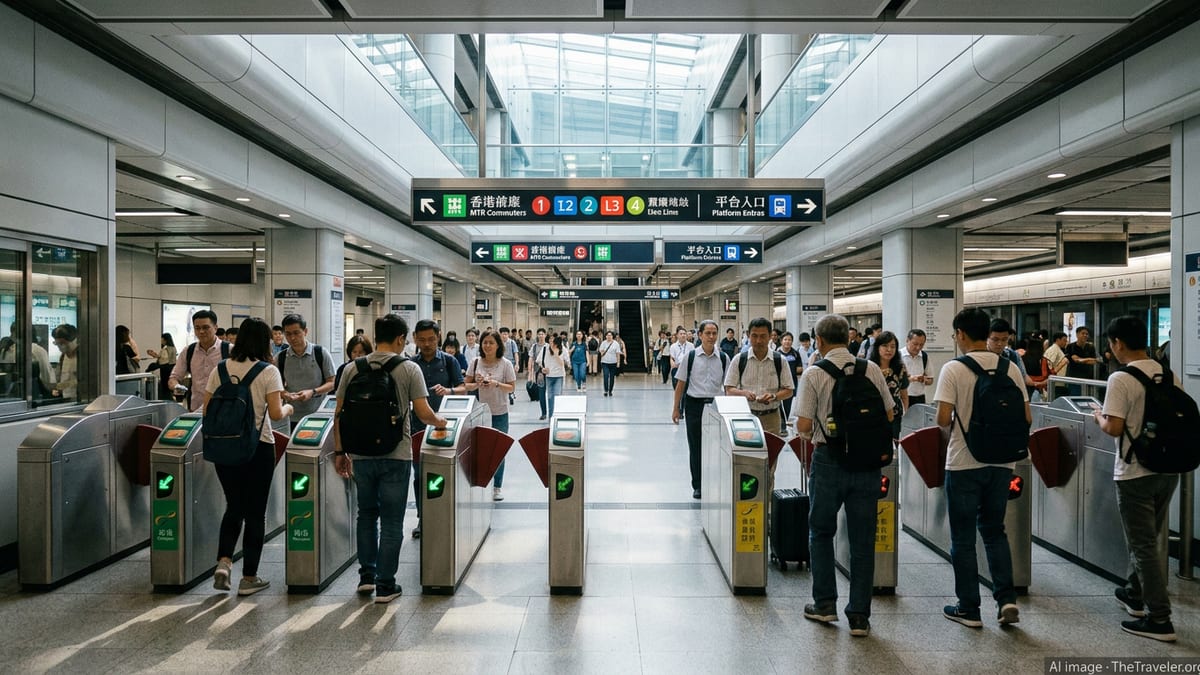
Stations are clearly signed in Chinese and English, with color coding for each line and consistent iconography for exits, lifts and facilities. Announcements and platform screens are bilingual, and trains run at high frequencies throughout most of the day, especially on central sections between key interchanges. For visitors, the most important stations are usually Central and Hong Kong on the Island side, Tsim Sha Tsui and Mong Kok in Kowloon, and interchange hubs such as Admiralty, Kowloon, Nam Cheong and Mei Foo.
All parts of the heavy rail MTR, including the airport line, use the same basic fare system when you pay with an Octopus card. The network is distance based, so your fare depends on how far you travel and which services you use. The Airport Express charges higher premium fares that are separate from the domestic lines, while a few specialist services, such as East Rail Line First Class, apply surcharges on top of the standard fare. For the vast majority of everyday journeys, however, a standard Octopus tap in and tap out is all you need.
Service hours vary slightly by line, but the main urban routes generally run from around 6 am until shortly after midnight. Trains are most crowded during weekday morning and evening peaks, particularly through cross-harbour tunnels and between interchange hubs. If you can travel slightly outside the peak, you will often find more space and a calmer experience without significantly longer waiting times.
Key Lines and Routes for Visitors
For most travelers, a handful of lines and interchanges will cover almost all day to day movements. The Airport Express connects Hong Kong International Airport with AsiaWorld Expo, Airport, Tsing Yi, Kowloon and Hong Kong stations in about 24 minutes end to end. It is designed for passengers with luggage, with wide doors, generous racks and step free access at every station. From Hong Kong or Kowloon station you can connect on foot to the main urban MTR network and continue to other parts of the city.
On Hong Kong Island, the Island Line runs along the northern shore through major business and entertainment districts, linking Kennedy Town, Sheung Wan, Central, Admiralty, Wan Chai, Causeway Bay and beyond. Admiralty is the main cross harbour and cross island interchange, linking the Island Line with the Tsuen Wan Line, the South Island Line and the East Rail Line. If you stay in Central, Sheung Wan, Wan Chai or Causeway Bay, this will likely be the line you use most often.
Across the harbour in Kowloon, the Tsuen Wan Line runs from Central and Admiralty through Tsim Sha Tsui, Jordan, Yau Ma Tei and Mong Kok towards Tsuen Wan in the New Territories. The Kwun Tong Line branches through Kowloon’s older urban areas, while the Tuen Ma Line forms a long east west arc linking Tuen Mun, Tsuen Wan West, Nam Cheong, Hung Hom, Diamond Hill and Sha Tin. The Disneyland Resort Line connects Sunny Bay station on the Tung Chung Line to Hong Kong Disneyland, with themed trains that are easy to spot.
The Light Rail network in the northwest serves Tuen Mun and Yuen Long with shorter, tram like vehicles and closely spaced stops. While not typically part of a short visitor itinerary, it shows how deeply integrated the MTR brand is with local life. All of these services appear together on the official system map, and electronic journey planners in the MTR mobile app or on station websites can suggest the quickest combination of lines and interchanges for any trip.
How Fares Work on the MTR
Hong Kong uses a distance based fare structure, but as a visitor you rarely need to think about individual numbers in advance. Standard adult Octopus fares on domestic MTR lines start at a low base for very short hops and increase gradually with distance. Most journeys within the core urban area fall into a moderate band that is considered good value for the reliability and speed provided. Airport Express fares are higher and are priced separately from the regular network, reflecting the dedicated airport service and more spacious rolling stock.
When you use an Octopus card, the system deducts the correct fare automatically when you exit through the gates. You tap once to enter a paid area and once to leave, and the gate reader displays your current card balance and the amount charged. If your balance is slightly below zero after a trip, the system will usually allow a small negative value, which you must clear the next time you top up. If your card has insufficient value to begin a journey, the gates will not open and you will need to add credit first.
The MTR often runs promotions and interchange offers that are only available to Octopus users. For example, Airport Express passengers who use the same Octopus to interchange with connecting domestic MTR lines within a specified time window can enjoy free or discounted onward journeys between Hong Kong, Kowloon or Tsing Yi and other stations on the heavy rail network. These arrangements change periodically, so it is worth checking the latest posters or official app notifications, but the principle remains that Octopus holders receive the most seamless pricing.
Concessionary fares exist for children, eligible students, and certain categories of seniors and persons with disabilities, typically through personalised or special edition Octopus cards. However, many of these schemes are aimed at residents and require local documentation, so short term visitors will generally pay standard adult Octopus fares. You may see references to the JoyYou Card or specific resident only discount schemes, which do not apply to tourists but illustrate how central the Octopus system is to fare policy across the region.
What Is an Octopus Card and Why You Need One
The Octopus card is a reusable, contactless stored value card that functions as a universal wallet across most of Hong Kong’s transport network and a large share of its retail environment. You simply tap it on a reader at MTR fare gates, on buses, on ferries and at many convenience stores and vending machines. The fare or purchase amount is deducted instantly from the stored balance, and the experience is notably faster than chip and PIN or many mobile payment methods, especially at busy times.
There are two main categories relevant to visitors. On loan Octopus cards are standard cards issued with a refundable deposit plus initial stored value, which you can return at the end of your stay for a refund of the remaining balance minus any handling fee. Sold Tourist Octopus cards and special tourist products such as travel passes are intended to be kept as souvenirs and may bundle limited period travel entitlements with stored value. In practice, standard on loan adult cards remain the simplest option for many short visits, because they are flexible and behave exactly like local cards.
Octopus can be physical plastic cards or virtual cards stored in compatible smartphones and smartwatches through mobile wallet integrations. Residents increasingly use Mobile Octopus linked to local bank accounts or credit cards, but tourists can also access a dedicated app based product in some cases, usually by loading value through international payment cards. The key advantage of any Octopus format is that the same tap works almost everywhere, from MTR gates and trams to coffee shops and some attractions.
For travelers, this simplicity is the main reason an Octopus is so strongly recommended. Instead of queueing for single journey tickets before every ride or handling coins on buses that may not offer change, you tap in and out and receive the best available Octopus fare for that route. The card also makes splitting bills or covering children’s fares easy, since you can tap multiple times where allowed and track the remaining balance with a quick glance at the reader or a check in the official Octopus app.
Buying, Topping Up and Refunding an Octopus
You can obtain an Octopus card as soon as you arrive in Hong Kong. At Hong Kong International Airport, MTR and Airport Express customer service counters as well as major convenience stores sell standard adult on loan cards, and in many cases these services operate throughout airport business hours. If you arrive late at night when some counters are closed, convenience stores within the terminal or ticket vending machines near the Airport Express platforms often remain viable options for purchasing or topping up a card.
In the city, almost every MTR station has at least one customer service centre that sells and manages Octopus cards, including child and personalised variants for those who qualify. Convenience store chains such as 7 Eleven and Circle K, supermarket groups and certain retail outlets can also sell or reload cards. Minimum initial stored value and deposit levels may change over time, so you should treat any quoted figures as indicative rather than fixed, but they are typically set at a level that covers a handful of journeys in the urban area.
Topping up is straightforward. Add value machines inside stations accept cash notes and credit the amount to your card, while many shops and service counters can add value using cash or electronic payments. If you use a mobile or smartwatch based Octopus, you can usually top up directly from a linked payment card within the app, with near instant updating of your usable balance. It is wise to keep a small buffer on the card, as exit gates require that the final balance not fall below an allowed negative limit.
When you are ready to leave Hong Kong, you can reclaim the remaining value on an on loan Octopus at designated service counters, often including those at the airport and major MTR hubs. Staff will typically refund your stored balance and, if you choose to fully cancel the card, return the deposit minus any administrative fee if the card has been held for less than a set period. Policies on fees and processing can change, so plan a few extra minutes at the station before you head to airport check in if you want to complete a refund in person.
Using Octopus on the MTR Step by Step
Using an Octopus on the MTR is as simple as following a consistent tap in, tap out routine. As you approach the entry gates at any station, you hold your card or device flat against the yellow Octopus reader pad. A short beep and a green light indicate successful entry, and the gate opens. If the reader emits a different warning tone or displays a red signal, the card may lack sufficient value or be incorrectly positioned, in which case you simply adjust, try again or visit a nearby add value machine.
Once inside the paid area, you follow signs to your line and platform, board the train and ride to your destination. When you reach your final station, you follow the exit signs from the platform and tap the same card on the reader of any exit gate. The display will show your remaining balance and the fare just deducted. It is important to use the same card for both entry and exit of a single journey, as the system needs to match the two taps to calculate the distance based fare correctly.
If your journey includes an interchange between lines within the MTR paid area, such as changing from the Tsuen Wan Line to the Island Line at Admiralty, you do not tap again; you remain in the paid zone and simply follow the direction signs between platforms. Exceptions apply when transferring between the Airport Express and domestic lines at Hong Kong, Kowloon or Tsing Yi, where dedicated paid areas and fare arrangements can mean additional gates. In these cases, clear signage shows whether you should tap at a special interchange gate or remain in the shared paid area.
In the rare event that something goes wrong, such as forgetting to tap out or entering the wrong station by mistake, station staff at the customer service centre can review your card’s recent transactions and help correct the record. It is advisable to approach them as soon as you notice an issue, and to carry your card physically if you are relying on a mobile wallet, in case of battery failure during long days of sightseeing.
Airport Express, Tourist Passes and Special Offers
The Airport Express is often the first MTR service that visitors encounter. Trains run between the airport and Hong Kong Island with stops at AsiaWorld Expo, Tsing Yi, Kowloon and Hong Kong stations, and they maintain a fast journey time with large luggage spaces and comfortable seating. Fares on this line are higher than standard MTR fares, but Octopus users typically enjoy a small discount compared with single journey paper tickets, and occasional promotions further reduce prices for designated passenger groups and interchange patterns.
Tourists can also consider dedicated products such as Airport Express travel passes and Travel Super Pass style Octopus cards, which may bundle a single or round trip on the Airport Express with a limited number of days of unlimited rides on the domestic MTR network, excluding premium or cross boundary services. These passes are most economical if you plan an intensive sightseeing schedule, using the MTR multiple times each day, and want to simplify budgeting by prepaying your main transport costs. However, for light users or those staying longer than the pass validity, a standard adult Octopus and separate Airport Express Octopus fare may be more flexible.
Airport Express stations at Hong Kong and Kowloon host in town check in services for some airlines, where you can check your luggage and receive boarding passes before traveling to the airport. While the range of participating airlines can change, this facility is one of the reasons some travelers are willing to pay the premium Airport Express fare. Whether or not you use these services, your Octopus will still work normally on the Airport Express, provided it has sufficient stored value for the higher fare.
From time to time the MTR Corporation introduces seasonal promotions, fare rebates or interchange discounts targeted at Octopus card users. Examples have included half price Airport Express rides linked to same day taxi receipts to gateway stations or free domestic MTR connections when you use the Airport Express with an Octopus. These campaigns are usually heavily advertised on posters in stations, inside trains and within official apps, so you can plan to take advantage of them if they coincide with your travel dates.
Practical Tips for Stress Free MTR Travel
Although the MTR feels intuitive, a few habits make travel smoother. Always keep your Octopus card somewhere you can reach quickly, such as a front pocket or a dedicated slot on your phone case, to avoid holding up queues at busy gates. When tapping, hold the card or phone briefly and firmly on the reader rather than waving it quickly over the surface, as a solid contact reduces misreads and repeated attempts. If you carry several contactless cards or devices together, separate the one you intend to use to avoid accidental double charging or confusion.
Inside the stations and trains, follow local etiquette. Stand on the correct side of escalators according to crowd flow and let passengers alight fully before you board. Most train cars have designated priority seats and marked areas near doors for wheelchairs and strollers. Eating and drinking are discouraged inside paid areas and on trains, and announcements may remind passengers of rules during the journey. Keeping bags close and not blocking doors helps maintain the MTR’s enviable on time performance.
For planning, official mobile apps and in station information panels are your best allies. Journey planners can suggest the quickest route, an estimated journey time and the current Octopus fare, while live train status updates help you anticipate any disruptions. Even if you prefer to explore spontaneously, it is worth checking the last train times for your nearest station, especially if you are staying out late in entertainment districts far from your hotel.
Finally, remember that the MTR integrates closely with buses, minibuses and ferries. Your Octopus card usually works the same way on these modes, but each has its own fare structure and boarding practices. If you are venturing beyond the core tourist areas to hiking trails, country parks or outlying islands, combining MTR segments with other transport becomes routine, and your Octopus remains the unifying tool that simplifies every leg of the journey.
The Takeaway
Mastering the MTR and the Octopus card is the single most useful step you can take to make Hong Kong feel navigable from day one. The rail network’s clear line structure, dense station coverage and predictable frequencies make it suitable for almost any itinerary, while the Octopus card removes friction at gates and cash registers across the city. Once you have tapped through your first few journeys, moving between airport, hotel, markets, museums and hiking trailheads becomes second nature.
With a basic understanding of how routes align, how fares are calculated and how to buy, top up and refund an Octopus, you gain both flexibility and peace of mind. You can change plans mid journey, respond quickly to weather or crowding and take advantage of promotional offers without worrying about separate tickets for each leg. Combined with courteous station staff, clear signage and modern rolling stock, the system makes independent exploration both efficient and enjoyable.
As policies, promotions and technology options continue to evolve, details such as specific fare levels, tourist pass pricing and mobile wallet compatibility will shift over time. The core principles, however, remain stable: tap in, tap out with your Octopus, follow the color coded lines and watch the city unfold around you. Equipped with this guide, you are well placed to use Hong Kong’s MTR like a seasoned local and make the most of every day you spend in the city.
FAQ
Q1. Do I really need an Octopus card to use the Hong Kong MTR?
While you can buy single journey tickets for most lines, an Octopus card makes entry and exit much faster, applies standard Octopus fares automatically and is widely accepted on buses, ferries and in shops. For most visitors, it quickly pays for itself in convenience.
Q2. Can I share one Octopus card with my travel companion?
Each person needs their own Octopus to pass through the MTR gates, because the system records one entry and one exit per journey per card. In some situations you can use a single card to pay for multiple bus fares, but you cannot share a card for simultaneous MTR travel.
Q3. Where is the best place to buy an Octopus card on arrival?
At Hong Kong International Airport you can purchase an Octopus at MTR or Airport Express customer service counters and many convenience stores in the arrivals area. If those are closed, you can usually buy or top up at ticket machines and shops once you reach the city.
Q4. How much money should I load onto my Octopus at the start?
This depends on your plans, but many visitors start with enough value for at least two or three days of urban travel plus any planned Airport Express ride. You can always add more later, so there is no need to load a very large amount in advance.
Q5. What happens if my Octopus balance goes negative after a trip?
The system allows your balance to fall slightly below zero after a journey, within a small permitted limit, but you must top up before you can start another trip. Add value at the next opportunity using cash or card at a machine or service counter.
Q6. Are there discounted MTR fares for children and seniors using Octopus?
Yes, there are concessionary fares for children and eligible seniors, but many are linked to specific card types aimed at residents. Visiting families may be able to buy child Octopus cards for younger travellers, while senior schemes often require local eligibility.
Q7. Can I use a mobile wallet instead of a physical Octopus card?
Some phones and smartwatches support Mobile Octopus, allowing you to tap your device on the reader instead of a plastic card. Availability and top up options depend on your device, operating system and payment cards, so check compatibility before you travel.
Q8. Does the Octopus card work on all lines including the Airport Express and Light Rail?
Yes, you can use Octopus on the domestic MTR network, the Airport Express and the Light Rail, as well as on many buses and ferries. Airport Express fares are higher and calculated separately, but the tap in and tap out process is the same.
Q9. How do I get a refund on my Octopus card before leaving Hong Kong?
Visit an MTR or Octopus service counter, often at major stations or the airport, and ask for a refund of your remaining balance. Staff can return your stored value and, if you surrender an on loan card, refund your deposit subject to any applicable handling fee.
Q10. What should I do if I lose my Octopus card during my trip?
If you lose a standard anonymous card, it generally cannot be blocked and any remaining value may be used by whoever finds it. If you have a registered or personalised Octopus, contact customer service as soon as possible to report the loss and discuss possible protection of the balance.