

More news on this day
Hundreds of passengers at Hong Kong International Airport were left stranded this weekend after a wave of abrupt cancellations to Riyadh, Doha and Dubai, as a joint United States and Israeli airstrike on Iran triggered one of the most disruptive shutdowns of Middle East airspace in years.
Hong Kong Flights Axed as Gulf Gateways Go Dark
The turmoil began late Saturday local time, when Hong Kong flag carrier Cathay Pacific and several Gulf airlines scrubbed or rescheduled departures as airspace across Iran, Iraq, Israel, Qatar, Kuwait, Bahrain and the United Arab Emirates was abruptly closed following the strikes. With Dubai, Doha and Abu Dhabi effectively offline as transit hubs, key services from Hong Kong to Riyadh and Dubai were among the first to be cut.
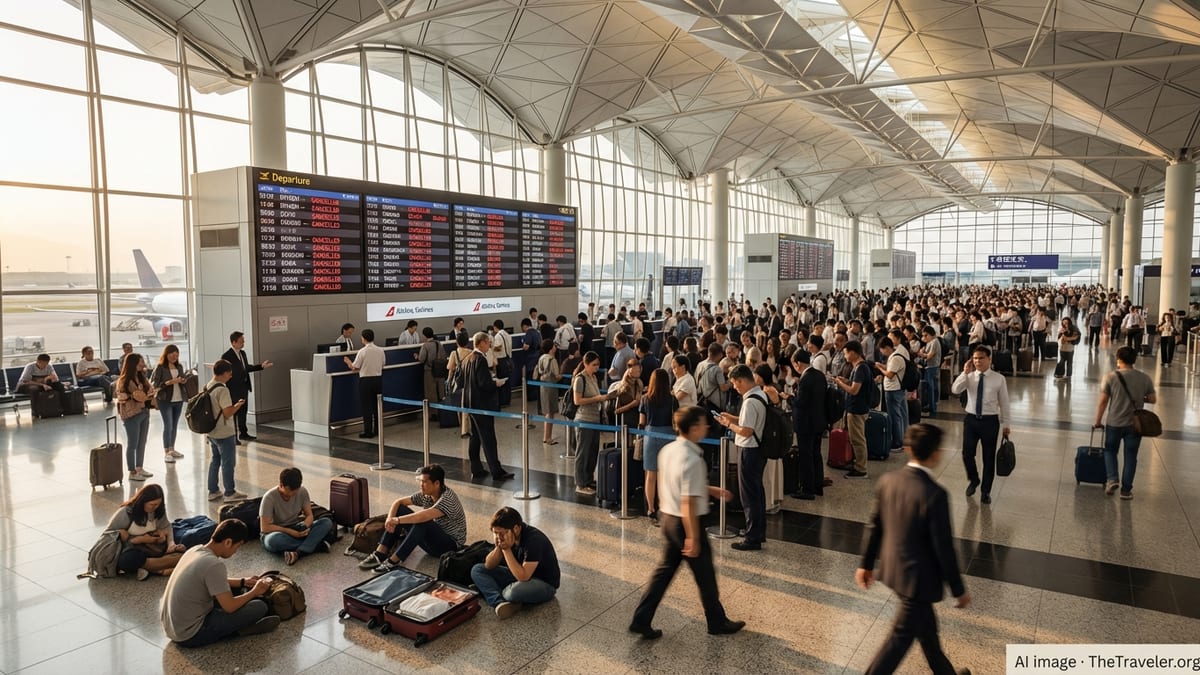
Airport Authority Hong Kong said a cluster of Middle East services scheduled for Saturday and Sunday had been cancelled or heavily delayed, urging passengers bound for Saudi Arabia and the wider Gulf to contact airlines before travelling to the airport. Departures boards at Hong Kong International Airport showed multiple flights to Riyadh, Doha and Dubai listed as cancelled or “delayed until further notice,” leaving travellers camped out in departure halls and seating areas.
Cathay Pacific has suspended all passenger and cargo operations to the Middle East for several days, including services to Dubai and Riyadh, and is routing long-haul flights around the affected airspace. Gulf carriers Emirates, Qatar Airways and Etihad have also halted the vast majority of services in and out of their home hubs, removing the main connection options Hong Kong travellers typically use to reach destinations in Africa, Europe and the Middle East.
Aviation analysts warn that the sudden loss of three of the world’s busiest transfer hubs, on top of existing detours around Russian and Ukrainian skies, has created a chokepoint that will reverberate across Asia for days, if not weeks. For Hong Kong, whose post-pandemic recovery relies heavily on long-haul connectivity, the disruption is a sharp setback.
Why Flights to Riyadh, Doha and Dubai Are Being Cancelled
The immediate trigger for the chaos was a large-scale US-Israeli air campaign against targets in Iran, followed by Iranian missile and drone strikes on sites across the Gulf. In response, regional governments closed significant portions of their airspace, citing security concerns and the risk to civilian aircraft transiting potential conflict zones.
Saudi Arabia has kept its airspace open under tighter restrictions, but with neighbouring Iran, Iraq and the Gulf states shutting down or severely limiting routes, the traditional east–west corridors over the Middle East have effectively been severed. That makes direct flights to Riyadh more complex and pushes connecting services via Doha and Dubai off the table entirely while those hubs remain closed or operating at minimal capacity.
Major airports in Dubai, Abu Dhabi and Doha have reported damage or nearby impacts from retaliatory strikes and have sharply curtailed movements to allow inspections and security operations. With key runways and terminals affected, airport authorities have told airlines to cancel or divert almost all traffic. As a result, carriers based in Asia, Europe and North America have opted to ground flights rather than attempt lengthy and uncertain diversions.
Regulators in Europe and parts of Asia have issued conflict-zone advisories, strongly recommending that airlines avoid the affected skies at all altitudes. For carriers such as Cathay Pacific, which typically overfly the Gulf region on routes to Europe and Africa, the safest immediate option has been to suspend some services entirely and reroute others via longer paths over Central Asia and the Indian Ocean.
How Passengers at Hong Kong International Airport Are Coping
Inside Hong Kong International Airport’s departure halls, the disruption has produced scenes reminiscent of the early pandemic era: long queues at airline service counters, families asleep on terminal floors and travellers glued to their phones searching for alternatives. Some passengers bound for business meetings in Riyadh reported being offered rebooking days later via Europe, while others heading to Dubai for onward connections were told to request refunds or open-dated tickets.
Staff at airline transfer and ticketing desks have been working extended shifts to process rebookings and issue meal and hotel vouchers where possible. However, because the shutdown affects multiple countries and a wide swathe of airspace rather than a single airport, many stranded travellers have been advised that guaranteed onward journeys cannot be confirmed until governments clarify how long restrictions will last.
Hotels near the airport reported a spike in last-minute bookings as travellers accepted they would not be departing as planned. Others, particularly those holding non-refundable packages or visas tied to specific dates, faced difficult choices about abandoning trips altogether. Travel agents in the city said they were fielding urgent calls from clients seeking alternative routings via Singapore, Bangkok, Seoul or Tokyo, but warned that available seats were vanishing quickly as airlines filled remaining capacity.
Airport information desks are directing passengers to airline hotlines and mobile apps, while Hong Kong’s Security Bureau has reiterated its existing red travel alert for Iran and urged residents to reconsider non-essential journeys anywhere near the conflict zone. Officials have also reminded citizens already overseas to register contact details so they can receive security updates.
What This Means for Global Routes and Prices
The closure of large sections of Middle East airspace is rippling far beyond the region. With key corridors blocked, airlines are being forced to add hours to flights between Europe and Asia by looping south over the Arabian Sea or north via Central Asia, increasing fuel burn and crew costs. Industry experts say that if the closures persist through the coming week, travellers should expect more cancellations, tighter seat availability and rising fares on many long-haul routes.
For Hong Kong-based passengers, popular one-stop itineraries to European and African cities via Doha or Dubai have effectively disappeared overnight. Carriers in East Asia and Europe are likely to benefit in the short term as they pick up displaced demand, but they will also bear higher operating costs from detours and potential congestion on remaining safe corridors.
The disruption also hits global cargo flows. Major Gulf airlines operate some of the largest freight networks linking Asia to Europe and Africa, and their temporary standstill is already prompting concerns among logistics firms about delays to e-commerce shipments and just-in-time supply chains. With Cathay Pacific also rerouting or suspending some freighter services, Hong Kong’s role as a regional cargo hub faces additional pressure.
While some aviation authorities have suggested that limited corridors could reopen within days under tight military coordination, security analysts caution that any further strikes could trigger renewed closures. Airlines are therefore planning for a protracted period of uncertainty, which typically results in conservative scheduling, buffered flight times and, eventually, higher ticket prices passed on to travellers.
What Travellers From Hong Kong Should Do Now
Passengers with tickets to Riyadh, Doha, Dubai or onward destinations that usually connect through the Gulf are being urged to treat their bookings as highly fluid. Airlines advise checking flight status repeatedly in the 24 hours before departure and avoiding travel to the airport until a specific flight is confirmed as operating.
Most major carriers serving Hong Kong have introduced short-term waivers that allow customers to change dates or routes without extra fees if their itinerary touches the affected region. Travellers should read the fine print carefully, as some waivers apply only to tickets issued before a specified cut-off date or to journeys scheduled within the next few days.
Those who must travel urgently are being told to consider alternative routings via hubs in East or Southeast Asia, even if this means longer journeys and higher costs. Travel insurers say policyholders should document all communication with airlines and agents, retain receipts for accommodation and meals, and check policy wording to see whether “war” or “civil unrest” exclusions apply to their claims.
For now, there is no clear timeline for the full restoration of flights over the Middle East. Until governments reopen their skies and key hubs in Dubai, Doha and Abu Dhabi resume normal operations, travellers in Hong Kong and across Asia can expect rolling disruption, last-minute schedule changes and a premium on any available seats that bypass the conflict zone.