

More news on this day
Honolulu’s Daniel K. Inouye International Airport has introduced a fleet of new electric trams to shuttle passengers between terminals and gates, marking the latest step in Hawaiʻi’s broader push to cut transportation emissions while improving the airport experience for millions of travelers each year.
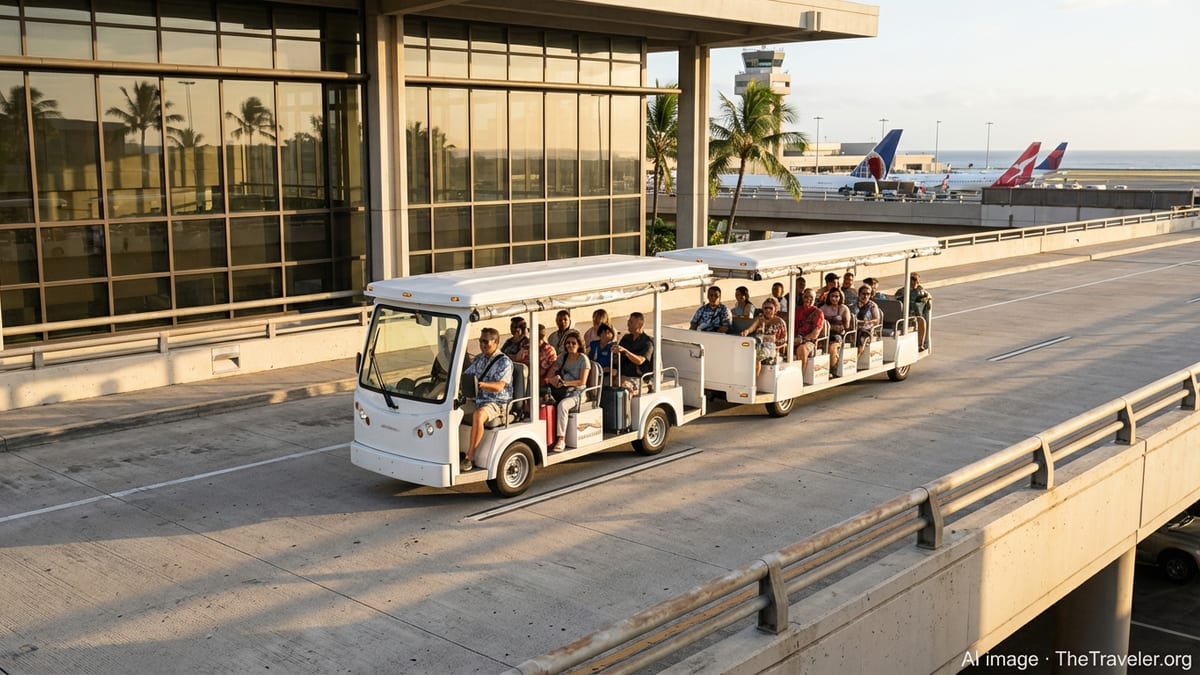
New Electric Trams Join the Wiki Wiki Shuttle Fleet
The Hawaiʻi Department of Transportation has begun operating three new electric transit trams at Daniel K. Inouye International Airport, adding a cleaner, quieter option to the airport’s longstanding Wiki Wiki shuttle system. The open-air trams began carrying domestic passengers on February 15, running between concourses and terminals that handle the bulk of interisland and mainland flights.
State transportation officials describe the trams as a supplemental service layered onto the existing Wiki Wiki buses, which are a familiar part of the Honolulu airport experience for decades of travelers. The new vehicles follow a similar route, connecting gates in the C and G concourses with Terminals 1 and 2, where most passengers check in, clear security and collect baggage.
By expanding the shuttle fleet with battery-powered vehicles, airport leaders say they can move more people more comfortably through the sprawling terminal complex while lowering emissions and noise on the airfield. The trams are intended to support peak travel periods and ease pressure on conventional buses, particularly as passenger numbers continue to rebound and grow.
Each of the new trams consists of a motorized electric vehicle coupled with trailers, configured to carry approximately 40 passengers at a time. Domestic travelers with carry-on bags can board directly, with boarding points located on the third floor of the terminal complex along the existing Wiki Wiki corridor.
Service Hours, Passenger Experience and Operations
The electric trams currently operate daily between 10 a.m. and 6 p.m., a service window targeted at the busiest portions of the daytime schedule for interisland and mainland departures and arrivals. Officials say the hours are designed to maximize visibility and ease of use while the system ramps up, with potential for adjustments as passenger patterns and demand are evaluated over the coming months.
Passengers encounter the trams along familiar paths: wayfinding signs direct travelers to boarding stops near established Wiki Wiki shuttle areas. The vehicles operate on shared lanes along the terminal’s secure-side circulation path, allowing passengers to ride between concourses without exiting the sterile area or navigating long walking distances in Honolulu’s tropical heat.
From a rider’s perspective, the trams are intended to offer a more relaxed and sensory-friendly journey compared with older gas-powered vehicles. Electric propulsion removes engine noise and exhaust odors, creating a calmer environment as shuttles glide between gates. Open-air sides allow natural airflow and views of the runway and ramp activity, which officials hope will be especially welcome for families and visitors arriving in Hawaiʻi for the first time.
Travelers accustomed to the “Wiki Wiki” experience will still recognize the system’s core function: fast, frequent transfers that bridge the gaps between check-in counters, security checkpoints and distant gates. The addition of electric trams is not a replacement for buses but an expansion of options intended to keep wait times low and crowding to a minimum during peak flight banks.
Technology, Safety Features and Funding Model
The three new trams are American-made Moto Electric vehicles acquired under Hawaiʻi’s Electric Vehicle as a Service contract with the firm Sustainability Partners. Under this model, the state does not shoulder all upfront capital costs on its own; instead, it partners with a private provider that delivers the vehicles, manages maintenance and helps ensure the fleet remains in good working order throughout its service life.
Each tram carries a price tag of roughly 255,000 dollars and comes equipped with onboard cameras, GPS and other monitoring technology. These systems allow the Hawaiʻi Department of Transportation to track vehicle locations in real time, monitor driver behavior, and review operations data to refine schedules and routes. Officials say the technology also bolsters safety and security by giving dispatchers better visibility over movements in the secure area.
The vehicles are designed for frequent stop-and-go operations, a typical pattern for airport ground transport. Lithium-based battery packs are charged through the airport’s growing electric vehicle infrastructure, which includes charging stations built as part of broader electrification projects serving rental car buses and other ground support equipment.
Because the trams are part of a wider clean transportation portfolio, the same Electric Vehicle as a Service framework supports a larger fleet transition, from shuttle buses to maintenance vehicles. For airport managers, this arrangement helps contain long-term operating costs, lock in predictable service agreements and speed up the rollout of low-emission vehicles without navigating complex one-off procurements for each type of equipment.
Part of a Broader Green Mobility Strategy at HNL
The launch of electric trams at Daniel K. Inouye International Airport comes as the facility has already met a major climate milestone ahead of schedule. In 2025, state officials announced that the airport had achieved its target of reducing airport-controlled emissions per passenger by 50 percent from 2009 levels, reaching a goal originally set for 2030 fully five years early.
Key to that progress has been an aggressive shift toward electric and low-emission ground transportation. In addition to the new trams, HNL has deployed autonomous electric shuttle vehicles under a pilot program, and is in the process of replacing diesel rental car shuttles with a planned 20-bus battery electric fleet. The first four of those rental car buses began operating between the terminals and the Consolidated Rental Car Facility in December 2025.
Energy efficiency projects in the terminals, solar installations and upgraded building systems further reduce the airport’s carbon footprint, while expanded electric charging infrastructure supports both public-use charging stations and operational vehicles. The state has also invested in an airport bus maintenance facility with dedicated electric bus charging, reinforcing the ground-side backbone needed to keep a growing zero-emission fleet in service.
For Hawaiʻi, where the impacts of sea level rise and extreme weather are a pressing concern, the push to decarbonize transportation is framed as both environmental responsibility and economic pragmatism. Airports are high-visibility test beds for clean technology, and the Honolulu upgrades are intended to show how islands can modernize mobility while maintaining reliable service for residents and visitors.
Integrating Trams with Rail, Buses and Digital Wayfinding
The electric trams are one element in a rapidly evolving access network around Honolulu’s main airport. In October 2025, the second segment of the city’s elevated Skyline rail line opened, including the Lelepaua station at Daniel K. Inouye International Airport. The station is linked to the Terminal 2 and International parking garages by pedestrian walkways, bringing driverless rail service directly into the airport campus.
In coordination with the rail extension, the Hawaiʻi Department of Transportation reconfigured ground transportation at the airport, moving city bus stops and rideshare pickup zones from the upper-level roadways down to the ground level. The goal is to streamline the flow of vehicles and pedestrians, simplify transfers, and reduce congestion on the busy departure deck. The tram system complements these changes by improving circulation within the secure area, while rail and bus services enhance access to and from the airport.
Inside the terminals, new digital tools are designed to make it easier for passengers to navigate an increasingly complex transportation hub. Electronic displays in Terminal 1 and, soon, Terminal 2 provide real-time security checkpoint status and estimated wait times. Mobile wayfinding apps launched in 2025 give travelers a live “blue dot” view of their location within the terminal, helping them locate gates, restrooms, food and ground transportation options like the electric trams and rental car shuttles.
Combined, these investments point toward a more integrated, multimodal airport where passengers can move from rail platforms to trams, from check-in counters to gates, and from baggage claim to rental cars or buses with fewer bottlenecks. The electric trams are an important missing link on the airside, ensuring that travelers do not have to rely solely on walking or older diesel vehicles for every transfer.
Capacity, Accessibility and Inclusivity for Diverse Travelers
With each tram capable of carrying around 40 passengers, the new fleet significantly boosts HNL’s internal transport capacity during busy periods, from morning interisland banks to afternoon mainland departures. While three trams may sound modest compared with fleets at some mega-hubs, state officials note that these vehicles are strategically targeted to corridors where walking distances and crowding have been frequent complaints.
The trams are purpose-built with accessibility in mind. Low-floor boarding, grab rails and priority seating support travelers with reduced mobility, while attendants can assist with boarding and alighting for older adults, families with small children and passengers with disabilities. The electric drivetrains also contribute to accessibility by providing smoother acceleration and braking, which can be especially important for standing passengers or those using mobility devices.
Airport planners say the new vehicles should help improve the transit experience for residents who regularly fly between islands for work, health care or family visits as much as for vacationers. For local travelers, consistency and reliability are critical; for visitors, the first ground transport they encounter in Hawaiʻi shapes their early impressions of the islands. The trams are designed to serve both groups by reducing wait times, clarifying boarding points and providing a more welcoming ride.
Language-light wayfinding, visual signage and clear pictograms at tram stops are intended to assist international visitors who may be unfamiliar with the airport layout or with English. Coordination with airline staff and airport volunteers aims to ensure that connecting passengers, including those with tight layovers, are directed to tram boarding zones quickly to avoid missed flights.
A Model for Regional and Global Airport Sustainability
The rollout of electric trams at Daniel K. Inouye International Airport is drawing attention among airport planners looking for scalable ways to decarbonize ground operations without massive new rail or monorail investments. HNL’s approach relies on a modular fleet of road-based vehicles that can run on existing pavements, making it a comparatively low-cost and flexible strategy.
As aviation hubs worldwide grapple with climate targets and regulatory pressure, incremental changes like electrifying shuttles, improving wayfinding and optimizing passenger flows are increasingly seen as practical steps that can be implemented on short timelines. Honolulu’s combination of autonomous shuttles, rental car buses and now electric trams offers a layered case study in how airports can integrate multiple electric modes suited to different routes and passenger needs.
Industry observers note that Hawaiʻi’s efforts also align with a broader shift in the global airport sector toward meeting carbon accreditation standards and net-zero roadmaps. For HNL, early achievement of its 2030 emissions goal provides runway to pursue deeper cuts and pilot new technologies, from additional electric ground support equipment to smarter energy management across terminals and parking structures.
For travelers, the most visible sign of that strategy is now pulling up to curbs and boarding platforms in the form of quiet, battery-powered trams. Whether connecting from Skyline rail to interisland gates, or moving between far-flung concourses with carry-on in hand, passengers at Honolulu’s primary gateway will increasingly experience sustainable mobility as an everyday part of their journey rather than a niche or experimental option.