

More news on this day
Hundreds of passengers were left stranded at Honolulu’s Daniel K. Inouye International Airport on Saturday as six cancellations and around 30 significant delays hit flights operated by Hawaiian Airlines, American Airlines, Asiana Airlines and South Korean carrier Air Premia, snarling long‑haul routes to Tokyo, Manila, Los Angeles and major U.S. cities.
Wave of Cancellations and Long Delays Ripples Across Key Routes
The latest disruption unfolded against a backdrop of wider operational strains at Daniel K. Inouye International Airport, which has seen a spike in irregular operations in recent days on both domestic and international services. According to airport and airline operations data reviewed on February 28, a cluster of six cancellations combined with roughly 30 late departures and arrivals concentrated on high‑demand transpacific and mainland U.S. routes.
Hawaiian Airlines, which relies on Honolulu as its primary hub, absorbed several of the most consequential schedule hits, with affected services to Los Angeles and major West Coast gateways where connections feed into the broader U.S. network. American Airlines, operating daily links between Honolulu, Los Angeles and other mainland hubs, also reported delayed departures that pushed some long‑haul flights deep into the night and early‑morning hours.
On the international side, passengers booked on Asiana and Air Premia flights to major Asian hubs faced extended waits as departure boards at Honolulu filled with rolling delay notices. Services to Tokyo and Manila, critical links for both leisure and visiting‑friends‑and‑relatives traffic, were among those hardest hit, forcing many travelers into unplanned overnight stays or lengthy rebooking queues.
The pattern mirrored a broader uptick in disruption seen at Honolulu on February 27 and 28, when separate operational reports recorded dozens of delays and a string of cancellations across multiple carriers serving the U.S. mainland, Japan and the Philippines. The latest cluster added fresh pressure on an already stretched airport operation heading into a busy late‑winter travel weekend.
Ground Reality: Long Lines, Missed Connections and Confused Tourists
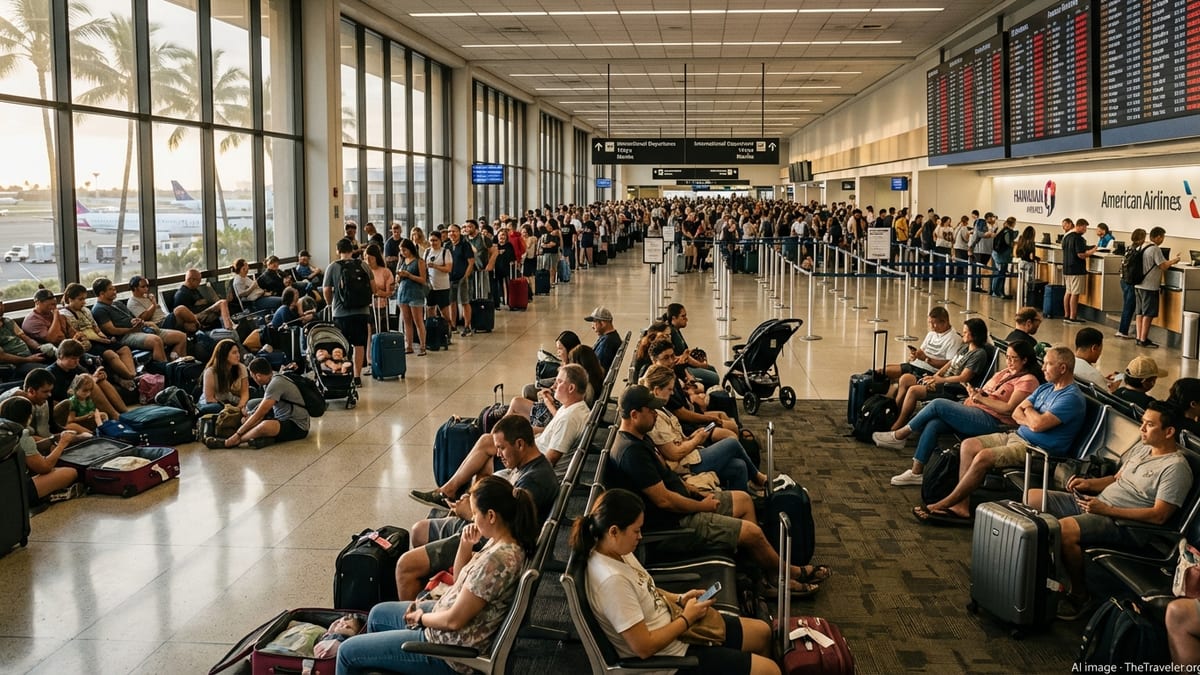
Inside the terminal, the operational data translated into long customer service lines and packed gate areas as passengers waited for clarity on revised departure times and rebooking options. Families bound for Tokyo’s Haneda and Narita airports watched as their departure times slid back in 30‑ and 60‑minute increments, while those scheduled to connect onward from Los Angeles to cities such as New York, Chicago and Dallas weighed whether they would still be able to reach the mainland in time.
Travel agents on the islands reported a surge in last‑minute queries from stranded visitors trying to salvage itineraries that included onward cruises, interisland hops and connecting flights to the continental United States. Some leisure travelers heading to Manila to visit relatives were told they would have to be rerouted through alternative Asian hubs or rebooked onto departures leaving late on Saturday or into Sunday, depending on seat availability.
Hotel desks near the airport and in Waikiki saw an uptick in walk‑in requests as reprotected passengers sought somewhere to sleep after misconnecting in Honolulu. With many long‑haul services operating overnight, even delays of two or three hours left travelers facing the prospect of arriving at mainland or Asian destinations well past planned morning arrival windows, complicating onward road, rail and domestic flight connections.
At the gates used by Hawaiian and American, staff worked to juggle rolling updates from operations control with a steady stream of passenger questions about voucher eligibility, baggage handling and the status of checked surfboards and other oversized leisure equipment common on Hawaii routes. Display screens across the terminal showed a patchwork of red and amber indicators next to flights bound for Los Angeles, San Francisco, Tokyo and Manila.
Operational Pressures Behind the Disruptions
The latest wave of irregular operations comes as Honolulu’s airfield and terminal complex manages a demanding mix of long‑haul international, mainland U.S. and interisland flights, many of which are tightly timed to facilitate same‑day connections. Recent airfield works and taxiway changes have added further operational complexity, requiring some widebody aircraft to be shifted between terminals and stands, which can lengthen turnaround times and increase susceptibility to knock‑on delays when earlier flights run late.
Industry analysts note that carriers such as Hawaiian, American, Asiana and Air Premia operate transpacific schedules with limited slack, especially on peak days and during holiday periods. Aircraft often arrive from one long‑haul leg and are due to turn quickly for another, meaning that a delay inbound from the mainland or Asia can cascade rapidly into later departures from Honolulu to cities like Los Angeles, Tokyo or Manila.
Across the broader network, a separate wave of delays and cancellations has also been reported at other key West Coast and Pacific gateways, including Seattle‑Tacoma, where carriers such as Alaska Airlines, Hawaiian and Delta have grappled with their own schedule disruptions. Those knock‑on effects can further complicate the repositioning of aircraft and crews needed to operate Honolulu services on time.
For foreign carriers such as Asiana and Air Premia, coordination with overseas hubs introduces another layer of complexity. Slots at congested airports in Tokyo and Seoul, along with crew duty limits on ultra‑long‑haul sectors, can limit the extent to which airlines can simply “make up time” later in the schedule, forcing them instead to delay departures at origin or, in some cases, cancel a rotation outright.
Airlines Scramble With Rebooking, Waivers and Customer Care
As the scale of Saturday’s disruption became clear, affected airlines moved to activate their irregular‑operations playbooks. Hawaiian Airlines and American Airlines agents at Honolulu set up dedicated rebooking queues for passengers whose connections in Los Angeles and other mainland hubs could no longer be met, prioritizing those with tight onward international or red‑eye itineraries.
Customer service desks offered meal vouchers and, in select cases, hotel accommodations for travelers facing lengthy overnight delays, subject to each carrier’s contract of carriage and the cause of the disruption. For those booked on Asiana and Air Premia services to Asia, staff focused on securing seats on the next available departures or on partner airlines, a challenging task given strong demand on weekend transpacific routes.
Airlines also encouraged passengers to make use of mobile apps and online tools to track real‑time flight status, accept self‑service rebooking options and verify baggage information. However, intermittent spikes in demand meant that some customers struggled to access digital channels at peak times, prompting many to continue queueing at airport counters for in‑person assistance.
Even for travelers who ultimately departed only a few hours late, the knock‑on impact to their plans was significant. Late arrivals into Los Angeles increased the risk of missed connections to major U.S. cities in the Midwest and East Coast, while delayed landings in Tokyo compressed minimum connection times for flights onward to other Japanese cities and regional Asian destinations.
Advice for Travelers Passing Through Honolulu
With Honolulu having experienced repeated bouts of disruption over February 27 and 28, travel planners advised passengers with upcoming itineraries through the airport to build in extra time, particularly if connecting to or from long‑haul flights. Same‑day interline connections between Asia, Hawaii and the mainland U.S. were highlighted as particularly vulnerable when schedules tighten.
Airline and airport representatives emphasized the importance of monitoring flight status frequently on the day of travel, checking in online as early as possible and arriving at the airport ahead of the recommended time when adverse conditions or operational challenges are expected. Travelers were also urged to keep essential items, including medications and a change of clothes, in carry‑on bags in case of irregular operations.
For those yet to book, experts suggested considering slightly longer connection windows through Honolulu when traveling between Asia, Hawaii and major U.S. cities, even if this means spending additional time in the terminal. While the majority of flights continue to operate close to schedule, the recent run of delays and cancellations has underscored how quickly a busy hub can become congested when multiple carriers are affected at once.
As operations gradually stabilize, airlines serving Daniel K. Inouye International Airport will face continued scrutiny from both regulators and passengers over how effectively they manage communication, customer care and resilience planning in an era when even a handful of cancellations and a few dozen delays can ripple around the Pacific in a matter of hours.