

More news on this day
Hours long security lines at Houston’s airports have pushed frustrated travelers into basement corridors and parking areas this week, as a Homeland Security funding lapse and peak spring break demand converge into one of the most extreme screening bottlenecks seen at George Bush Intercontinental and William P. Hobby in recent years.
Get the latest news straight to your inbox!
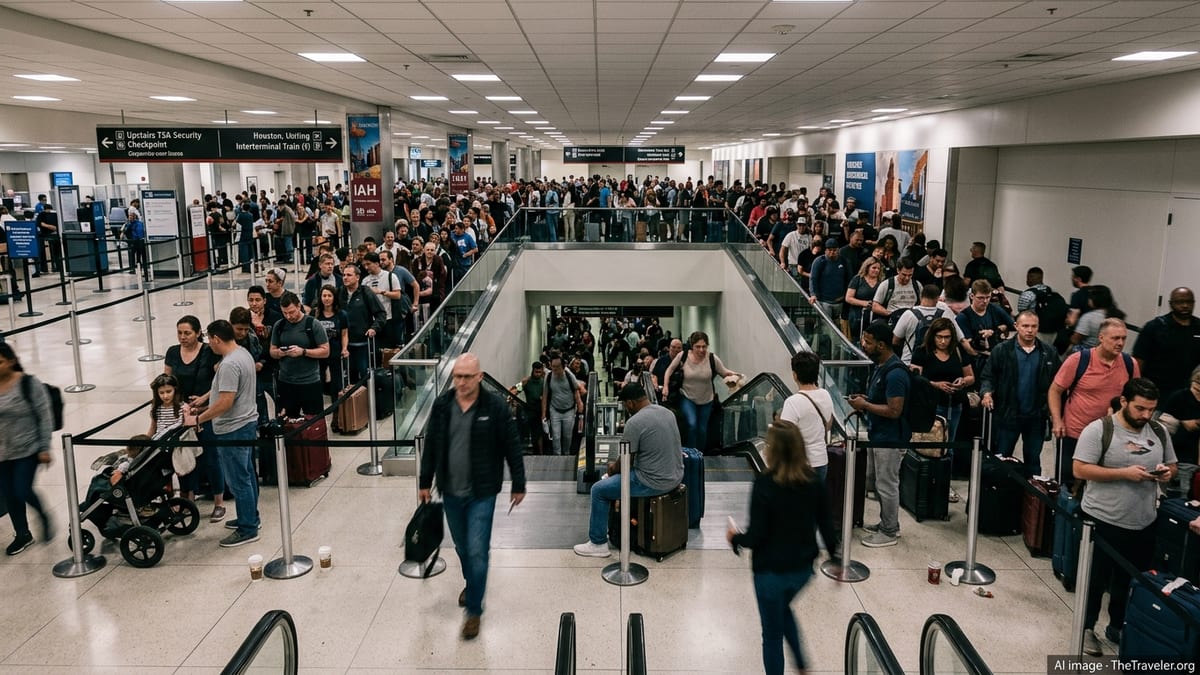
Four Hour Waits and Lines Dropping Into the Basement
On March 24, travelers arriving at George Bush Intercontinental Airport reported Transportation Security Administration waits hovering around four hours, with queues looping across multiple levels of the terminals. Social media images and first hand accounts describe lines beginning at standard security checkpoints, winding down escalators into basement corridors near the airport’s inter terminal subway, then snaking back up toward departure halls.
Posts on passenger forums and community discussion boards depict a system pushed beyond capacity. Travelers describe setting stopwatches from the moment they located the end of the line in baggage claim, then inching forward across two or three floors before finally reaching the screening area. Some passengers report missing scheduled departures after spending the better part of a morning in line, even when arriving several hours before flight time.
While official online tools indicated estimated waits of around 240 minutes at peak periods, anecdotal reports suggest the situation on the ground fluctuated between three and five hours depending on terminal and time of day. The result has been a chaotic, high stress environment as passengers attempt to calculate whether they can clear security in time or need to rebook flights entirely.
Hobby Airport Lines Spill Into Baggage Claim and Parking Garage
The crisis is not limited to Bush Intercontinental. Earlier in March, William P. Hobby Airport saw its own wave of extreme delays, with local media photography and national coverage showing queues spilling from the central checkpoint down into the lower level baggage claim and out toward an adjacent parking garage. Reports indicate that standard screening lines at Hobby on March 8 stretched across multiple floors, with travelers waiting two to three hours or longer to reach the scanners.
Coverage from Houston based outlets and national news organizations linked the backups at Hobby to a combination of heavy spring break traffic and reduced staffing at security checkpoints. Images showed tightly packed lines zigzagging through the terminal and into areas not typically associated with passenger screening, underscoring how far beyond design capacity the airport’s security operation had been pushed.
Although subsequent days brought some relief, with wait times at Hobby reportedly falling closer to 20 minutes during quieter periods, travelers continue to share cautionary tales from the worst of the surge. For many, the prospect of lines backing into garages and service levels has become a symbol of the broader strain on airport infrastructure during the ongoing funding dispute in Washington.
Shutdown Driven Staffing Shortages Create a Perfect Storm
The immediate backdrop to Houston’s airport turmoil is the partial shutdown of the Department of Homeland Security that began in mid February. Publicly available information indicates that thousands of Transportation Security Administration employees nationwide have missed or only partially received paychecks, with call out rates rising at some of the country’s busiest hubs.
Published coverage from national news organizations notes that Houston’s airports rank among the hardest hit. Reports indicate that both Bush Intercontinental and Hobby have faced elevated numbers of absences compared with typical operations, even as spring break travel pushes passenger counts toward seasonal highs. Reduced staffing at security checkpoints has in turn led to fewer open lanes, longer lines and sharply extended wait times.
Analysts and aviation observers describe the situation as a classic perfect storm. Strong leisure demand, full flights and tight schedules leave little margin for disruption, while an unpaid workforce faces mounting financial pressure. The result is a widening gap between the number of passengers funneled toward checkpoints and the number who can be screened in a reasonable timeframe.
Desperate Workarounds as Travelers Try Not to Miss Flights
As the delays have lengthened, passenger behavior at Houston’s airports has shifted in ways that underscore the sense of urgency. Accounts from travel forums suggest some travelers are arriving at Bush Intercontinental as early as four hours before domestic departures and even earlier for international flights, effectively building the worst case wait time into their plans.
Others have described last minute attempts to salvage disrupted itineraries, including searching for rental cars when it becomes clear a flight will be missed or weighing whether to rebook onto departures from other Texas airports with shorter screening times. A recurring theme in online discussions is the dilemma of deciding how long to stay in line versus when to abandon a departure and seek alternatives.
Some posts even contemplate extreme measures, such as clearing security late at night and sleeping in the terminal to guarantee access to early morning flights. While these strategies remain outliers, their appearance in public discussion reflects how far from normal conditions Houston’s security experience has drifted during the latest wave of disruption.
What Houston’s Meltdown Signals for Spring Break Travel
The scenes unfolding at Houston’s airports offer a stark preview of the broader pressures facing the United States air travel system as the spring break season reaches its peak under the shadow of a Homeland Security shutdown. Reports from other hubs, including New Orleans and Atlanta, point to lengthy lines and staffing challenges, but Houston has emerged as one of the most visible flashpoints.
Aviation experts note that large connecting hubs like Bush Intercontinental are particularly vulnerable when security capacity drops. With many passengers relying on tight connections between domestic and international flights, hours long waits at checkpoints can cascade into missed legs, misplaced baggage and network wide delays. Houston’s recent experience illustrates how quickly a local staffing shortage can ripple through airline schedules far beyond Texas.
For now, publicly available guidance from airport and airline channels continues to stress early arrival, close monitoring of flight status and flexibility when disruption strikes. Whether the most extreme images of basement level queues and four hour waits become a recurring feature of the season will depend heavily on how quickly the political standoff in Washington is resolved and how fast the security workforce can be stabilized after weeks of uncertainty.