

More news on this day
Passengers moving through Houston’s George Bush Intercontinental Airport on April 7 faced another bruising day of disruption, with 307 flight delays and cancellations snarling operations at one of the nation’s busiest hubs.
Get the latest news straight to your inbox!
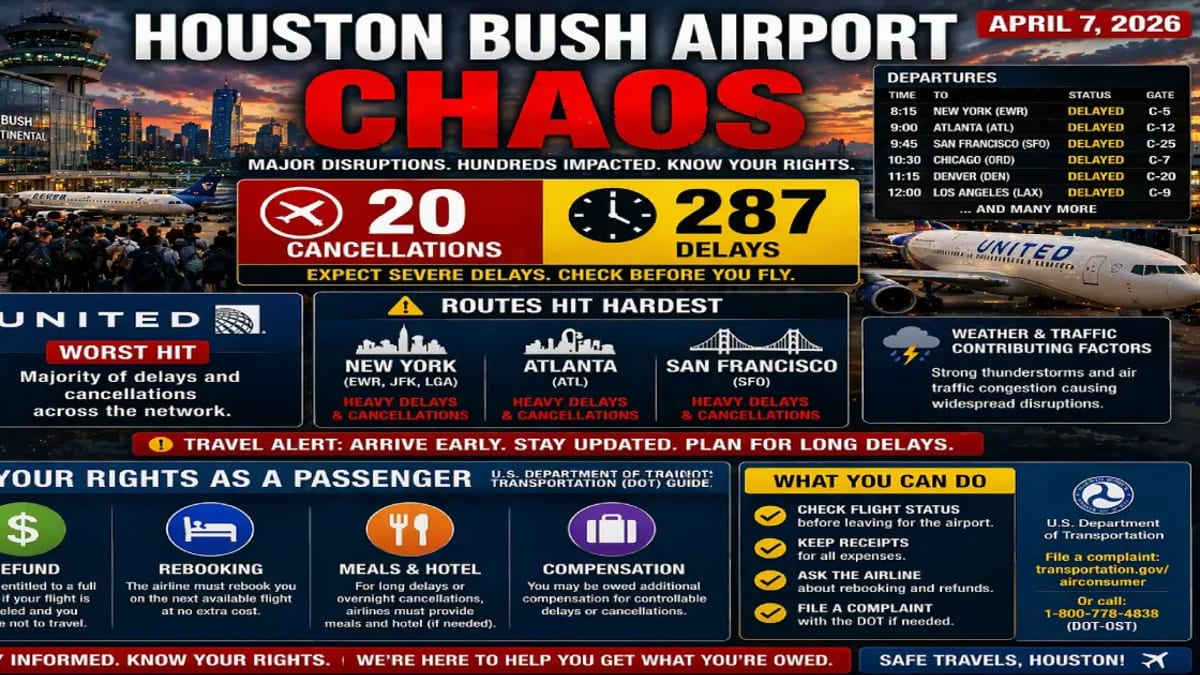
IAH Becomes a Hotspot in Nationwide Flight Turmoil
Publicly available flight tracking data and operational summaries for April 7 indicate that Houston’s Bush Intercontinental was among the country’s most affected hubs, contributing 307 individual disruptions to a wider pattern of delays and cancellations across the United States. Those figures include both late departures and arrivals, as well as outright cancellations, compounding pressure on airlines and airport facilities throughout the day.
Coverage by aviation and travel outlets points to a turbulent start to the week for U.S. air travel, following an already difficult Easter holiday period. Nationally, several thousand flights were delayed or canceled on April 7, with major hubs such as Atlanta, New York, Chicago, Los Angeles and Orlando also reporting significant operational strain. Within this broader picture, Bush Intercontinental’s 307 disrupted flights stood out as a concentrated flashpoint for Texas and the central United States.
The disruption figures for Houston followed earlier episodes of strain at the airport system in March, when staffing shortages, high passenger volumes and weather-related constraints contributed to long security lines and schedule instability. The April 7 numbers underline how quickly irregular operations can re-emerge when several stress factors align, even in relatively calm local weather conditions.
Operational trackers show that by Monday afternoon, disruption at Houston had spread across multiple banks of departures and arrivals, creating pockets of congestion across terminals and leaving many travelers facing extended waits, missed connections and last-minute itinerary changes.
Weather, Congestion and Network Knock-On Effects
Local weather in Houston on April 7 was relatively benign, with warm temperatures and mostly overcast skies reported around the airport. Forecasts from regional meteorological outlets pointed to pleasant daytime conditions, a notable contrast with the severe thunderstorms and winter weather that have affected Texas operations at various points in recent months. As a result, analysts and travel commentators have placed greater emphasis on airspace congestion and knock-on network effects as likely drivers of the day’s turmoil.
Nationally, traffic flows remained heavy coming out of the Easter weekend. Published coverage from industry trackers shows that earlier storms and bottlenecks in other regions, particularly around the East Coast and Midwest, had already reduced available slack in airline schedules. That left carriers more vulnerable to relatively minor disturbances, including late-arriving aircraft and crew reassignments, which can cascade rapidly through interconnected hubs such as Houston.
Construction and modernization work at Bush Intercontinental has also formed part of the operational backdrop. Federal aviation documents and airport planning reports describe multi-year upgrades at key terminals intended to improve capacity and passenger handling over the long term. In the short term, however, temporary gate reconfigurations, work zones and changed traffic patterns can reduce flexibility during peak periods, increasing the likelihood that a surge in delays elsewhere in the system translates into visible disruption on the ground.
Airline-specific travel waivers issued around the first week of April, including policies tied to thunderstorms and congestion in the Houston area, further illustrate how carriers anticipated continued irregular operations. These waivers allow travelers to change plans without typical fees and are often deployed when internal forecasts suggest an elevated risk of widespread itinerary changes in and out of a hub.
Airlines, Routes and Passengers Most Affected
Published accounts from travel industry publications on April 7 highlight how the disruption at Bush Intercontinental cut across domestic and international networks. Information compiled from flight status platforms points to operational challenges for major carriers with a heavy presence at IAH, including United Airlines on both domestic and long-haul routes, as well as American Airlines, Air Canada and other partners on selected services.
Travel media coverage focusing on Houston reported clusters of cancellations tied to specific routes, including flights to and from key international and domestic destinations such as Toronto, Vancouver, Frankfurt, Miami and several U.S. regional cities. While the total number of outright cancellations at Bush remained in the single digits for some individual carriers, the far larger volume of rolling delays produced similar levels of uncertainty for passengers and crews.
The impact was particularly acute for travelers attempting to connect through Houston to other U.S. hubs or onward international flights. When an inbound aircraft arrived significantly behind schedule, passengers frequently missed tightly timed domestic connections, increasing rebooking volumes at customer service desks and via airline apps. In some cases, aircraft and crews ended the day out of position, adding complexity to airline planning for April 8 and beyond.
By early evening on April 7, tracking dashboards showed knock-on delays continuing to affect departures from Houston toward major hubs across the Midwest and East Coast. The resulting congestion at some destination airports risked amplifying the disruption further, underscoring the tightly coupled nature of U.S. airline networks.
Strain on Airport Operations and Traveler Experience
Reports posted to social media and travel forums throughout Monday described long lines at ticket counters and help desks, crowded gate areas and a scramble for available seats on later flights. While security wait times at Bush Intercontinental have been a recurring point of concern in recent weeks, the April 7 disruption added another layer of stress as affected passengers sought assistance and accommodations inside already busy terminals.
Observers noted that staffing levels at some customer-facing points appeared stretched, with airline employees working to reroute travelers across complex itineraries while simultaneously managing boarding for flights that were operating close to schedule. This created visible bottlenecks around certain gates and concourses, especially during the midday and late afternoon waves of departures when disrupted and on-time flights overlapped.
Ground operations were also affected, as late aircraft arrivals and revised departure slots forced ramp crews, catering teams and fuelers to work around a continually shifting schedule. Even when individual delays were relatively modest, a high number of slightly late turns can push resource planning to its limits, leaving little margin to absorb additional irregularities such as minor maintenance findings or air traffic control holds.
For many travelers, the cumulative effect was one of unpredictability. Some departures initially listed with short delays were later pushed back by additional increments, while others departed sooner than revised estimates once slots became available. Such volatility can complicate decisions about when to arrive at the airport, whether to rebook or when to adjust ground transport and hotel arrangements.
What April 7 Signals for Spring and Summer Travel
The spike of 307 disruptions at Bush Intercontinental on April 7 adds to a growing list of stress tests for the U.S. aviation system early in 2026. In March, the Houston region saw periods of high wind, severe storms and heavy demand linked to spring break and major local events. Combined with staffing shortages and construction-related constraints, those forces produced several days of visible strain at both of the city’s commercial airports.
Analysts who track airline performance suggest that episodes like April 7 may foreshadow further challenges as travel demand builds into the late spring and summer. Schedules are ramping up toward peak-season levels, yet capacity in some parts of the system remains tight, and many carriers are still balancing crew availability, maintenance needs and ongoing investment in new aircraft and infrastructure.
For passengers planning to travel through Houston in the coming weeks, operational histories from March and early April offer some practical lessons. Flexible itineraries with longer connection windows, early departures where possible, and close monitoring of flight status in the 24 hours before departure may help mitigate the risk of being caught in a large disruption wave. The presence of multiple carriers on key routes can also provide alternative options if one airline experiences concentrated delays.
At the same time, investments in terminal modernization and airfield capacity at Bush Intercontinental are intended to deliver a more resilient operation over the medium term. While the 307 disruptions recorded on April 7 underline the airport’s current vulnerabilities to system-wide shocks, they also highlight why those projects, and ongoing efforts across the industry to improve scheduling and recovery, remain central to the travel experience for millions of passengers moving through Houston each year.