

More news on this day
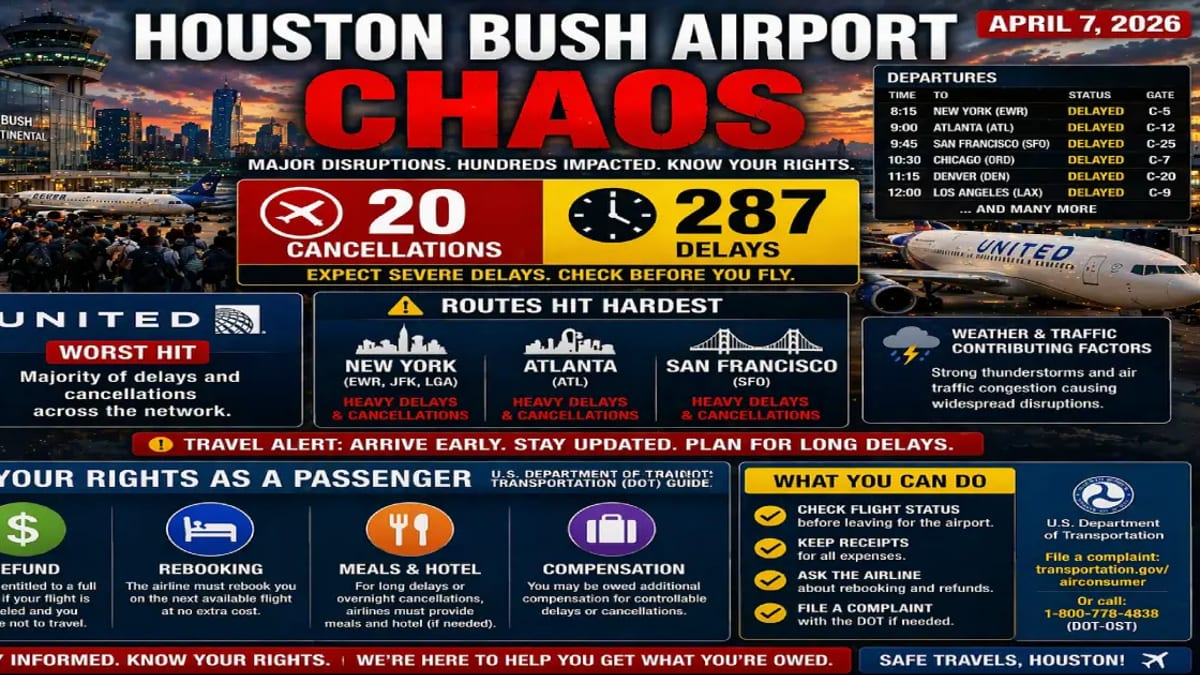
Travelers passing through Houston’s George Bush Intercontinental Airport on April 7 encountered another day of severe operational disruption, as hundreds of flight delays and cancellations rippled through already strained spring schedules across the United States.
Get the latest news straight to your inbox!
Disruptions Mount as Spring Travel Peaks
Operational data and aviation tracking dashboards for April 7 indicate that George Bush Intercontinental Airport in Houston was again among the U.S. hubs wrestling with large-scale schedule upheaval. Across the country, reports pointed to thousands of delayed flights and hundreds of cancellations, with Houston featuring prominently among the hardest-hit airports.
While national totals varied slightly between tracking platforms, several tallies put the combined number of delays and cancellations affecting services into and out of Houston at well over the 300-mark over a 24-hour period, capturing both morning and evening peaks. The figure reflects not only flights departing from IAH, but also services bound for the airport that were disrupted upstream by weather, congestion, and knock-on schedule issues at other hubs.
These rolling disruptions landed on one of the busiest stretches of the spring travel period, when U.S. passenger volumes are climbing toward seasonal highs. Publicly available data from the Transportation Security Administration shows checkpoint volumes in March and early April trending at or near record levels, magnifying the impact of each delayed departure or cancellation for travelers trying to make tight connections.
Although the precise causes varied by flight and carrier, a mix of residual weather challenges, congestion in key air corridors, and operational constraints at several large airports combined to push IAH’s operation under sustained strain through much of the day.
Houston’s Recent History of Strain
The April 7 disruption did not emerge in isolation. George Bush Intercontinental has been under an intense spotlight for weeks, as a series of storms, staffing pressures, and infrastructure constraints created repeated waves of congestion. Local coverage earlier in April highlighted a ground stop at the airport following severe thunderstorms, which triggered delays that cascaded throughout airline networks.
Travel and consumer outlets have repeatedly cited Houston among the major hubs with elevated delay and cancellation counts this spring, often grouping IAH with Atlanta, New York, Chicago, and Orlando as airports experiencing the heaviest turbulence in day-to-day operations. In mid-March, separate reporting noted more than a hundred disrupted flights in a single day at IAH alone, underscoring how quickly minor schedule wobbles can grow into full-blown gridlock.
At the same time, security screening bottlenecks have compounded the frustration for passengers. National travel coverage in recent days has described Bush Intercontinental as one of several U.S. airports that, in late March, were contending with checkpoint lines stretching for hours. Even as federal and local agencies moved to deploy additional resources and restore programs such as TSA PreCheck and CLEAR at key terminals, wait times remained highly volatile into early April.
The result has been an airport ecosystem in which even modest operational shocks can quickly create visible crowding at check-in, security, and gate areas, amplifying the sense of chaos when large numbers of flights are delayed or canceled at once.
Storms, Staffing, and Systemic Pressures
April’s surge in disruptions at IAH is tied to several overlapping factors that extend beyond Houston itself. Weather remains a primary driver. A series of fast-moving storm systems across the central and eastern United States in early April forced reroutes, ground stops, and spacing restrictions on arrivals and departures. When major hubs such as Atlanta, New York, and Chicago slow or pause operations, flights into and out of Houston often suffer secondary delays.
These weather-related slowdowns have intersected with an aviation system still working through structural constraints. Airlines and airports across the country continue to balance busy schedules with finite pools of crew and ground staff. Industry coverage has noted that when aircraft and crews are out of position following a storm or earlier disruption, recovery can take many hours, or even spill into the next day’s operation.
In Houston, this dynamic is intensified by ongoing construction and modernization work across parts of the airport campus. Planning and regulatory documents show a multiyear capital improvement program at IAH, including terminal redevelopment and airfield projects. Although designed to improve capacity and efficiency over the long term, such works can temporarily reduce operational flexibility, particularly during peak travel windows.
On April 7, these broader pressures converged. Delays at other large hubs affected inbound flights to IAH, while aircraft based in Houston faced departure restrictions tied to congestion or weather in downstream markets. For passengers, the result was a patchwork of rolling delays, missed connections, and, in some cases, outright cancellations as airlines sought to reset their schedules.
Impact on Travelers and Airlines
The scale of April 7’s disruption at IAH translated into long hours of uncertainty for travelers. Airport-focused social media feeds and local forums throughout the day described crowded gate areas, lines forming quickly at customer service counters, and confusion as departure boards repeatedly updated with new times. Some passengers reported being rebooked multiple times as connecting flights further along their itineraries also succumbed to delays.
According to publicly available information from airline status pages and travel industry trackers, major U.S. carriers with large Houston operations saw a significant share of their IAH schedules affected. This included short-haul links to regional cities, high-frequency domestic business routes, and select international services. For airlines, the disruption meant added costs from crew repositioning, aircraft swaps, and customer care obligations, as well as the risk of eroding passenger confidence during one of the year’s most competitive travel periods.
Hotel and ground transport providers near the airport also felt the knock-on effects. Reports from previous disruption days this season suggest that when delays and cancellations spike at IAH, nearby accommodation quickly reaches capacity, forcing some passengers to seek rooms further from the airport or spend the night in terminals. Local transport operators, from app-based ride services to shuttles, can experience sharp surges in demand as travelers attempt to adjust plans on the fly.
While most passengers ultimately reached their destinations, many did so hours later than planned, illustrating how a dense, interconnected flight network leaves little margin for error once widespread disruption sets in.
What Travelers Can Expect Next
Looking ahead, travel analysts note that the conditions that produced April 7’s disruption at Houston Bush Intercontinental are unlikely to disappear quickly. Spring weather patterns across the central and eastern United States remain unsettled, and demand for air travel is expected to stay strong into late April as leisure and business trips continue to climb.
Publicly available guidance from airlines and travel organizations continues to emphasize preparation and flexibility for anyone transiting major hubs such as IAH. Passengers are being encouraged to monitor flight status frequently on day of travel, build in longer connection times, and keep essential items in carry-on bags in case of overnight delays. Same-day schedule changes, where offered, are also being highlighted as a way to sidestep known trouble spots or tight connections.
In Houston specifically, the restoration of enhanced screening options like TSA PreCheck and CLEAR at several terminals may gradually ease some of the most acute checkpoint backups, although access may vary by time of day and staffing levels. Continued work on terminal and airfield projects is expected to bring long-term benefits, but the short-term challenge for both airlines and passengers will be navigating periodic spikes in disruption similar to what unfolded on April 7.
For now, the day’s tally of more than 300 disrupted flights stands as another reminder of how quickly operations at a major hub can tilt into chaos, and how far-reaching the effects can be for travelers across the national air network when Houston’s primary international gateway struggles to keep to schedule.