

More news on this day
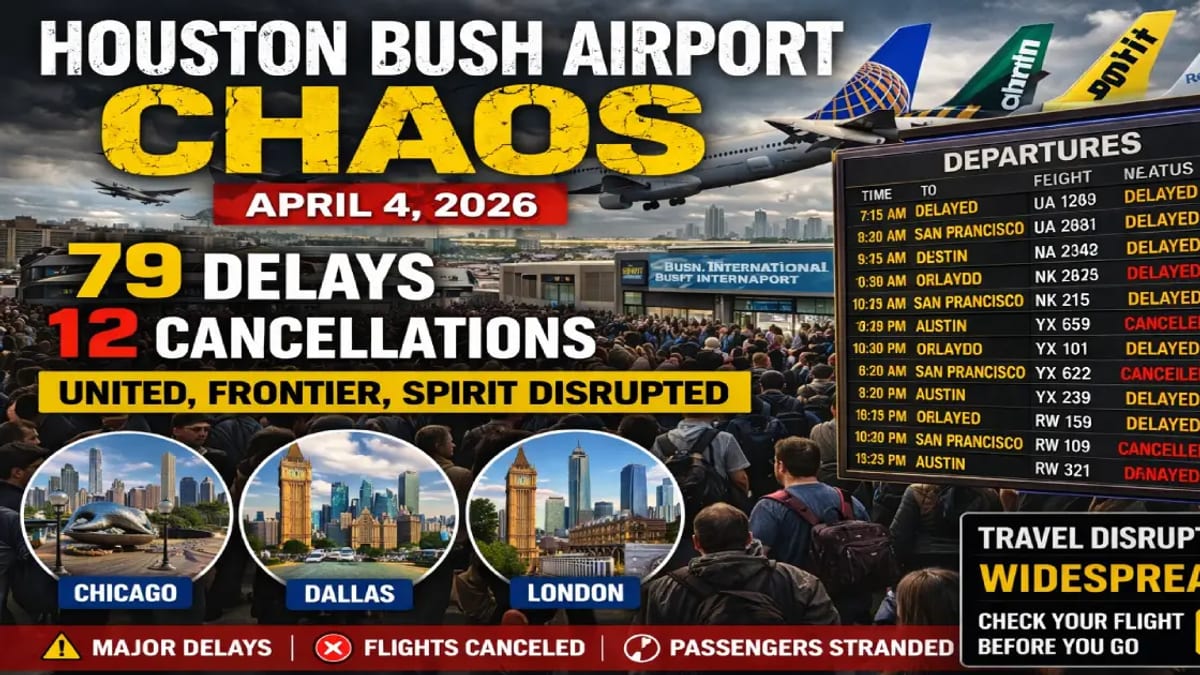
Travelers passing through Houston’s George Bush Intercontinental Airport on April 4 faced a difficult start to the weekend as a mix of stormy weather, ongoing construction and security bottlenecks contributed to at least 132 flight delays and 16 cancellations across the schedule.
Get the latest news straight to your inbox!
Stormy Skies and a Crowded Spring Travel Day
The disruption at Bush Intercontinental unfolded on one of the busier Saturdays of the spring travel period, with thunderstorms sweeping across the Houston area and complicating traffic in and out of the hub. Publicly available tracking data for April 4 shows a spike in delayed departures and arrivals throughout the afternoon and evening, with airlines slowing operations as cells moved through the region and visibility deteriorated.
Weather related slowdowns at major Texas hubs are not unusual in early April, but the timing of storms over Houston intersected with already heavy weekend demand. Airlines adjusted flight sequences, stretching turn times on arriving aircraft and leaving passengers waiting at gates while ground crews navigated lightning holds and wet ramp conditions. Affected routes included both short-haul domestic services within Texas and the Gulf Coast and longer transcontinental and international flights.
Operational data aggregating Saturday’s performance at Bush Intercontinental indicates that the weather impact was significant but uneven. Many flights still operated close to schedule, yet the combination of even modest delays on multiple banks of departures created a visible backlog during peak afternoon hours.
Security Lines Under Strain After Weeks of National Scrutiny
The flight disruptions came against a backdrop of extended security wait times that have put Houston’s main airport under an unusual national spotlight in recent weeks. Coverage from major outlets has highlighted Bush Intercontinental among airports experiencing some of the longest lines in the country as the Transportation Security Administration works through staffing shortages following federal budget turmoil.
Reports from earlier in the week described waits that could stretch past three hours during peak periods, prompting travelers to arrive far earlier than normal for flights. That pattern appeared to continue into April, creating a feedback loop in which passengers arriving excessively early filled checkpoints long before their scheduled departure times. On April 4, that dynamic added to the sense of crowding across several terminals even when real-time metrics at times showed improving throughput.
Security staffing has reportedly stabilized somewhat since the worst days of the government funding uncertainty, and national data shows marginally better callout rates among screening officers. Even so, Houston remains in the group of airports where the margin between smooth and severely congested lines is thin, particularly when weather or schedule disruptions push many passengers into the same narrow windows at the checkpoints.
Construction and Infrastructure Limits Reduce Flexibility
Another factor shaping Saturday’s experience was the longer running construction program at Bush Intercontinental. Federal aviation documents outlining construction impacts for 2026 describe continuing airfield and terminal area projects at the airport, with reduced capacity and increased susceptibility to delay flagged as ongoing risks during the multi-year works.
Taxiway closures and periodic adjustments to ramp and gate access reduce the flexibility airlines and controllers typically rely on to absorb irregular operations. When weather triggers even brief pauses in arrivals or departures, a constrained airfield can take longer to unwind the resulting queues. On April 4, this meant some aircraft spent extended time waiting for gate availability after landing, while others held on the ground awaiting departure slots as traffic flows were metered.
Outside the secure area, roadway and curbside construction around the terminals has also been noted in recent advisories as a contributor to congestion. Travelers heading to the airport on Saturday encountered pockets of slow traffic on approach roads and at drop off zones, adding another layer of stress for those attempting to arrive early enough to navigate security and potential schedule changes.
Impact on Passengers and Airlines at the Houston Hub
The 132 delays and 16 cancellations recorded for April 4 translated into significant disruption for passengers connecting through one of the country’s key domestic and international gateways. Even relatively short delays can cause missed connections in a tightly timed hub structure, and travelers on multi segment itineraries through Houston were particularly exposed as afternoon and evening banks of flights began to stack up.
Major carriers that use Bush Intercontinental as a hub adjusted by rebooking travelers onto later services, rerouting some connections through alternate airports and, in a number of cases, issuing flexible travel policies tied to the day’s storm activity in the Houston region. Social media posts and travel community discussions on Saturday highlighted a mix of long waits at customer service counters, gate holds while aircraft awaited new departure times and searches for scarce same day alternative routings.
For the airlines, the operational impact extended beyond Houston itself. Late arriving aircraft from Bush Intercontinental created ripple effects at downline airports, contributing to additional delays on flights that had otherwise not been directly affected by the Texas weather or Houston security crowding. This knock on impact is typical when a large hub encounters a disruptive mix of constraints, and data from previous seasons suggests that such days can take several schedule cycles to fully unwind.
What Travelers Can Expect in the Coming Days
Analyses of historical performance and current construction forecasts suggest that Bush Intercontinental will remain vulnerable to elevated delay levels through the remainder of the spring and into the busy summer period. Federal reports on airport capacity note that construction affecting runways, taxiways and terminal areas is scheduled to continue into 2027, advising that reduced flexibility and heightened delay risk are likely at times during the project.
At the same time, security screening operations at Houston’s airports are under continued scrutiny following widely reported crowding in March. Travel coverage indicates that staffing levels have begun to improve and that the agency responsible for screening is gradually rebuilding normal operations after budget related disruptions, but travel experts still recommend additional buffer time at airports that have recently recorded very long lines.
For passengers planning to travel through Bush Intercontinental in the days ahead, Saturday’s pattern serves as a reminder that several interacting factors can converge quickly. Spring thunderstorms, a heavy weekend schedule, residual security pressures and continuing construction all contributed to the 132 delays and 16 cancellations that defined April 4. While not every travel day will see that level of disruption, publicly available data and recent reporting suggest that Houston’s primary international airport will remain an important focus for travelers watching for developing bottlenecks across the national air system.