

More news on this day
Hundreds of passengers at Houston’s George Bush Intercontinental Airport faced a day of disrupted plans today as publicly available tracking data showed 138 flight delays and 3 cancellations, affecting operations across United Airlines, American Airlines, Delta Air Lines and several smaller carriers.
Get the latest news straight to your inbox!
Widespread Schedule Disruptions Across Major Carriers
Real time flight tracking platforms for March 28, 2026 indicate that George Bush Intercontinental Airport experienced significantly above average disruption, with 138 flights running late and 3 services canceled outright. The irregular operations affected both departures and arrivals, rippling through the networks of the airport’s primary hub carrier United Airlines as well as American Airlines, Delta Air Lines and a range of regional and international operators.
The pattern of disruption appeared concentrated in the morning and early afternoon peak, when banks of connecting flights typically move through Houston. Delayed inbound aircraft created knock-on effects for outbound services, lengthening connection times and forcing some passengers to miss onward flights. While cancellations remained limited, the cumulative impact of so many delayed services led to crowded gate areas and rebooking queues in several terminals.
United Airlines, which designates Bush Intercontinental as one of its largest hubs, bore a substantial share of the delays simply due to its scale of operations at the airport. Publicly available information on airline schedules shows United operating hundreds of daily movements through Houston, meaning even modest disruptions can quickly translate into large numbers of affected passengers. American and Delta, while operating smaller schedules at IAH, also saw a noticeable portion of their flights running behind schedule.
Regional partners and international airlines were not immune. Feeder services that connect smaller Texas and Gulf Coast cities into Houston reported late arrivals and departures, while several long haul flights waited for connecting passengers and aircraft servicing, adding further minutes and sometimes hours to their planned gate times.
Federal Staffing Strains and Weather Add to Operational Pressure
The disruption at Bush Intercontinental comes as the broader U.S. aviation system continues to manage the knock-on effects of recent federal government funding uncertainty. According to published coverage on the ongoing budget negotiations in Washington, agencies involved in aviation oversight and security screening have faced weeks of uncertainty around staffing and overtime, contributing to localized bottlenecks at some major hubs.
In Houston, travelers this week have already reported extended security lines and variable wait times at Transportation Security Administration checkpoints. A widely shared online megathread tracking conditions at IAH described early morning queues stretching into terminal connectors on some days, although more recent posts for March 28 highlighted somewhat improved throughput, with many passengers clearing security in under 90 minutes.
Weather has also played a supporting role. Seasonal spring systems over Texas and the broader Gulf Coast region brought bouts of low clouds and scattered showers through the week, occasionally reducing visibility and slowing airport operations. While conditions on March 28 were not characterized by a single severe storm event, intermittent convection and low ceilings prompted conservative spacing between aircraft on approach and departure at various points in the day, according to publicly accessible meteorological data and aviation bulletins.
Combined, these factors created an environment where even minor operational hiccups could escalate, particularly during the busiest traffic waves. Airlines appeared to prioritize maintaining core connectivity while absorbing delays into less time sensitive services, a strategy that limited outright cancellations but left many flights running well behind schedule.
Impact on Connecting Passengers and Downline Networks
As a major connecting hub for both domestic and international itineraries, Bush Intercontinental’s day of disruption resonated far beyond Houston itself. Passengers traveling between smaller regional airports and large coastal cities often route through IAH, and delays on these feeder legs prompted missed connections and last minute rebookings across multiple carriers.
Online posts from travelers over the past several days have described tight transfer windows, sprinting between terminals and, in some cases, overnight stays when onward flights could not be accommodated. With today’s delays stacked onto an already strained system, many customers found that same day alternatives were limited, particularly on heavily booked routes at the start of a busy spring travel weekend.
The operational stress in Houston also rippled out through airline networks. Aircraft and crews arriving late into IAH departed late for their next destinations, carrying the disruption forward to cities across the United States. Publicly available industry data on delay propagation shows that large hubs like Houston often function as amplifiers: once schedules fall behind, it can take many hours and multiple flight cycles to fully recover.
Airlines have attempted to mitigate these issues by offering flexible rebooking policies. United Airlines, for instance, has issued a series of Houston specific travel waivers in recent days, allowing eligible customers to change their itineraries without standard change fees for travel dates spanning late March. Similar, though sometimes more limited, options have been noted on other carriers serving the airport.
Traveler Experience Inside the Terminals
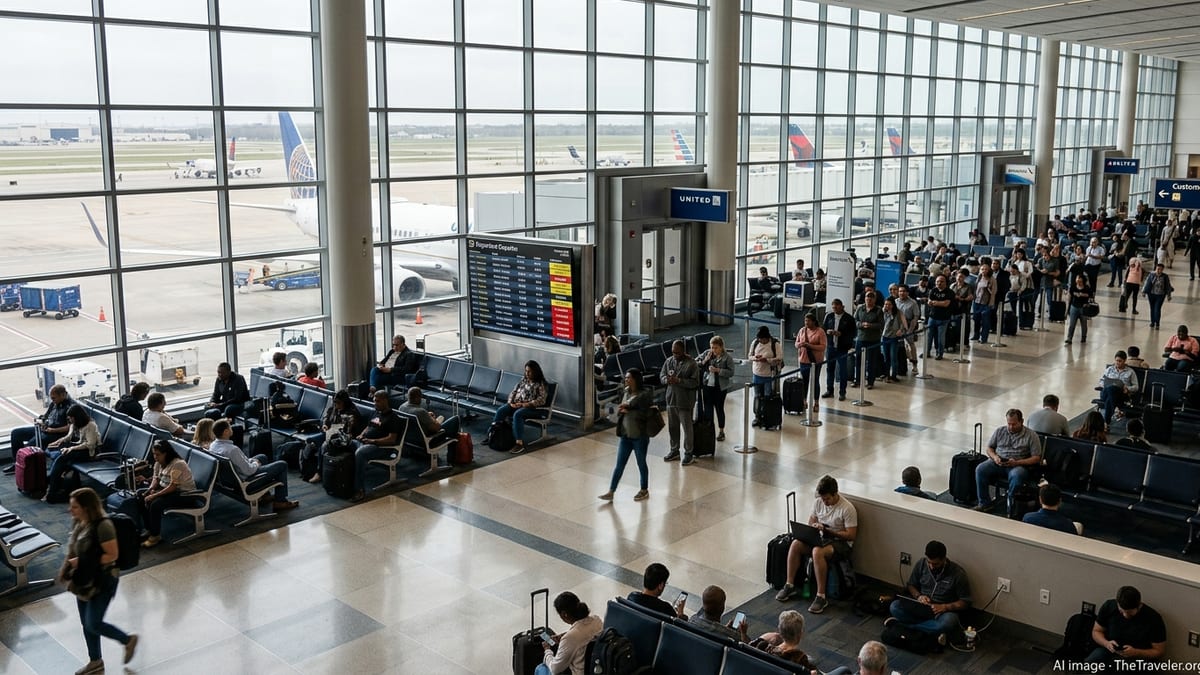
Inside the terminals, the day’s irregular operations translated into crowded but generally orderly conditions. Posts to local community forums described lines at ticket counters and customer service desks as passengers sought new routings after missed connections or significantly delayed departures. Gate areas filled with travelers waiting for updated departure times, many monitoring airline apps and airport information screens for the latest estimates.
Despite the challenges, some travelers reported that security wait times on the morning of March 28 were shorter than earlier in the week, with several accounts citing approximately one hour from joining the line to clearing the checkpoint in Terminal A. Other terminals, including the international-focused Terminal E, were described at points as relatively calm, with little or no queue at security during late morning hours.
Concessions and seating areas experienced the usual knock-on effects of extended dwell times. Cafes and quick service restaurants saw steady business as travelers waited out delays, while available power outlets near gates quickly filled with passengers charging devices and working remotely. Airport staff and airline ground teams appeared to focus on keeping information flowing through public address announcements and updated display boards, an important factor in maintaining a manageable atmosphere during prolonged disruption.
While the day presented frustrations for many, travelers familiar with Houston’s hub operations noted that the airport has experienced more severe disruption during past extreme weather events. In those cases, extensive flooding or thunderstorms have led to widespread ground stops and far higher numbers of cancellations than those recorded today.
What Passengers Can Expect Next
Looking ahead to the remainder of the weekend, publicly available scheduling and forecast data suggest that airlines at Bush Intercontinental will continue working to absorb the backlog of delayed aircraft and reposition crews. If weather conditions remain generally stable, operations could gradually normalize over the next several scheduling banks, though individual flights may still experience residual delays.
Travel industry guidance recommends that passengers scheduled to travel through Houston in the coming 24 to 48 hours monitor their flight status closely via airline websites or mobile apps, as departure times may shift with relatively short notice. Those with tight connections at IAH may wish to consider earlier departures or alternative routings where possible, particularly on busy domestic corridors and popular international links.
Published consumer travel advice also emphasizes the importance of understanding each carrier’s disruption policies. Many airlines provide meal vouchers or hotel accommodations in specific circumstances, especially when delays or cancellations fall under the airline’s control rather than being solely due to weather or air traffic constraints. With today’s disruptions involving a mix of operational and external factors, eligibility can vary by route and ticket type.
For now, the combination of 138 delayed flights and 3 cancellations at George Bush Intercontinental Airport serves as a tangible reminder of how quickly conditions can shift in a complex hub environment. Even on a day without headline-grabbing storms or prolonged ground stops, incremental pressures on staffing, weather and airspace can converge to reshape travel plans for hundreds of passengers in a matter of hours.