

More news on this day
Spring break travel through Houston’s William P. Hobby Airport has descended into a grinding security bottleneck this week, with some passengers facing up to five hours in Transportation Security Administration lines as a federal funding standoff cripples staffing at checkpoints.
Government Shutdown Collides With Spring Break Rush
Hobby Airport, Houston’s smaller but busy domestic hub, has become a national flashpoint for the impact of the partial Department of Homeland Security shutdown on air travel. Over the weekend and into Monday, estimated wait times at the standard TSA checkpoint repeatedly exceeded three hours, with airport officials at points urging travelers to arrive four to five hours before departure to avoid missing flights.
The spring break surge has magnified the strain. Houston Airports, which oversees both Hobby and George Bush Intercontinental, expects roughly 2.2 million passengers to pass through its terminals during the 2026 spring break period, a modest year-over-year increase but one now colliding with reduced federal staffing. While Bush Intercontinental has seen elevated but manageable waits, Hobby’s more limited checkpoint capacity and heavy early morning schedules have turned it into the epicenter of the disruption.
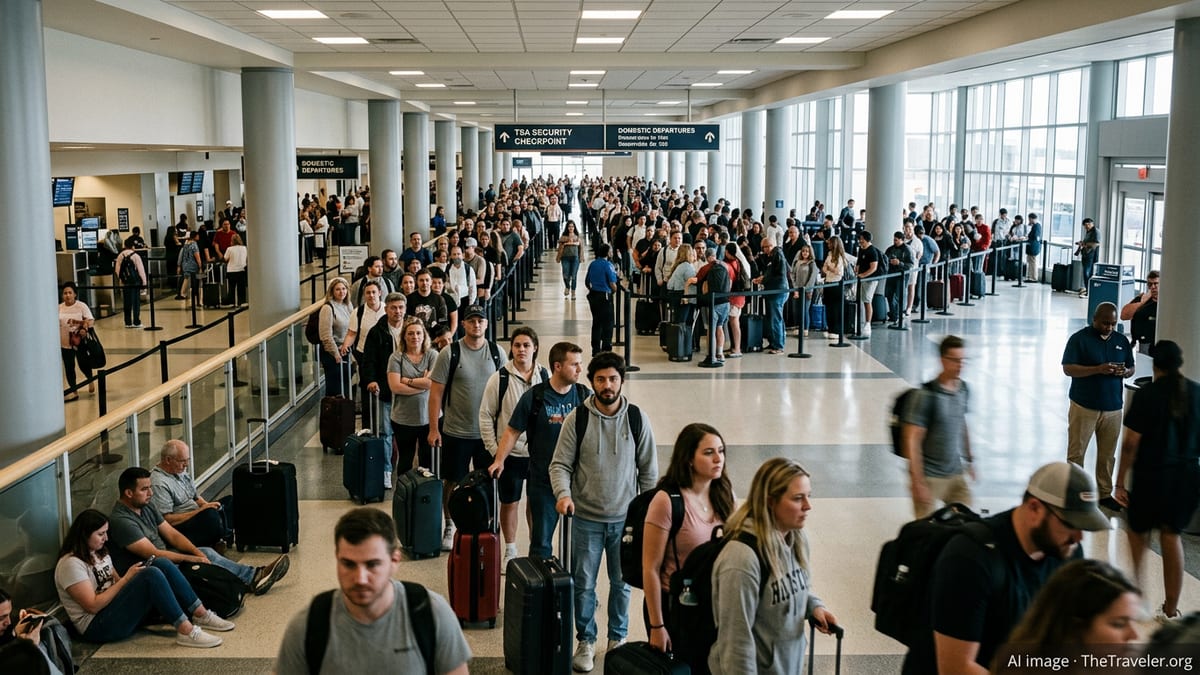
Airport social media updates over the past several days charted a steady escalation from routine “arrive early” reminders to increasingly urgent pleas for travelers to budget the better part of a day just to clear security. By Sunday evening, posts referenced three to five hour lines, and images circulating in local media showed passengers snaking out of the terminal and into the parking garage.
Federal officials say the problems at Hobby are a preview of what could appear elsewhere if the shutdown persists into the heart of the spring travel season, particularly at medium-size airports with fewer lanes and limited flexibility to reassign staff.
TSA Staffing Shortages Trigger Lane Closures
At the core of the crisis are staffing shortages among TSA officers, who are reporting for duty without pay while the shutdown drags on. Union representatives and agency officials alike describe a volatile day-to-day picture at Hobby, where the number of open lanes can change from shift to shift depending on how many officers call out or are forced to juggle second jobs to cover basic expenses.
With fewer officers available, Hobby has at times been forced to operate with only a portion of its security lanes open, even during peak departure banks. Travelers reported that on some mornings only four lanes were screening hundreds of passengers queued through the ticketing hall and beyond, with TSA PreCheck lanes either closed entirely or opening sporadically depending on staffing. That has led to long lines even for travelers who paid for expedited programs, and in some cases, missed flights despite arriving more than two hours before departure.
Jim Szczesniak, Houston’s director of aviation, has praised TSA officers who have volunteered for extra shifts to keep additional lanes functioning, but acknowledged that the shutdown is imposing severe constraints on operations. Houston Airports has warned publicly that security performance will remain inconsistent as long as checkpoint staffing is subject to last-minute gaps, emphasizing that conditions can swing from tolerable to extreme within the span of a few hours.
Industry analysts note that TSA has struggled with recruitment and retention at busy Sun Belt airports even in normal times, as a tight labor market and relatively low starting pay complicate efforts to keep checkpoints fully staffed. The current shutdown, which deprives officers of full paychecks while demanding overtime-style efforts to handle surging traffic, has pushed that fragile equilibrium to a breaking point at Hobby.
Passengers Describe ‘Organized Chaos’ in the Terminal
For travelers, the operational challenges have translated into a stressful and in some cases chaotic experience. Families heading home from spring break vacations reported arriving three hours before early morning flights only to spend that entire window inching forward in security lines, then watching departure times tick past while they remained landside.
Some passengers described “organized chaos” as airport staff tried to separate travelers by departure time, calling out boarding groups and hustling those at risk of missing flights into ad hoc fast-track lanes where space allowed. Others said they had to abandon checked-bag counters or food lines to rejoin security queues that showed little sign of easing, choosing between eating, rebooking or risking a missed flight.
Images shared by travelers showed serpentine queues wrapping around the ticketing area, down escalators and through the parking structure, as stunned passengers compared notes about departure times and airline rebooking policies. A few described turning back entirely, canceling or pushing flights to later in the week after being told that the wait to clear TSA screening would stretch for most of the morning.
While some travelers expressed sympathy for unpaid TSA workers, there was rising frustration at what many characterized as a predictable collision between a known shutdown deadline and peak spring break schedules. Several questioned why additional federal resources were not shifted to Hobby proactively once it became clear that the airport was experiencing some of the nation’s longest delays.
Houston Officials Urge Extreme Early Arrivals
Local authorities are now issuing some of the strongest travel advisories in the country. Houston Airports has urged Hobby passengers to arrive at least four hours before domestic departures during the peak spring break window, with even longer buffers recommended for those checking bags or traveling with large groups.
Airport officials also advise travelers to monitor security wait times through official channels on the morning of travel and to build in extra time for parking and shuttle transfers, which have become clogged as more passengers arrive in the predawn hours. Airlines serving Hobby, including major domestic carriers and low-cost operators, are sending push alerts reminding customers of the extraordinary conditions and encouraging them to use mobile boarding passes and carry-on bags when possible.
Houston’s convention and tourism sectors are closely watching the situation, wary that images of hours-long lines could undercut marketing campaigns that promote the city as an easy, convenient gateway for Gulf Coast vacations and Texas events like the Houston Livestock Show and Rodeo. Travel industry observers say the optics of a major leisure hub struggling to move passengers through security could linger long after the shutdown is resolved.
For now, city officials maintain that the most effective mitigation step remains traveler behavior: arriving early, traveling light and staying informed about real-time wait times. Behind the scenes, they continue to press federal leaders for an end to the funding impasse that has left frontline security workers in limbo at one of the region’s most important transportation nodes.
Uncertain Outlook as Shutdown Drags On
The outlook for relief at Hobby is murky. While some weekday periods have seen wait times temporarily ease to under an hour, transportation analysts warn that such lulls can be misleading in the context of an ongoing shutdown, where a single shift with high call-outs can return the airport to multi-hour backlogs overnight.
If the federal funding stalemate extends deeper into March, officials fear that burnout and financial strain among TSA officers will intensify, potentially triggering further absenteeism and forcing additional lane closures. That, in turn, could strand more spring break travelers and complicate operations for airlines already juggling tight schedules and high load factors.
Nationally, aviation groups and labor unions are amplifying their calls for Congress and the White House to restore funding for the Department of Homeland Security, warning that the situation at Hobby and other affected airports is eroding public confidence in the reliability of the air travel system. They argue that the combination of unpaid security staff and record passenger volumes is unsustainable at the height of one of the busiest leisure travel periods of the year.
For passengers with upcoming trips through Houston, the advice from both airport officials and travel experts is blunt: do not rely on pre-pandemic rules of thumb, and assume the worst when planning how early to arrive at Hobby. Until the shutdown ends and TSA staffing stabilizes, the possibility of five-hour lines will remain an unwelcome part of the spring break calculus.