

More news on this day
From the Gulf deserts to the Alpine foothills and the Danube plain, three major rail projects coming to fruition by 2026 are shrinking maps, redrawing regional connections and promising to make cross-border rail travel a faster, more realistic alternative to short-haul flights.
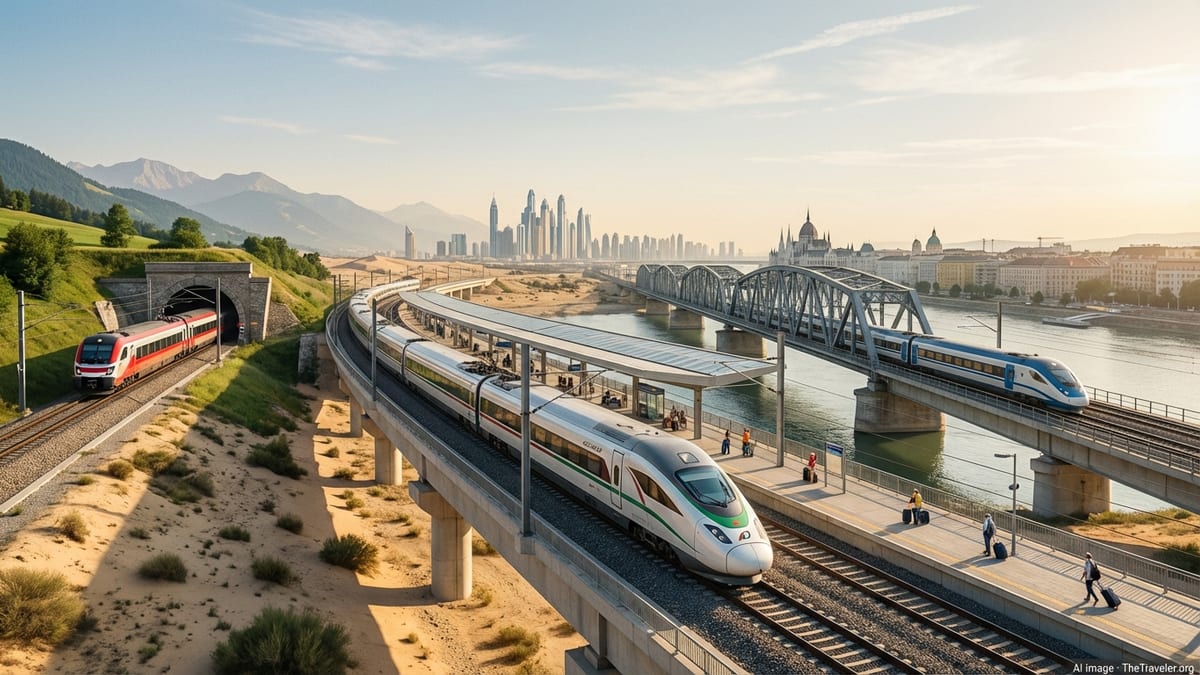
A New Generation of Rail Corridors Comes Online
In 2026, three headline projects on different continents are converging into what transport planners are calling a step change for medium-distance rail. In the United Arab Emirates, Etihad Rail is preparing to launch its first national passenger network, knitting together cities that have long relied on highways and air travel. In southern Austria, the newly opened Koralmbahn has begun carving hours off journeys across the Alps. And in Central and Southeast Europe, the Budapest–Belgrade high-speed corridor is entering its final stretch, with completion targeted in 2026.
Individually, each line answers a long-standing mobility challenge: congestion and sustainability in the Gulf, mountainous geography in Austria, and outdated infrastructure on a vital north–south axis in the Balkans. Taken together, they illustrate how rail is re-emerging as a strategic tool for governments that want to pull regions closer while cutting carbon and reducing the need for short-haul flights.
What binds these projects is a common ambition: to crush travel times that once made rail a second-best choice. The Koralmbahn has cut the journey between Graz and Klagenfurt from up to three hours to around 41 minutes. The future Budapest–Belgrade timetable aims for under three hours across 350 kilometers. And in the Emirates, Etihad Rail is promising under an hour between Abu Dhabi and Dubai and under two hours from the capital to Fujairah, distances that today largely belong to motorways.
Beyond speed, these corridors are designed as building blocks of broader networks. Austria’s Koralmbahn slots into a north–south spine linking Poland to Italian ports. The Budapest–Belgrade line is a flagship of the Belt and Road route from Greece’s Piraeus port into Central Europe. Etihad Rail forms the backbone of a planned Gulf rail system that could eventually allow passengers to board in Muscat or Riyadh and step off in Abu Dhabi or Dubai without taking to the air.
Etihad Rail: Stitching the Emirates and the Gulf Together
In the UAE, Etihad Rail is on the cusp of transforming how residents move between the country’s fast-growing cities. Freight services have been running since 2023 across a 900-kilometer network linking key industrial hubs, ports and logistics zones. Now the focus is shifting to passengers, with phased services due to start in 2026 and connect Abu Dhabi, Dubai and Fujairah before rolling out to all seven emirates.
The passenger network has been designed from the outset with speed and frequency in mind. Trains are expected to operate at up to 200 kilometers per hour, with modern rolling stock configured in three classes and capacity of around 400 passengers per train. Projected journey times highlight the scale of the shift: 57 minutes between Abu Dhabi and Dubai and around 1 hour 45 minutes between Abu Dhabi and Fujairah, significantly undercutting typical driving times on busy highways.
Equally important is integration with existing urban transport. Planned stations in Abu Dhabi and Dubai are being coordinated with metro, tram and bus networks, alongside park-and-ride facilities and a digital-first ticketing system that is expected to work seamlessly with local smart cards. For a country where daily life has been built around the car, the goal is not just to provide an alternative but to make rail the most convenient option for many intercity trips.
Strategically, Etihad Rail is more than a domestic project. The completed network runs to Al Sila near the Saudi border and towards Fujairah on the Gulf of Oman, positioning the UAE as a central node in the long-envisioned Gulf Cooperation Council railway. Future links to Oman and Saudi Arabia, which regional officials continue to promote, would turn Etihad Rail into a bridge between Gulf ports and hinterlands, multiplying the impact of faster passenger services at home.
Koralmbahn: A Once-in-a-Century Alpine Shortcut
While the Emirates build their first national passenger railway, Austria has just completed one of the most ambitious rail engineering projects in Europe. The Koralmbahn, a 127-kilometer double-track high-speed line between Graz and Klagenfurt, opened to full passenger service in mid-December 2025 after more than a quarter-century of planning and construction.
At the heart of the project lies the Koralm Tunnel, a 32.9-kilometer twin-bore base tunnel bored deep beneath the Koralpe mountains. Together with additional tunnels and more than 100 bridges, it allows trains to run at up to 250 kilometers per hour through what was once some of the most time-consuming rail terrain in the country. Long-distance services between the two provincial capitals now take around 41 minutes, compared with up to three hours on the winding historic route or roughly two hours by bus.
Koralmbahn is not a stand-alone shortcut but a critical link in a broader upgrade of Austria’s southern axis. It slots into the modernized Südbahn corridor that connects Vienna with Graz, Klagenfurt and onward to Villach, Italy and Slovenia, and will work in tandem with the Semmering Base Tunnel due later this decade. The result is a much straighter, faster line from Central Europe to the Adriatic that serves commuters, tourists and freight alike.
The benefits are expected to be wide-ranging: easing pressure on Alpine roads, shifting passengers and freight to rail, and strengthening regional labor markets by making daily cross-regional commuting realistic for the first time. Austrian officials have touted the project as a milestone for climate policy as well as connectivity, pointing out that faster and more comfortable trains are essential if people are to switch from cars and short flights to rail.
Budapest–Belgrade: High-Speed Rail in the Heart of Europe
Further east, the Budapest–Belgrade railway is edging toward its own 2026 milestone. The 350-kilometer line, a joint project of Hungary and Serbia backed by Chinese finance and contractors, is being rebuilt and upgraded to allow passenger trains to run at up to 200 kilometers per hour. Once complete, officials say the journey between the two capitals will fall to around 2 hours 40 minutes, about half today’s typical timing.
The southern section of the corridor, from Belgrade to Subotica near the Hungarian border, has already entered service, bringing faster trains to northern Serbia. Attention is now focused on completing works and systems integration along the remainder of the route, including European Train Control System signaling being installed by Chinese firms. Recent statements from officials in both countries have reaffirmed 2026 as the target for full corridor completion, even as some station works and regulatory approvals continue into 2025.
The line carries significance that goes well beyond the Hungarian and Serbian capitals. It is the flagship link in a longer chain that is intended to reach south to Skopje and Athens, providing a direct rail artery from Central Europe to Greece’s major ports. Those ports, and especially Piraeus, have been developed with strong Chinese participation as entry points for Asian goods into Europe, making the Budapest–Belgrade corridor a physical expression of broader geopolitical and commercial shifts.
For passengers, the attraction will be more straightforward: shorter journeys, modern rolling stock and a smoother cross-border experience on a route that has long suffered from slow trains and ageing infrastructure. For the wider rail sector, the project is a test case of how non-European suppliers can integrate with the continent’s regulatory framework, signaling standards and public sensitivities over transparency and debt.
Crushing Travel Times and Mental Borders
Beyond their technical specifications, these three projects share a subtler ambition: to shrink not only journey times but also the psychological distance between regions. When Graz and Klagenfurt are less than three quarters of an hour apart, or when Abu Dhabi and Dubai are under an hour by train, the way people think about where they can live, work or study begins to change.
In Austria, planners anticipate that the Koralmbahn will gradually create a single, integrated labor market across two provinces that previously felt separated by mountains and slow routes. Universities, hospitals and cultural institutions in both cities expect to draw from a wider catchment area as travel becomes more predictable and less tiring. Regional tourism bodies are already marketing joint itineraries that treat Styria and Carinthia as one extended destination stitched together by fast, frequent rail.
In the UAE, Etihad Rail aims to loosen the grip of the car on daily life. Faster, comfortable trains between major cities could encourage commuters to live further from their workplaces, redistribute visitor flows beyond the most famous hubs and make weekend getaways to less-visited regions more attractive. The railway’s designers have emphasized user experience at stations, hoping that a seamless door-to-door journey will tip the balance away from driving for many residents and visitors.
On the Budapest–Belgrade axis, the reduction in journey time is expected to give practical weight to longstanding political talk of closer ties between Central and Southeast Europe. Cutting hours from rail travel encourages more spontaneous cross-border trips, whether for business, leisure or family visits, and helps bring what can feel like distant neighbors back within a comfortable day’s travel.
Climate, Capacity and the Push to Shift from Air to Rail
The 2026 rail wave also aligns closely with climate and capacity debates that are reshaping transport policy. Aviation remains a major and growing source of emissions, while many highway corridors are struggling with congestion and accidents. Against that backdrop, fast intercity rail has become a centerpiece of strategies to decarbonize travel without constraining mobility.
In Europe, the opening of the Koralmbahn fits into a broader EU objective of making rail a viable alternative to short- and medium-haul flights. Brussels has set ambitions to expand high-speed networks and is working on policies to simplify cross-border ticketing and improve the performance of routes connecting major cities. National investments in projects like the Koralmbahn, coupled with international schemes such as Budapest–Belgrade, are seen as crucial building blocks in that plan.
The Gulf is pursuing a parallel logic from a different starting point. The UAE has invested heavily in airports and highways, but is now seeking to reduce road congestion, improve safety and cut emissions by shifting a share of freight and passenger movement onto rail. Etihad Rail forecasts a significant reduction in carbon dioxide emissions once both freight and passenger services are fully ramped up, complementing the country’s wider clean energy and climate goals.
Capacity is another driver. High-speed and higher-speed rail lines free up space on existing tracks for regional and freight services, or in the case of the UAE, re-balance the transport network away from overburdened highways. By carving new, faster corridors, these projects allow older lines and roads to focus more on local and regional needs, rather than long-distance flows that could travel more efficiently by rail.
Cross-Border Hurdles: Standards, Systems and Sovereignty
If the vision is one of seamless cross-border movement, the reality on the ground remains complicated. Even as new lines open, operators must contend with differing national standards, regulatory regimes and commercial interests. The Budapest–Belgrade project stands at the center of many of these debates.
One major question is interoperability. The corridor is being equipped with European Train Control System signaling to meet EU requirements, yet much of the installation work is being carried out by Chinese companies more accustomed to their domestic standards. Ensuring that systems integrate smoothly with European rolling stock fleets and safety regulations requires extensive testing, documentation and oversight.
Transparency and financing have also been contentious, particularly on the Hungarian side of the Budapest–Belgrade project, where aspects of the economic analysis have been shielded from public view. Critics argue that such opacity makes it harder to assess long-term value for money and to compare the line against alternative investments, especially at a time when EU institutions are urging member states to carefully prioritize infrastructure spending.
Even in Austria, where the Koralmbahn has been widely celebrated, integration into Europe’s broader high-speed network depends on the timely completion of other cross-border projects and on sustained political will to improve international timetables and ticketing. And while the UAE’s Etihad Rail primarily runs within national borders, its eventual role in a Gulf-wide system will demand delicate coordination among neighbors with differing regulatory frameworks and economic priorities.
Redrawing the Global Rail Map Beyond 2026
The coming two years mark an inflection point rather than an endpoint. By late 2026, if current timelines hold, passengers will be traveling on a fully operational Koralmbahn, on a completed Budapest–Belgrade high-speed line and on the first phases of Etihad Rail’s national passenger network. Each line will then face the test that truly matters: how many people choose the train over the car or the plane.
Early indicators will be watched closely by governments and operators contemplating their own high-speed or higher-speed investments. Strong uptake on these routes would bolster arguments that well-designed rail can compete effectively with air on journeys of a few hundred kilometers, especially when combined with attractive pricing and simple booking across borders.
There will also be lessons about the softer elements of rail revolutions. The Koralmbahn’s success will depend not only on its remarkable engineering but also on reliable operations and good connections beyond its endpoints. Etihad Rail will need to convince first-time rail users that the experience is comfortable, intuitive and worth shifting their habits. In Central Europe and the Balkans, Budapest–Belgrade must navigate the politics of external investment while demonstrating tangible benefits to everyday travelers.
For now, what is clear is that the global rail map of 2026 will look very different from that of just a decade earlier. Tunnels under Alpine ridges, high-speed lines racing across the Pannonian plain and sleek trains cutting through the Emirati desert are turning once-abstract plans into lived reality. As they do, they are steadily eroding both physical and mental borders, one fast journey at a time.