

More news on this day
Premium economy is emerging as the most important battleground in U.S. aviation, as Delta Air Lines, American Airlines, United Airlines and JetBlue Airways move aggressively in 2026 to capture travelers willing to pay for more comfort without the price tag of business class. From new cabins and larger seat counts to domestic first-style products and evolving loyalty perks, the middle of the plane is where the industry’s next big shift is unfolding.
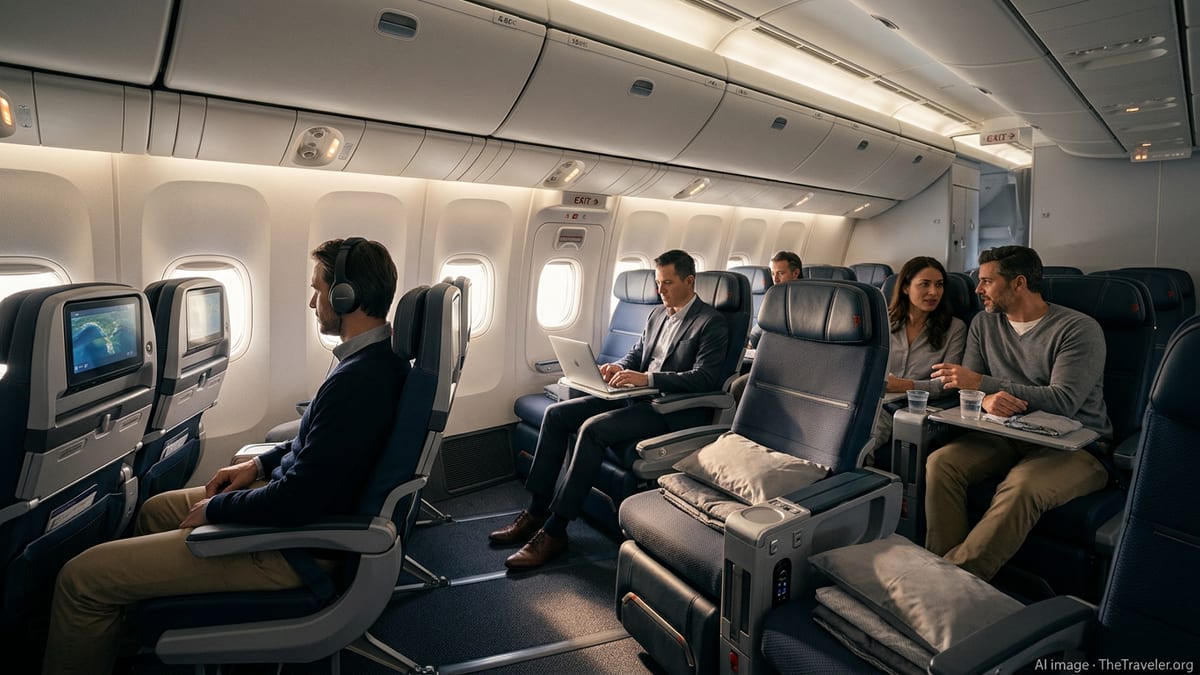
Why Premium Economy Is Becoming the New Front Line
For years, airlines focused their fiercest competition on lie-flat business class and rock-bottom basic economy. In 2026, the strategic spotlight has shifted to the middle. Premium economy cabins, with wider seats, extra legroom and enhanced service, are proving to be one of the most profitable parts of the aircraft, appealing to leisure travelers trading up and corporate buyers seeking savings against business class.
Analysts say this “comfort without luxury” segment is now central to revenue planning at Delta, American and United, which all offer true premium economy cabins on long-haul jets and are adding more seats on new deliveries. JetBlue, historically known for generous standard economy and its Mint business cabin, is pushing into this space with a more layered premium strategy that includes new products debuting in 2026.
The timing is no accident. Demand for international travel remains strong, but corporate travel budgets are under pressure. That combination makes premium economy the sweet spot for companies looking to downgrade from business while still keeping staff productive and rested, and for families willing to pay extra on long flights without leaping to the front of the plane.
At the same time, basic economy fares are losing perks and earning power, especially at American, nudging price-sensitive but perk-conscious flyers toward higher fare classes and, in many cases, premium economy upsells. The result is a deliberate reshaping of the cabin pyramid that could make today’s “middle” seat experience the standard aspirational choice for many travelers.
United Upsizes Premium Plus for Long-Haul Growth
United Airlines has been one of the most aggressive U.S. carriers in scaling up premium cabins, and that strategy is now being baked into its fleet plan. New Boeing 787-9 Dreamliners arriving from late 2025 and rolling into service through 2026 feature the airline’s refreshed “Elevated” interior, with a larger concentration of premium seats and an upgraded Premium Plus cabin that adds privacy features and modern amenities.
United executives have emphasized that these widebodies will carry one of the highest ratios of premium seating among U.S. airlines, reflecting strong demand for both Polaris business and Premium Plus. The latter is gaining popularity on long routes such as San Francisco to Singapore and London, where the renewed cabin is scheduled to appear on early 2026 flights, showcasing larger seatback screens, power at every seat and more defined separation from standard economy.
The airline is also expanding the footprint of Premium Plus on selected long-haul and leisure-heavy routes with larger dedicated cabins and more seats per flight. That upsizing gives United additional flexibility: sell more seats directly to travelers paying cash or miles for premium economy, while preserving space to clear upgrades from lower cabins using its PlusPoints system.
United’s bet is that by making Premium Plus both more available and more clearly differentiated, it can pull travelers away from competitors’ economy products and from Delta’s and American’s premium offerings. If that gambit pays off, the middle of United’s aircraft could become one of its most important profit engines in the next few years.
American Deepens Its Flagship Premium Economy Strategy
American Airlines, an early mover in offering a separate premium economy cabin on its long-haul fleet, is quietly turning the product into a core pillar of its 2026 network. The airline has expanded premium economy to dozens of international routes, including more transatlantic and high-yield transcontinental services, and now fields a sizeable dedicated cabin on many Boeing 787 and Boeing 777 aircraft.
The seats themselves are designed to be a clear cut above the main cabin, with extra width, increased pitch in the 38-inch range on key aircraft types, larger screens and enhanced dining compared with standard economy. American’s focus for 2026 is less about reinventing the seat and more about getting premium economy onto the right markets at the right density, particularly where corporate contracts can be steered away from higher-cost business class.
At the same time, American is tightening the value proposition of its lowest economy fares. Recent changes mean many basic economy tickets no longer earn AAdvantage miles or Loyalty Points, a shift that reduces the appeal of the cheapest seats just as the carrier promotes paid and mileage upgrades into premium cabins. For elite members, upgrade rules on flights that feature premium economy are continually being refined, with more tiers of potential movement up the cabin ladder.
The combined effect is to subtly guide frequent flyers toward booking higher fare classes from the outset, with premium economy positioned as a meaningful but attainable step up. As these policies mature through 2026, American’s version of the “new normal” could be an aircraft where the main cabin is increasingly a budget product and premium economy becomes the de facto standard for many business travelers.
Delta Focuses on Consistency and Experience
Delta Air Lines has spent the last several years standardizing its premium offerings across an increasingly global network, and Delta Premium Select sits at the heart of that effort. By 2026, the cabin is present on the airline’s key long-haul aircraft types, giving travelers a more predictable experience on transatlantic and transpacific routes regardless of aircraft swap or season.
Delta’s premium economy strategy leans heavily on soft-product details, aiming to make Premium Select feel closer to a scaled-down business class than a glorified extra-legroom seat. Travelers typically find wider seats with leg rests, upgraded bedding, enhanced dining and amenity kits, along with SkyPriority services on the ground. The airline is also investing in seatback entertainment, connectivity and mood lighting to keep the cabin feeling distinct from Main Cabin and Comfort+.
For 2026, the carrier’s challenge is competitive pressure from both United’s enlarged Premium Plus cabins and American’s wide rollout of premium economy. Instead of a radical redesign, Delta is expected to emphasize service consistency, on-time operations and loyalty integration, ensuring Medallion members see tangible upgrade pathways into Premium Select and beyond.
That approach reflects Delta’s broader brand strategy: stake out the premium end of the market and rely on perceived quality to retain customers, even if competitors undercut on price. In a landscape where nearly every major airline now offers a comfort-focused middle cabin, the battle may come down to which carrier can make premium economy feel the most reliably pleasant from airport to arrival.
JetBlue Reinvents the Middle With New Premium Products
JetBlue, long known for offering some of the roomiest standard economy seats in the United States, is reshaping its cabin strategy in 2026 as financial pressures and shifting customer expectations push it deeper into the premium segment. The airline has announced plans to introduce a new domestic first-class style product across aircraft that currently lack its Mint business cabin, with the rollout beginning in 2026 and accelerating into 2027.
Often described internally as a smaller-scale extension of Mint, this new cabin is intended to give JetBlue a true front-of-cabin product on high-yield routes that do not justify full lie-flat seats. At the same time, the carrier is evolving its extra-legroom offerings into a more defined, premium economy-style experience, with branded seating that promises more space, early boarding, dedicated overhead bin access and complimentary alcoholic drinks on many routes.
These moves represent a strategic pivot away from offering unusually generous legroom to everyone toward a more tiered cabin structure where comfort is increasingly monetized. Standard economy pitch is gradually being brought closer to industry norms, while the value gap between core economy, the new premium economy experience and Mint becomes clearer both in the cabin and at the booking screen.
JetBlue’s success in this arena will depend on how well it can convince once-spoiled economy customers to pay more for the extra comfort they previously took for granted, even as it courts higher-spend flyers with new premium options. If it works, the airline could emerge from 2026 with one of the most nuanced premium ladders in the U.S. market, spanning everything from slightly better legroom to full flat-bed suites.
How These Shifts Could Change the Way We Fly
The emerging premium economy arms race among Delta, American, United and JetBlue is about more than seat measurements or menu choices. It marks a fundamental rebalancing of how cabins are structured and how travelers think about value. As more aircraft are delivered with larger premium economy sections and as more routes gain dedicated cabins between business and economy, the middle of the plane is poised to become the default upgrade target for millions of flyers.
For business travelers, that likely means corporate travel policies that more often allow premium economy on long-haul flights while restricting business class to top executives or special occasions. For leisure travelers, especially families and long-haul vacationers, it could normalize the idea of paying a substantial but manageable supplement for trips that feel markedly less punishing than traditional coach.
Airlines, in turn, will use pricing, loyalty incentives and inventory management to carefully balance how many seats they sell outright versus how many they reserve for mileage redemptions and elite upgrades. As basic economy continues to lose perks and elite programs are recalibrated to reward higher spend, premium economy will sit at the crossroads of revenue growth and loyalty retention.
If current trends hold, by the end of 2026 the most consequential change in air travel for many passengers will not be a new first-class suite or a record-low fare. It will be the quiet transformation of the cabin between them into the place where comfort, status and price finally intersect.