

More news on this day
Across the hospitality sector, artificial intelligence is reshaping how hotels understand their guests, replacing the familiar marketing “persona” with dynamic, data-rich profiles that update in real time as travelers search, book, arrive and interact with a property.
Get the latest news straight to your inbox!
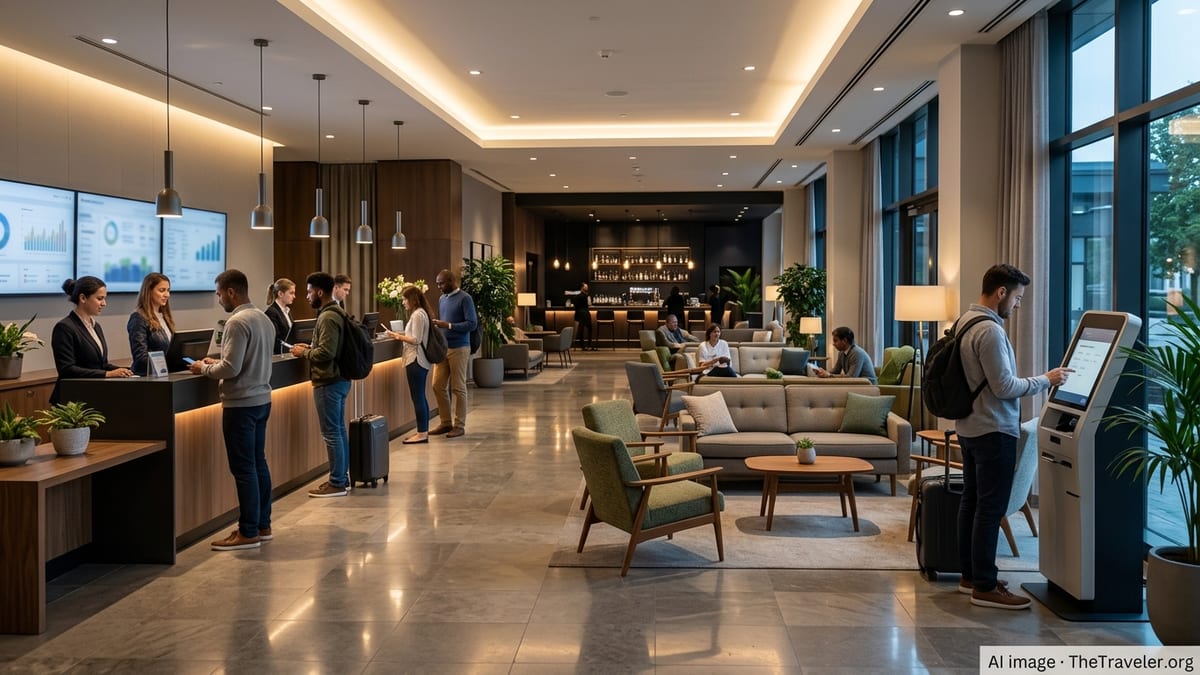
From Static Segments to Living Guest Profiles
For years, hotels have relied on guest personas such as “road warrior,” “bleisure traveler” or “family vacationer” to guide marketing and service design. These profiles were typically based on historical averages, demographic assumptions and small samples of behavioral data. Industry analyses now suggest that these static categories are increasingly mismatched with how travelers actually behave across channels and stays.
Recent research from hospitality schools and technology vendors indicates that AI-driven systems are starting to treat each guest as a fluid, evolving profile instead of a fixed type. Data from booking engines, loyalty programs, apps, point-of-sale systems and feedback platforms is being combined into what some providers describe as a 360-degree view of the traveler. Rather than assigning someone permanently to a segment, algorithms continuously update their predicted needs, price sensitivity and preferences as new information appears.
These living profiles allow hotels to move beyond one-size-fits-many offers. A guest who books like a leisure traveler but spends like a business traveler can be recognized as such, and pricing, messaging and service options can be adjusted dynamically. Reports from European and Asian markets show that hotels using AI-assisted segmentation tools are recording higher direct booking rates and improved repeat-guest retention as offers become more precise.
Academic work in revenue management, including teaching and conference sessions led by Dr. Cindy Heo of EHL Hospitality Business School, has highlighted how this shift dovetails with modern pricing science. Instead of building strategies around broad personas, revenue teams can run simulations on microsegments defined by actual transactional and behavioral data, then let machine-learning models refine those clusters as conditions change.
Hyper-Personalization Across the Guest Journey
Published coverage on hospitality technology points to hyper-personalization as a central application of AI in hotels today. At the pre-stay stage, recommendation engines use search history, device data and loyalty records to tailor room suggestions, packages and add-ons. Travelers who frequently book spa treatments may see wellness-focused offers, while those who favor early flights and short midweek stays might be offered flexible check-in or workspace bundles.
During the stay, AI is increasingly embedded in operational tools that monitor real-time signals such as mobile-app activity, in-room controls, restaurant spending and service requests. Hotel case studies describe systems that detect patterns like repeated Wi-Fi complaints or skipped breakfasts and automatically trigger interventions, such as adjusting room allocation, offering an upgrade or pushing an alternative dining option through the app.
Vendors in areas like in-room voice assistants and guest-messaging platforms report that AI models can now summarize long message histories, gauge sentiment and prioritize issues for staff. These tools not only respond to requests but also feed structured insights back into the guest profile. Over time, the data can reveal nuanced preferences, such as a guest’s favored pillow type, preferred coffee style or tendency to extend stays on weekends, which in turn shapes future offers.
Industry surveys cited by hospitality trade outlets suggest that personalization and predictive analytics are among the fastest-growing AI use cases in hotels, alongside dynamic pricing. By linking these capabilities, properties can tailor both the experience and the commercial proposition, aligning targeted upsells, loyalty benefits and ancillary services with each traveler’s predicted willingness to pay and propensity to return.
AI, Revenue Management and the End of the “Average Guest”
Revenue management has been an early testing ground for AI in hospitality, and this work is closely connected to the move beyond traditional personas. Publicly available conference programs and academic brochures show that Dr. Cindy Heo and other specialists are increasingly focused on how generative and predictive AI reshape forecasting, price optimization and demand management.
Instead of setting rates primarily by segment, season and historical pickup, hotels are adopting models that ingest large volumes of demand signals, from web traffic patterns to competitor pricing and local event calendars. These systems can forecast at a much more granular level, effectively treating each booking request as a unique combination of attributes rather than an instance of an “average guest.”
In practice, this means that two travelers who look similar on paper may see different price points and offers, depending on their real-time behavior and the hotel’s assessment of risk and opportunity. A loyalty member who tends to book late but rarely cancels may be given access to flexible rates, while a price-sensitive guest who often switches channels could be targeted with limited-time, mobile-only discounts. AI is not inventing new commercial logic, but it is scaling the kind of nuanced decision-making that used to require intensive manual analysis.
Educational material on AI in hospitality also emphasizes that these tools are not just about squeezing more revenue from each stay. When connected to service design, they can help hotels identify which enhancements deliver outsized satisfaction gains for specific microsegments, such as including co-working credits for long-stay digital nomads or offering family-friendly check-in windows for guests traveling with young children.
Balancing Deep Data With Privacy and Trust
The same data that allows AI to move beyond broad personas raises questions about privacy, consent and guest comfort. Hospitality-focused reports note that travelers are increasingly aware of how much information hotels can collect, from device identifiers and location data to voice interactions and social media signals, and they are more likely to reward brands that are transparent about how this information is used.
Vendors of voice assistants and personalization platforms have responded by emphasizing consent mechanisms, anonymization and data-minimization practices. Many systems are designed so that voice data is only processed after a clear trigger phrase and is not stored in identifiable form, while profile-building relies on aggregated patterns rather than detailed personal histories wherever possible. Public documentation from AI providers also highlights tools that allow hotels to configure what is collected and retained, aligning with local data-protection regulations.
Experts in hospitality technology argue in published analyses that the long-term success of AI personalization depends on guests perceiving a fair exchange of value. When travelers see that sharing preferences leads to tangible benefits such as smoother check-in, more relevant recommendations or fewer service errors, they are more willing to participate. If AI-driven decisions feel intrusive, opaque or biased, however, the risk is that travelers will push back by limiting data sharing or avoiding certain brands.
As a result, training programs and conference sessions involving Dr. Cindy Heo and peers often highlight the importance of ethical frameworks, clear communication and human oversight. Hotels are being encouraged to treat AI not as a way to manipulate behavior, but as a tool to better align service delivery with what different types of guests genuinely want, while still allowing room for surprise and discovery.
Redefining Talent and Operations in an AI-Infused Hotel
The shift from static personas to adaptive AI profiles is also changing how hotels structure their teams and processes. According to recent hospitality industry coverage, many properties are investing in hybrid roles that blend revenue management, marketing, operations and data analytics. Staff in these positions are tasked with interpreting AI outputs, testing new personalization strategies and ensuring that technology-driven insights translate into on-the-ground service improvements.
Industry surveys suggest that a majority of AI deployments in hotels still focus on augmenting, rather than replacing, human staff. Automation is often applied to routine tasks such as responding to common guest questions, routing requests to the right department or generating first-draft content for upsell offers and city guides. This is intended to free front-line employees to focus on higher-value interactions, particularly with guests whose needs fall outside predictable patterns.
Training programs referenced in academic and professional materials stress that emotional intelligence and cultural awareness remain critical. AI can surface patterns and recommendations, but it cannot fully account for the context and nuance of every guest interaction. Front-desk teams, concierges and revenue managers therefore need to understand both what the algorithms are suggesting and when it makes sense to override them, whether to resolve a service failure or to recognize a loyal guest in a way that transcends data points.
In this environment, the concept of a “guest persona” does not disappear, but it becomes more flexible and operational. Instead of being a static marketing archetype, it functions as a starting hypothesis, continually tested and refined by AI and human judgment. For hotel brands that can manage this balance, the emerging model promises experiences that feel less like interactions with a category and more like service designed for an individual traveler in a specific moment.