

More news on this day
As escalating tensions in the Middle East trigger rolling airspace closures and mass flight cancellations, the quiet workhorse of the cruise industry – air logistics for crew rotations – is being thrust into the spotlight, exposing just how dependent modern cruise operations are on a fragile web of long-haul connections through Gulf and regional hubs.
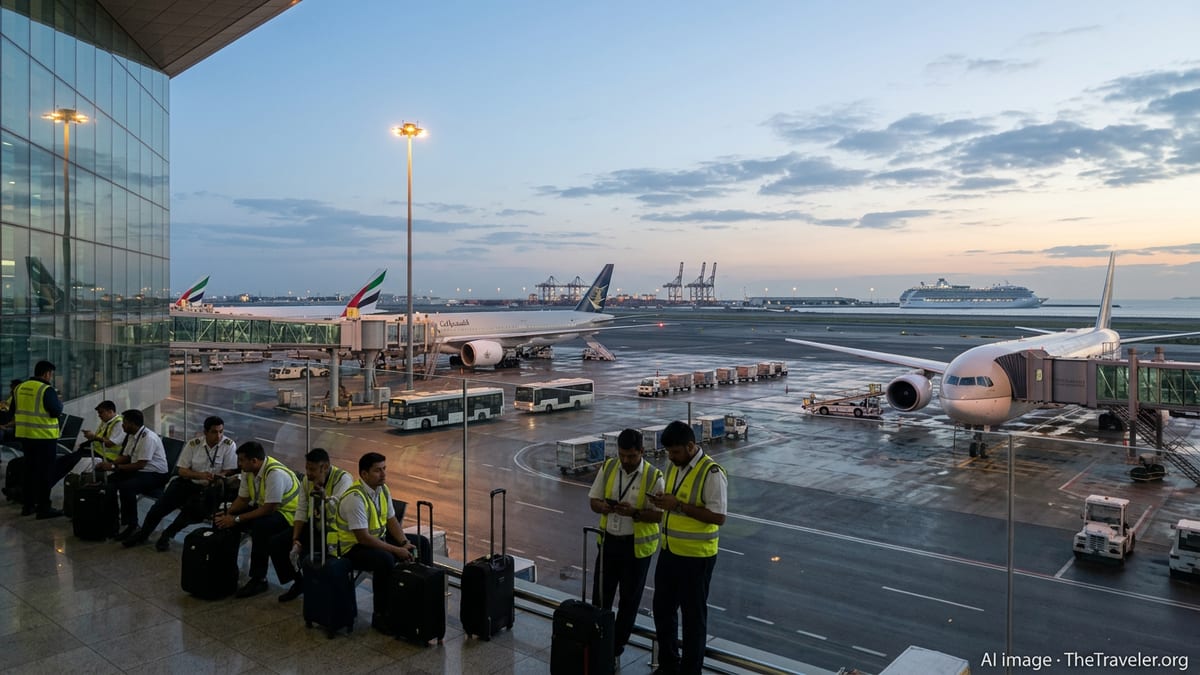
Flight Cancellations Expose a Hidden Vulnerability
The latest wave of airspace restrictions across parts of the Gulf and wider Middle East has stranded thousands of passengers and crew on at least six cruise ships in the region, according to industry updates and local media. With key airports in the United Arab Emirates, Qatar and neighboring states facing rolling suspensions and diversions, the usual flow of incoming and outgoing crew has slowed to a crawl.
Hub carriers such as Emirates, Qatar Airways and Etihad normally act as the backbone of cruise crew logistics, stitching together journeys from recruitment markets in Asia, Eastern Europe, Latin America and the Philippines to embarkation ports in the Red Sea, Arabian Gulf and Mediterranean. When those hubs are disrupted, aircraft and flight crews end up out of position, schedules unravel and duty-time limits are quickly reached, removing pilots and cabin crew from service just as demand for repositioning flights spikes.
The cascading effect is felt onboard. Cruise lines operating in and around Dubai, Doha and Abu Dhabi now face the prospect of running ships with crew whose contracts have expired, delaying relief teams or mounting costly charter operations to move staff through alternative gateways such as Istanbul, Cairo or European hubs where capacity is still available.
For itineraries that were already adjusted in recent years because of Red Sea security concerns and shifting demand, the sudden loss or reduction of air connectivity amounts to a fresh operational shock. While cruise lines can reroute ships away from high-risk areas, they cannot easily reroute the global aviation system that crew movements depend on.
Why Cruise Lines Rely So Heavily on Gulf Air Hubs
Behind every cruise departure is a carefully choreographed sequence of crew changes that may touch several continents. Large ocean ships can carry 1,000 to 2,000 crew members, with staggered contracts that see dozens or even hundreds rotate on and off at each port turnaround. For vessels based seasonally in the Middle East or transiting via Suez, Gulf aviation hubs have become the default connectors.
Over the last decade, airlines based in Dubai, Doha and Abu Dhabi built dense networks into traditional crew sourcing countries, offering competitive fares and reliable schedules for bulk corporate bookings. Cruise operators, manning agencies and travel management companies in turn structured their crew-change calendars around these routings, often buying blocks of seats months in advance to align with ship deployment plans.
That concentration brings efficiencies in normal times but magnifies risk when geopolitical crises close airspace or force wide detours. Longer routings via Turkey, Central Asia or Southern Europe add hours to flight times, increasing costs and shrinking the margin for error in just-in-time crew arrivals. In some cases, ships cannot clear port formalities or meet safety manning levels if specific licensed officers or technical specialists are delayed.
The situation is especially acute for repositioning voyages between Europe and Asia, which already face maritime detours because of insecurity in the Red Sea and around the Strait of Hormuz. When both sea routes and preferred air corridors are constrained, the flexibility cruise lines once had to swap crew in convenient ports along the way is significantly reduced.
Charters, Alternative Gateways and Longer Tours of Duty
To keep rotations moving, cruise companies are dusting off contingency plans that until recently were reserved for major weather events or isolated port closures. Some brands are in talks to charter widebody aircraft directly, either alone or as part of consortia, to shuttle crew between unaffected airports and temporary hubs closer to ships.
In parallel, operators are exploring alternative gateways such as Muscat, Salalah, Jeddah and Mediterranean ports where commercial capacity is still flowing. Logistics providers say they are stitching together complex multi-leg itineraries that may send crew via India, East Africa or southern Europe before transferring them onto regional services or buses to reach embarkation points.
Where airlift simply cannot be secured in time, lines are asking seafarers to extend their contracts by several weeks, a familiar tactic from the pandemic era but one that raises concerns about fatigue and morale. Maritime unions and welfare groups have already urged companies to monitor workloads closely and provide onboard support as tours of duty lengthen unexpectedly.
For crew trying to return home, the uncertainty can be particularly stressful. Extended waits in port, repeated airport trips and last-minute cancellations mean many are spending days in limbo, separated from families and unsure when they will be able to travel. For new hires on their first contract, disrupted travel can delay income and complicate visa and medical paperwork that are often time-sensitive.
Knock-on Effects for Global Cruise Schedules
The impact of air logistics disruption extends well beyond the ships currently stuck in the Middle East. Many vessels were due to reposition to Europe for the spring and summer seasons, carrying not only passengers but also large cohorts of crew scheduled to rotate in key turnaround ports such as Barcelona, Piraeus and Civitavecchia.
If crew cannot be moved into place on time, lines may be forced to shorten or cancel individual voyages, swap ships between brands, or keep vessels laid up until stable air routes are restored. Travel agents in source markets from the United Kingdom to Australia report a rise in passenger queries about contingency plans, particularly where cruise-and-fly packages rely on connections through affected hubs.
The strain is likely to be felt unevenly. Large global brands with established air contracting teams and relationships with multiple carriers are better positioned to secure scarce seats or arrange charters. Smaller or regional lines that rely heavily on scheduled services through one or two Gulf airports may face tougher choices, including redeploying ships away from the region entirely or scaling back itineraries that depend heavily on fly-in embarkation.
Port cities that have grown as cruise gateways thanks to Gulf air connectivity could also see ripple effects, from reduced hotel stays and shore spending to disrupted supply chains for provisioning ships. For destinations still recovering from earlier crises, another season of cancellations or truncated calls would be a significant setback.
What Passengers and Crew Should Expect Next
Operational planners and aviation analysts say the outlook hinges on how quickly airspace restrictions are eased and whether airlines can safely resume regular patterns through the region. Even if some corridors reopen in the coming days, backlogs of stranded passengers, displaced aircraft and out-of-position crews may take weeks to work through.
Cruise lines are urging both crew and guests to maintain close contact with their employers, agents and airlines, and to be prepared for itinerary changes, extended port stays or late-notice disembarkation plans routed through alternative airports. Many are prioritizing essential crew movements first, focusing on safety-critical roles and technical specialists before filling non-essential vacancies.
For now, the crisis has laid bare how tightly interwoven the cruise and aviation industries have become. Moving thousands of multinational crew safely and efficiently around the world depends on predictability in the skies as much as calm seas. As lines, airlines and regulators work to restore that predictability, the experience of those stuck in the Middle East may prompt a broader rethink of how and where future crew-change hubs are built, and how much redundancy should be built into a system that until now has largely operated on just-in-time assumptions.