

More news on this day
As long-range single-aisle jets reshape transatlantic and regional networks, the Airbus A321XLR and Boeing 737 MAX 10 have emerged as direct rivals with starkly different missions, timelines, and economics.
Get the latest news straight to your inbox!
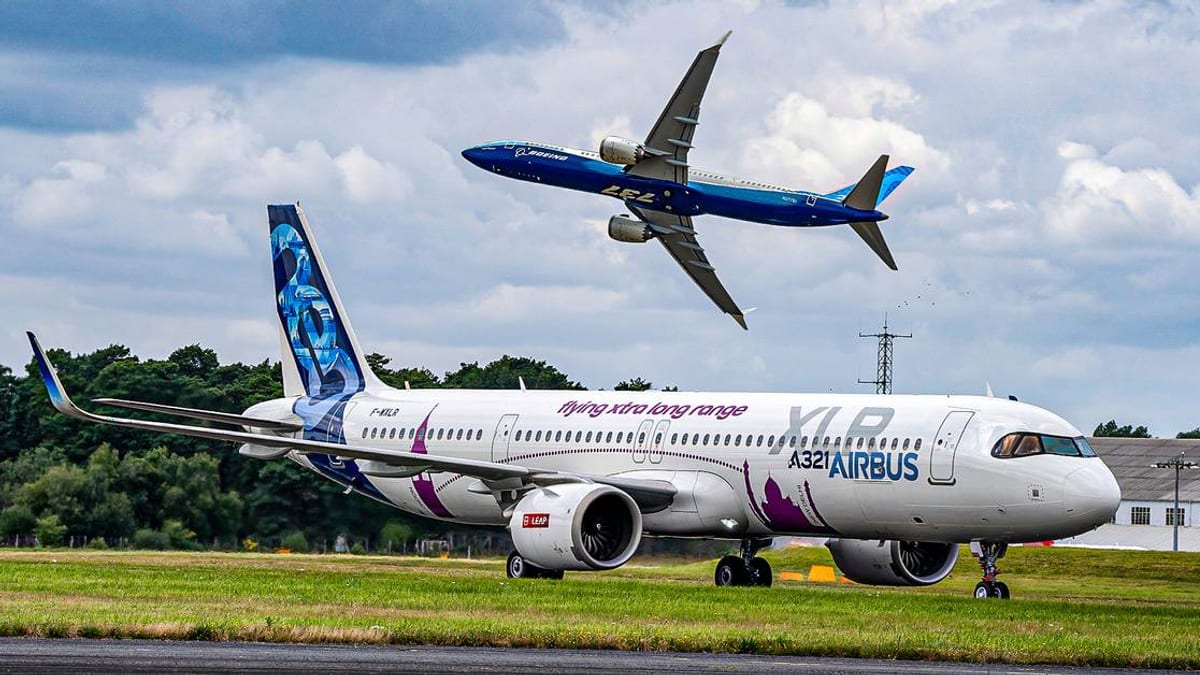
Image by Simple Flying
Entry Into Service: Airbus Pulls Ahead Of A Delayed Rival
Publicly available information shows that Airbus has moved the A321XLR from development milestone to commercial reality. The aircraft secured European type certification for its CFM-powered variant in mid-2024, followed by approval for the Pratt & Whitney-powered version in February 2025. Airbus’ latest corporate reporting indicates that commercial service began in late 2024, with additional customer deliveries ramping up through 2025 and 2026.
Airlines such as American Airlines, Air Canada and United Airlines have built new network plans around the A321XLR, including thinner transatlantic routes and longer seasonal services that previously required widebodies or older mid‑size aircraft. Schedules and fleet updates reported in industry coverage point to the type flying from North America to a growing list of secondary European destinations from 2025 onward, with more aircraft joining fleets into 2027.
The Boeing 737 MAX 10, by contrast, remains in the certification queue. Public filings and airline commentary over the past year suggest that the largest MAX variant is not expected to enter commercial service before the second half of this decade. Some major customers have removed near‑term MAX 10 deliveries from planning documents or shifted growth assumptions, citing continuing regulatory review and production constraints.
Industry analysis notes that Boeing has been preparing production capacity for the MAX 10 at its facilities, but the aircraft’s entry into service still hinges on final approval from United States regulators. As a result, airlines looking for immediate long‑range narrowbody capability are turning first to Airbus, while the MAX 10 is positioned as a later option aimed primarily at higher‑density short and medium‑haul markets.
Range And Mission Profile: XLR Goes Long, MAX 10 Goes Wide
The most striking technical divergence between the two aircraft is range. Airbus marketing and airline planning documents place the A321XLR’s advertised range around 4,700 nautical miles, enabled by an enlarged rear centre fuel tank and other structural changes. That performance pushes the aircraft firmly into long‑thin market territory, allowing carriers to connect smaller North American cities directly with secondary European or deep Latin American destinations.
By comparison, the Boeing 737 MAX 10 is optimised more for capacity than for extreme range. Industry analyses based on manufacturer planning data describe the MAX 10’s range as sufficient for most high‑density domestic and regional routes, but notably shorter than the A321XLR. Consultants who model narrowbody economics generally consider the two aircraft directly competitive up to roughly 3,000 nautical miles, beyond which the Airbus jet can operate missions the MAX 10 cannot reach without payload trade‑offs.
This capability gap is already visible in route planning. Network announcements show airlines earmarking the A321XLR for transatlantic and long‑haul leisure sectors where widebodies would be too costly to fill year‑round, while retaining existing 737 MAX variants and other narrowbodies for high‑frequency trunk routes. For the MAX 10, the emerging focus is on replacing older 737s and some A321s on dense short‑haul sectors rather than opening entirely new long‑range markets.
The divergence puts the two types on slightly different strategic paths. The A321XLR extends the traditional role of a single‑aisle into missions once dominated by mid‑size widebodies and legacy narrowbodies such as the Boeing 757. The MAX 10, while the largest 737 to date, is more of a capacity growth and cost‑per‑seat improvement tool in familiar domestic and intra‑regional markets.
Cabin Capacity, Layout And Passenger Experience
On cabin configuration, the Boeing 737 MAX 10 generally offers higher maximum seating than the A321XLR, reflecting its role as a high‑density workhorse. Boeing materials and airline order information indicate that the MAX 10 can be configured with up to around 230 seats in a single‑class layout. Typical mainline carriers are expected to opt for lower counts to balance comfort, premium seating and operational flexibility, but the basic airframe is tuned for volume.
The A321XLR, built on the stretched A321 platform, carries fewer passengers at full density but emphasizes a richer cabin mix. Examples from airline fact sheets show layouts around 190 to just under 220 seats, often with a noticeably larger proportion of business and premium‑economy seats than older narrowbodies on similar routes. One major carrier’s planning documents, for instance, highlight a double‑digit increase in premium seating compared with incumbent Boeing 737s on domestic and regional flights.
Passenger experience expectations also differ given the missions each aircraft is designed to fly. Airlines deploying the A321XLR on overnight transatlantic or multi‑hour regional sectors are specifying full‑flat or deeply reclining business‑class seats, larger overhead bins and upgraded inflight entertainment to compete with widebodies. Industry reports note that some carriers are marketing the type as a widebody‑style experience on a narrowbody footprint, particularly in premium cabins.
On the MAX 10, airlines are expected to mirror existing 737 MAX cabin concepts, prioritizing slimline seating, high‑density layouts and quick turnarounds. Cabin modernizations such as mood lighting, large pivot bins and improved air filtration are part of the package, but the core focus is on cost‑efficient, high‑frequency flying rather than ultra‑long single‑aisle comfort.
Fuel Burn, Economics And Environmental Positioning
Both manufacturers pitch their latest narrowbodies as significant steps forward in fuel efficiency compared with older generations, but analysis suggests the A321XLR has an edge in long‑range performance. Independent aerospace consulting presentations comparing the two types report a notable fuel‑burn advantage per seat for the Airbus jet on missions near the top end of the single‑aisle range envelope, driven by its tailored tank design and aerodynamic refinements.
Airline financial disclosures and fleet evaluation documents echo this narrative. In one widely cited comparison, a major carrier projected double‑digit percentage fuel‑burn and emissions improvements per seat for the A321XLR versus previous 737 models on similar routes, highlighting the benefit of next‑generation engines and cabin layouts optimized for premium revenue. These advantages are particularly attractive as carriers face tightening emissions targets and rising fuel‑cost volatility.
For the MAX 10, Boeing’s economic case leans heavily on commonality and capacity. The aircraft shares much of its systems architecture and training footprint with existing MAX variants, which can reduce pilot training and maintenance costs for all‑Boeing operators. When configured near its maximum seating, the MAX 10 is designed to deliver highly competitive unit costs on shorter segments where range is less critical and quick turns are essential.
Environmental positioning is increasingly a factor in airline decision‑making. Airbus has framed the A321XLR as part of broader efforts to cut fleet emissions intensity, while many airlines acquiring the type publicly describe it as a way to retire older, less efficient mid‑size aircraft without sacrificing network reach. Boeing is making similar claims for the MAX family as replacements for 737NG and other legacy narrowbodies, but the MAX 10’s delayed entry means its real‑world performance and sustainability record will emerge later in the decade.
Market Impact And Airline Strategies
Order books and fleet plans show that both aircraft have attracted significant commercial interest, yet in different segments and timeframes. Airbus has accumulated hundreds of A321XLR commitments across North America, Europe, the Middle East and Asia-Pacific, with airlines using the type to bridge the gap between smaller narrowbodies and long‑haul widebodies. Early operators are using the aircraft to restore or replace former Boeing 757 routes, experiment with new city pairs and extend seasonal services into shoulder months.
The 737 MAX 10, while still awaiting final certification, holds a substantial share of Boeing’s narrowbody backlog. Large customers in the Americas, Europe and Asia have publicly identified the type as a future backbone for domestic and regional growth, particularly on slot‑constrained or high‑demand routes where adding frequency is difficult. Industry observers note that several carriers have nonetheless hedged their bets by ordering or leasing Airbus A321neos, including the XLR, to secure near‑term capacity.
From a competitive standpoint, the timing gap between the two programs is shaping network strategy. With the A321XLR already in service and ramping up, airlines can begin shifting long‑thin routes away from ageing widebodies and older narrowbodies immediately, potentially locking in valuable city pairs before the MAX 10 becomes available. When Boeing’s largest MAX variant does reach the market, it is expected to intensify competition on dense short and medium‑haul sectors rather than directly displace the XLR on its longest missions.
For travelers, the emerging divide means that long‑haul narrowbody flights in the next few years are more likely to be operated by Airbus A321XLRs, particularly on secondary transatlantic and leisure routes, while the Boeing 737 MAX 10 is poised to appear later as a high‑capacity option on familiar domestic and regional corridors. How quickly regulators and manufacturers move through the final stages of certification will determine how long Airbus’ head start in this niche persists.