

More news on this day
As new conflict ripples across West Asia, closing airspace and driving up fuel and insurance costs, aviation regulators and airlines are under growing pressure to maintain safety while preventing airfares from spiralling for millions of travelers who depend on the region’s hubs.
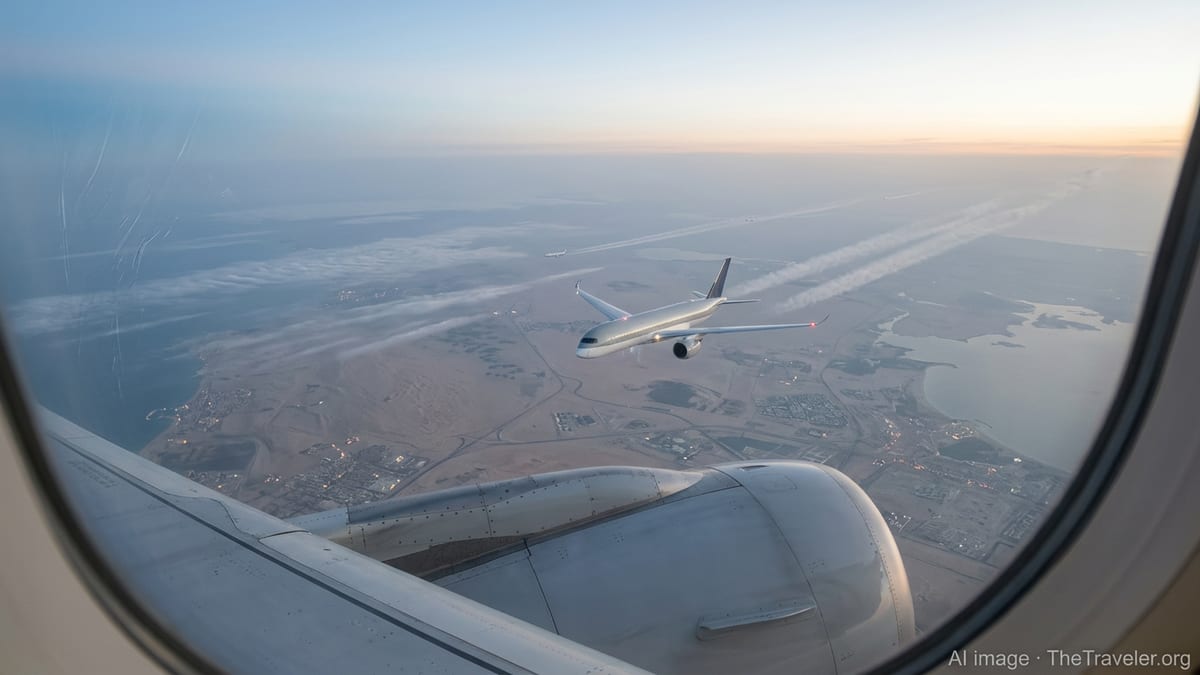
Conflict Shifts the Geography of the Skies
The latest war involving Iran and its neighbors has rapidly redrawn the aviation map over West Asia, triggering widespread airspace closures and diversions that have stranded passengers from Europe to Asia. Airports in Iran, Iraq, Syria, Israel, Qatar, Bahrain and Kuwait have faced closures or heavy restrictions in recent days, effectively shutting some of the world’s most critical east west corridors and forcing airlines to improvise safer, longer routes around active conflict zones.
The region’s hubs in the Gulf, long marketed as reliable connectors between continents, are under exceptional strain. Airlines are juggling last minute schedule changes, complex rerouting over alternative corridors and the challenge of keeping aircraft and crew out of missile and drone envelopes while still offering commercially viable services. Aviation analytics show that millions of seats that would normally operate to, from and within the Middle East have been canceled since the latest escalation, compressing capacity on remaining routes and pushing many flights to full or waitlisted status.
Even where airspace remains technically open, heightened military activity and intelligence-based risk assessments have prompted many carriers to avoid certain flight information regions entirely. The result is an intricate patchwork of no fly zones, preferred routings and altitude constraints that shift almost daily, testing airline operations centers and national air navigation service providers that must maintain safe separation in increasingly crowded alternative corridors.
Safety Architecture Under Stress but Holding
Despite the dramatic headlines and images of conflict, global aviation safety data still shows commercial air travel remains exceptionally safe, including in regions affected by unrest. The International Air Transport Association’s latest annual safety analysis for 2024 reported accident rates that remain near historic lows, with no jet hull loss accidents involving passenger airlines in the Middle East and North Africa included in the main classification, even as regional tensions intensified.
A key reason is the multilayered safety architecture that activates whenever conflict threatens civil aviation. Intelligence sharing cells involving national regulators, military planners and industry bodies coordinate to identify risky airspace and provide route guidance to airlines, often hours or days before the public is aware of specific threats. IATA and the International Civil Aviation Organization chair joint groups that consolidate threat assessments from different states and issue recommendations that many carriers treat as mandatory, even when legal responsibility ultimately sits with each airline’s own safety management system.
European and Gulf regulators in particular have strengthened their conflict zone guidance since previous tragedies, requiring operators to demonstrate that they have actively evaluated overflight risks and, where necessary, adjusted altitudes or routes. In practice, that has pushed more traffic into already busy corridors over Turkey, the Caucasus and Central Asia as flights to and from South Asia, Southeast Asia and Australia are rerouted away from the highest risk segments of West Asian airspace.
Airlines also rely increasingly on real time data, from satellite tracking to missile launch detection feeds, to support in flight decision making. Dispatchers can now push alternate routings to cockpits mid flight to respond to emerging threats, such as unexpected missile launches or drone activity, helping maintain safe separation from conflict areas without cancelling services outright.
Fare Pressures From Fuel, Insurance and Detours
The safety driven decision to lengthen routes and avoid certain skies has a direct impact on passengers’ wallets. Extended detours add hours to some long haul flights, translating into higher fuel burn, extra crew hours and additional overflight fees paid to states whose airspace now carries more traffic. Analysts note that fuel alone still accounts for roughly a third of airline operating costs in many markets, making any conflict related spike in crude prices or flying time a powerful driver of fares.
Insurance is another rising line item. Underwriters have progressively raised war risk premiums for aircraft flying near West Asia’s most volatile zones, and in some cases have narrowed coverage, pushing airlines to either reroute or accept sharply higher costs. Those that maintain services close to conflict areas often pass at least part of the expense to passengers through higher base fares or dedicated surcharges, a trend already visible on some routes connecting Europe and North America with South Asia and the Gulf.
Recent disruptions have produced eye catching price swings on last minute tickets via or around the Middle East, with some fares reportedly more than quadrupling as stranded passengers compete for scarce seats. Travel agents across Europe and Asia report that alternative itineraries, whether via secondary hubs or completely different continents, have been snapped up within hours of major escalation, leaving remaining options both more expensive and more complex, often involving additional stops.
Industry bodies caution that while acute price spikes are partly a function of simple supply and demand during crisis peaks, structural factors are also in play. Reduced competition on certain corridors, higher financing and maintenance costs in a high interest environment, and continuing supply chain bottlenecks for new aircraft and spare parts all limit airlines’ ability to absorb conflict related costs without adjusting fares.
Regulators Seek Strategic Oversight and Coordination
As volatility persists, aviation regulators and transport ministries across West Asia and key origin markets are pushing for stronger strategic oversight to keep skies both safe and accessible. Many are convening emergency task forces that bring together civil aviation authorities, defense officials, airlines and airport operators to ensure that risk assessments, no fly advisories and route recommendations are consistent rather than fragmented by national politics.
Internationally, there is renewed attention on agreements that underpin civil aviation in times of war, notably the Chicago Convention and related conflict zone guidance. IATA has reiterated its call for governments to prioritize the protection of civil aviation infrastructure and to share timely, actionable intelligence with airlines whenever missile or drone activity could pose a risk to overflying traffic. Trade groups are also urging states to avoid sudden, unilateral airspace closures that offer little notice to carriers and can leave aircraft and passengers stranded.
Some West Asian governments are exploring targeted relief measures to stabilize fares and maintain connectivity, especially for essential travel. These range from temporary reductions in air navigation charges on safer alternative routes, to short term waivers of airport fees, to priority slots for repatriation and humanitarian flights. Officials argue that such tools can help offset the cost pressures of longer routings and higher insurance, reducing the need for airlines to pass all increases directly to consumers.
At the same time, regulators are scrutinizing airline pricing behavior during crises, sensitive to accusations of opportunistic fare hikes. Competition and consumer protection authorities in several jurisdictions have signaled they are monitoring for unjustified surcharges or lack of transparency on war related cost components, even as they acknowledge that genuine operational expenses have risen sharply.
Traveler Behavior and the Future of West Asian Hubs
The instability is already influencing traveler behavior, with some leisure passengers deferring or redirecting trips that would normally route through West Asian hubs, while business travelers and diaspora communities continue to fly despite higher costs and longer journey times. Travel insurers have tightened policy wording around conflict related disruptions, and some now exclude coverage for itineraries that transit specific airports or airspace sectors unless travelers pay additional premiums.
For the Gulf’s major hub airports and their flagship carriers, the crisis is a mixed test. On one hand, their extensive route networks and large widebody fleets allow them to reroute traffic more flexibly than smaller rivals, and to mount evacuation and repatriation flights when other airlines withdraw. On the other, the concentration of global connectivity through a relatively narrow geographic band exposes them acutely to any escalation that closes or complicates nearby airspace.
Industry analysts say that over the medium term, strategic oversight and investment will determine whether West Asian hubs retain their dominance. If states can maintain predictable regulatory environments, coordinate on safety and airspace management, and support infrastructure upgrades in less developed markets, the region could emerge from the current crisis with a more resilient aviation ecosystem. Failure to do so could accelerate the shift of some long haul flows toward alternative hubs in Europe, Central Asia or the Indian Ocean.
For now, travelers planning to cross West Asia are advised to build in more flexibility, monitor airline and government advisories closely and budget for potential fare volatility. Behind the scenes, a dense web of regulators, air traffic managers and airline safety teams continues to work around the clock to ensure that, even in one of the world’s most unpredictable regions, commercial aviation remains one of its most stable and reliable connectors.