

More news on this day
Bangalore International Airport Limited is accelerating a multi-year strategy to reposition Kempegowda International Airport from a primarily origin-destination gateway into a competitive global transit hub, backed by rising transfer traffic, expanded capacity and a wave of infrastructure and airline-led enhancements.
Get the latest news straight to your inbox!
Rising Transfer Traffic Signals a Strategic Pivot
Publicly available traffic data indicates that Kempegowda International Airport in Bengaluru handled around 40.7 million passengers in 2024, placing it firmly in the “larger airport” category in India and reflecting a steady recovery and growth trajectory after the pandemic. Reports also show that the airport has recently overtaken Mumbai in domestic air traffic movements during select months, underscoring Bengaluru’s growing role in the national aviation network.
Within this broader growth story, transfer traffic is emerging as a key focus. Coverage citing Bangalore International Airport Limited leadership indicates that about 15 percent of the airport’s passengers currently use Bengaluru as a transit point, with an ambition to lift this share toward 20 to 30 percent over the next decade. The shift reflects a deliberate strategy to reposition the airport from a predominantly point-to-point facility to a hub that funnels regional and international flows through carefully timed connections.
Industry commentary suggests that network consolidation by major Indian carriers and the introduction of structured “banked” connections are expected to support this transition. As airlines refine schedules to create more connection windows and the airport improves wayfinding, processing times and minimum connection thresholds, Bengaluru is increasingly marketed as a viable alternative to long-established hubs in other Indian metros.
Terminal 2: A “Terminal in a Garden” Built for International Connections
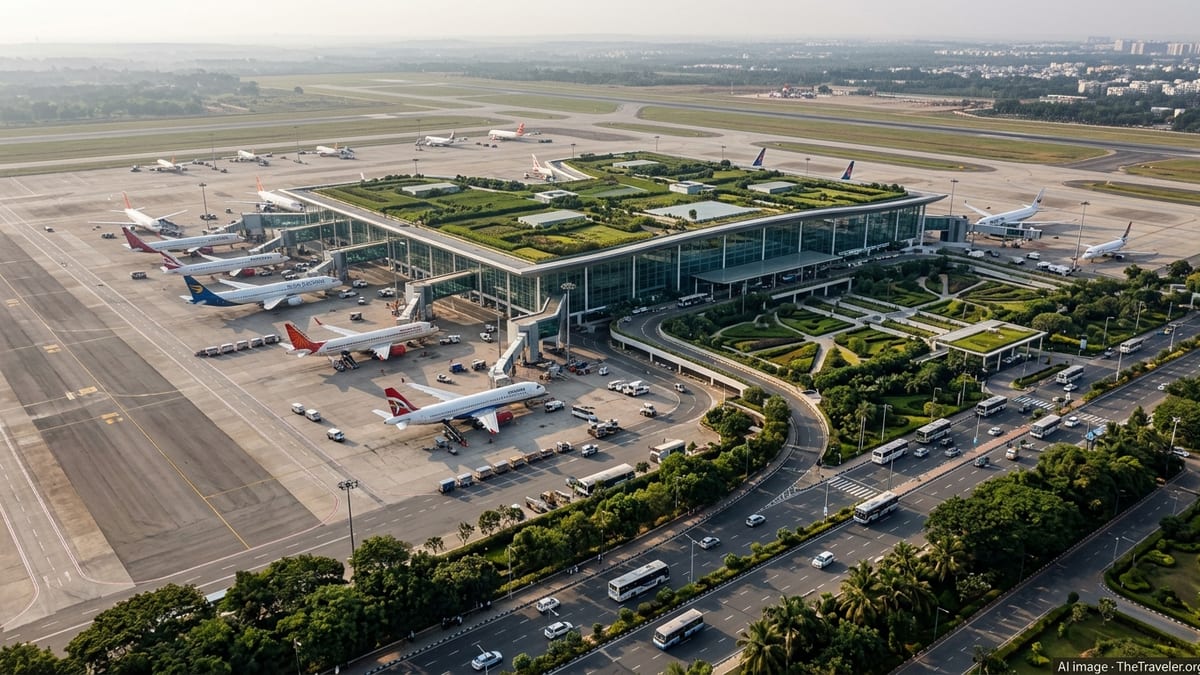
The opening of Terminal 2, designed as a “terminal in a garden,” has become the architectural and operational centerpiece of Bengaluru’s hub strategy. The facility, developed with substantial investment and conceived by international design firms, was initially opened for domestic operations and then began handling international flights from August 2023, following a phased migration of 27 airlines to the new building.
Spanning more than 250,000 square meters, Terminal 2 introduces a significant number of additional contact stands, wide-body capable Code F gates and expanded check-in, security and immigration capacity. Architecture-focused coverage describes a biophilic design with extensive natural planting, generous daylighting and layered spatial volumes that aim to ease travel stress and support smoother flows of large passenger volumes, including transfer travelers navigating short connection windows.
Operational reports link the start of international operations at Terminal 2 with the inauguration of a dedicated access corridor known as Terminal Boulevard, a 4.4 kilometer approach designed to separate T2 traffic and reduce congestion. The terminal’s layout, together with centralized security lanes and clearly signed connection routes, has been planned to simplify movement between domestic and international banks of flights, a core requirement for any emerging global transit hub.
Master plan documents and recent commentary also refer to an upcoming Phase 2 expansion of Terminal 2, targeted for completion toward the end of this decade. This second phase is expected to add further contact stands, processing capacity and retail and hospitality offerings, all of which are intended to support higher volumes of connecting passengers.
Airline Partnerships and MRO Facilities Strengthen Hub Credentials
Bangalore International Airport Limited is coupling infrastructure expansion with targeted airline partnerships. An agreement between Air India and the airport operator, highlighted in industry and corporate releases, is explicitly framed around developing Bengaluru as a premier aviation hub for southern India. The plan centers on expanded international connectivity, increased frequencies on key long-haul and regional routes, and a coordinated presence of Tata Group airlines at the airport.
As part of this collaboration, Air India has committed to developing a dedicated domestic lounge for premium and frequent flyers in Terminal 2, as well as investing in Maintenance, Repair and Overhaul facilities on the airport campus. According to published information, these MRO plans cover airframe maintenance for both wide-body and narrow-body aircraft and are intended to support heavy structural checks. Locating such facilities on-site is seen as a competitive advantage, reducing downtime for aircraft basing and rotations and reinforcing the airport’s status as an operational hub.
Other carriers are also deepening their presence. IndiGo, which already mounts a large share of domestic capacity at Bengaluru, is part of broader efforts to build connecting “banks” that align multiple arrivals and departures in compressed time windows. Additional codeshare and interline arrangements by Indian and foreign airlines using Bengaluru are supporting one-stop itineraries between secondary cities in India and international destinations, a pattern that typically underpins the evolution of transfer-focused hubs.
Ground-handling and cargo partnerships are being refreshed in parallel. A long-term agreement with global ground service providers, as reported in aviation trade channels, is designed to standardize passenger, ramp and baggage operations across terminals. At the same time, Bengaluru continues to position itself as India’s leading airport for perishable cargo, with recent years’ statistics showing a dominant share of the country’s temperature-sensitive exports. These cargo flows contribute to airline route economics and help justify additional wide-body rotations that can feed passenger connectivity.
Surface Connectivity and Airport City Support the Transit Vision
Beyond the terminal walls, surface transport and land-use planning are being aligned with the transit hub objective. State and city-level initiatives include new airport link roads, integration with an outer peripheral express corridor and plans for metro and suburban rail connections. Local planning documents and public reports describe recent tenders for additional approach roads and upgraded junctions intended to ease congestion on existing access routes, especially during peak banking waves.
Public transport agencies have also adapted services to the changing geography of demand. New airport bus routes linking emerging residential corridors and technology hubs to Kempegowda International Airport have been introduced, providing more predictable travel times for both origin-destination passengers and those using Bengaluru as a midway point on multi-leg journeys. The emphasis on multimodal connectivity reduces the perceived distance of the airport from the city and broadens the catchment area that can reliably feed international connections.
Adjacent to the airfield, the development of an “airport city” led by a dedicated subsidiary of Bangalore International Airport Limited is adding hotels, offices, logistics facilities and mixed-use commercial spaces. Statements from the developer outline a long-term target of handling up to 115 million passengers annually across refurbished Terminal 1, an expanded Terminal 2 and a planned Terminal 3. The airport city concept is positioned as a key enabler, providing on-site accommodation for transit passengers, airline crews and business travelers and creating an ecosystem that supports longer layovers and same-day meetings.
Together, these surface connectivity and airport city initiatives embed the airport more deeply into Bengaluru’s urban and economic fabric, a prerequisite for sustaining the high-frequency networks and passenger volumes that define a global transit hub.
Growth Metrics and Competitive Position in the Region
Available passenger figures show that Kempegowda International Airport has been recording high single-digit annual growth, crossing 40 million travelers in 2024 and registering higher daily air traffic movements year on year. Periodic peaks in daily passenger throughput and flight movements, reported in business and local media coverage, underline a capacity profile increasingly comparable to some of Asia’s established secondary hubs.
On the international front, the airport faces competition from other south Indian gateways, yet continues to expand its share of global traffic through new routes and frequencies. Civil aviation data cited in regional reporting suggests that while Chennai, for example, has alternated with Bengaluru in international passenger volumes during certain periods, Kempegowda International Airport’s pipeline of terminal expansion, airline partnerships and cargo specialization is consolidating its position as a key international gateway.
Looking ahead, the combination of Terminal 2’s phased build-out, the potential addition of Terminal 3 in the late 2020s or early 2030s, and the maturing of airline network strategies is expected to determine how fully Bengaluru can capture long-haul and regional connecting flows. Observers note that success will depend on continued investments in punctuality, baggage reliability, digital wayfinding and streamlined security and immigration processes, all of which are central to the traveler experience at major global transit hubs.
For now, the trajectory is clear. With transfer traffic on the rise, international operations consolidated into a new-generation terminal and a growing ecosystem of airline and infrastructure partners, Bangalore International Airport Limited is steadily reshaping Kempegowda International Airport into a contender in the global race for connecting passengers.