

More news on this day
Caribbean cruises are increasingly marketing turquoise water and coral-rich snorkel stops as more than a backdrop for holiday photos. A growing network of restoration projects, conservation partnerships and hands-on excursions is positioning cruise tourism as a surprising new ally in the fight to save the region’s reefs.
Get the latest news straight to your inbox!
Caribbean Reefs Under Pressure
Across the Caribbean, coral reefs are facing a combination of warming seas, disease outbreaks and coastal development that has left many iconic sites degraded. Publicly available research from marine nonprofits indicates that mass bleaching events and coral disease have reduced live coral cover in some parts of the region by more than half in recent decades, weakening natural breakwaters that protect shorelines and support fisheries and tourism-dependent economies.
Tourism has historically been part of the pressure. Cruise arrivals concentrate visitors at popular bays and sandbars, increasing physical impacts from anchors, boat traffic and poorly managed snorkeling or diving. At the same time, those same visitors generate significant revenue for island economies, from port fees to local excursions, creating an incentive to keep reefs healthy enough to attract travelers.
As the economic value of reefs becomes clearer, reports from conservation organizations show that regional governments, scientists and tourism businesses are reframing coral as natural infrastructure that requires active management. That shift is creating space for the cruise industry to be involved not only as a user of marine ecosystems, but also as a funder and facilitator of restoration work.
Cruise Lines Pivot Toward Restoration Partnerships
Major cruise companies are increasingly linking their Caribbean itineraries to environmental initiatives designed to stabilize and restore nearby coastal ecosystems. Corporate sustainability disclosures describe multi-year philanthropy and technical partnerships with groups such as The Nature Conservancy, which has expanded coral restoration and coastal resilience projects in the Caribbean with private funding from tourism and maritime companies.
Royal Caribbean Group has reported new collaborations with universities and marine centers in Florida and Mexico that focus on coral and coastal habitat recovery. One partnership with a coastal research center in Mahahual, near the Costa Maya cruise port, directs funding to restore mangroves, dunes and seagrass beds that help sustain adjacent reefs and buffer storm impacts on local communities. These programs are frequently framed as part of wider nature-based solutions strategies linked to climate resilience.
Carnival Corporation’s published sustainability material highlights long-running support for marine conservation efforts, including grants that have helped scale coral restoration work and reef mapping in the wider Caribbean. While many of these investments occur behind the scenes, the company also points to on-the-ground projects at popular ports, such as environmental certifications for beaches and support for reef-friendly practices around its private destinations.
Smaller and luxury cruise brands are entering similar arrangements. Industry coverage notes that several lines now sponsor coral nurseries or reef adoption programs in key regions, with restoration groups offering branded opportunities for guests and crew to help finance the outplanting of nursery-grown corals onto damaged reef structures.
From Shore Excursions to “Reef Restoration Tourism”
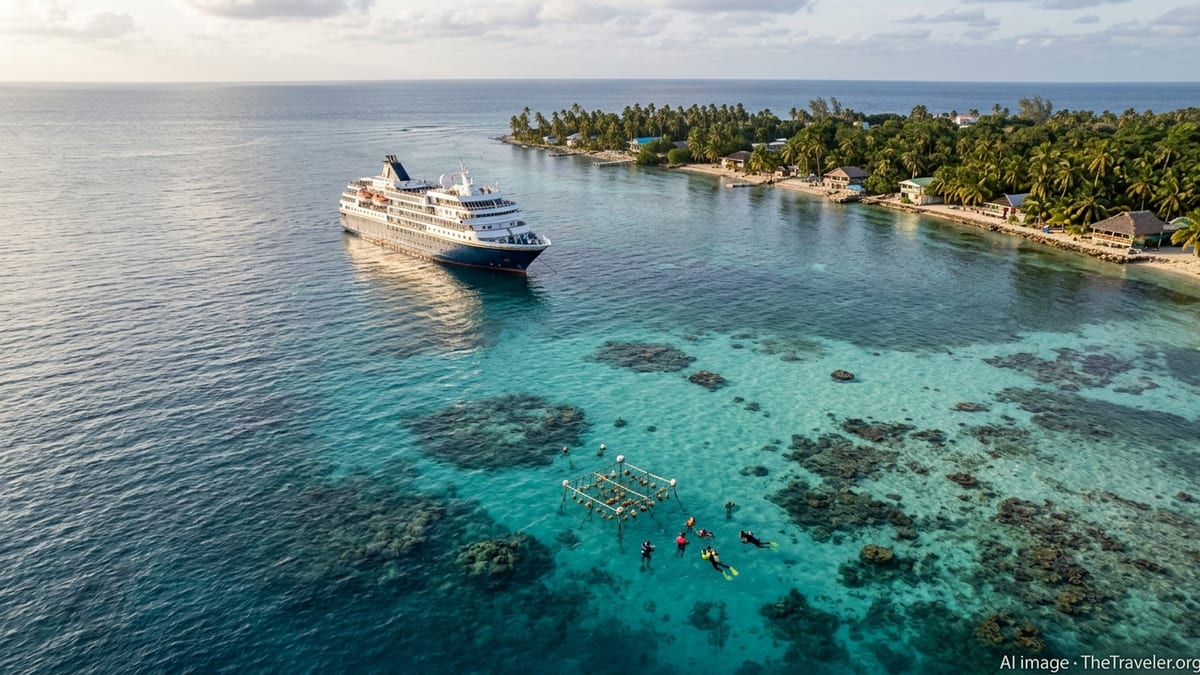
What has changed most visibly for travelers is the emergence of “reef restoration tourism” as an option alongside traditional snorkeling and beach excursions. Program descriptions from conservation organizations in the Dominican Republic and other Caribbean destinations outline guided experiences where visitors learn basic coral biology, tour underwater nurseries and sometimes assist trained staff with simple maintenance tasks under supervision.
These experiences are designed to meet both scientific and tourism standards. Restoration groups typically handle site selection, permitting and technical protocols, while local operators manage guest logistics and safety. Participating visitors may pay a premium over standard reef tours, with a portion of each ticket earmarked for nursery upkeep, coral outplanting and community education.
Resort partners in islands such as Jamaica, Saint Lucia and Grenada have already shown that structured restoration dives and specialty courses can attract a growing segment of environmentally minded travelers. Reports indicate that some of those models are now informing cruise-focused offerings, where guests book restoration-themed excursions directly through the line or via local operators that work near cruise piers.
For Caribbean communities, the shift opens a potential niche that combines marine science, youth training and visitor spending. Development agencies and regional initiatives have begun to describe reef restoration tourism as a way to diversify coastal economies while building local capacity to manage and monitor nearby reefs.
Science at Sea: Data Collection From Cruise Routes
Beyond discrete restoration sites, modern cruise ships are increasingly being used as mobile observation platforms. Public information from Royal Caribbean Group describes the long-running OceanScope program, which equips selected vessels with scientific instruments that continuously collect data on sea surface temperature, currents, salinity and carbon dioxide levels along established routes.
Because ships travel the same corridors between Florida, the Bahamas and Eastern Caribbean islands week after week, the resulting datasets can help researchers track seasonal changes and long-term trends in the waters that surround many popular cruise destinations. Those observations support climate and oceanographic studies that underpin coral reef management decisions, including early warnings for heat stress that can trigger bleaching.
Several lines also promote citizen-science style activities on board, such as naturalist talks, reef ecology presentations and occasionally guest participation in simple monitoring tasks. While these offerings vary by brand and ship, they contribute to a broader effort to turn ocean crossings into educational opportunities, reinforcing the link between guests’ itineraries and the health of the marine ecosystems they visit.
Scientists and conservation groups have argued that improved data on regional conditions, combined with targeted restoration and local protections, will be essential if Caribbean reefs are to adapt to warming seas. The growing use of cruise ships as platforms for ocean data collection suggests that the industry is increasingly aware of its role in that wider information network.
What Travelers Can Do on Their Next Caribbean Cruise
For travelers booking Caribbean cruises in the coming seasons, the most direct way to support reef recovery is to choose experiences and operators that are demonstrably investing in restoration and responsible practices. Cruise line sustainability reports and independent travel coverage often highlight excursions built around coral nurseries, mangrove planting or guided low-impact snorkeling, and travelers can look for this kind of detail in excursion descriptions.
On the water, simple behavior still matters. Marine agencies and nonprofit guidance consistently advise using reef-safe sunscreen, avoiding contact with coral or seagrass, and following local rules on mooring and marine protected areas. Guest demand for operators that respect these guidelines can help shift port economies toward more sustainable models.
Some restoration organizations active in the Caribbean also run coral adoption programs or visitor centers that can be accessed before or after a cruise. By channeling a portion of travel budgets into these initiatives, guests help underwrite the long-term, labor-intensive work of growing, planting and monitoring corals that will never be seen by most visitors.
As the region experiments with linking tourism revenue more directly to ecosystem repair, Caribbean cruises are gradually becoming more than a way to enjoy clear water and colorful reefs. For travelers willing to seek out the right itineraries and excursions, a week at sea can now contribute, in small but concrete ways, to the long task of rebuilding the very reefs that make the Caribbean such a coveted destination.