

More news on this day
China’s 2026 Spring Festival has emerged as a defining test case for “culture plus tourism,” with cities and scenic areas across the country weaving traditional rituals, immersive performances and smart services into a single, highly curated holiday experience that is reshaping how people travel for the nation’s most important festival.
A Record Holiday Puts Culture at the Center of Travel
The 2026 Spring Festival holiday, spanning a rare nine-day break from February 15 to 23, unfolded against the backdrop of a broader national pivot toward culture-led tourism. Building on the momentum of 2024, when the Spring Festival was inscribed on UNESCO’s list of Intangible Cultural Heritage, authorities have increasingly treated the holiday as both a family reunion period and a strategic engine for domestic consumption.
Preliminary figures from cultural and tourism authorities point to another surge in trips and spending, continuing the trend set during the 2025 Spring Festival, which saw more than 500 million domestic trips and record tourism revenue. Officials say this year’s market is not only larger, but also more diversified, with a higher share of visitors booking itineraries that combine performances, museum visits and hands-on heritage workshops alongside the usual scenic sightseeing.
To stimulate that demand, the Ministry of Culture and Tourism rolled out a national cultural consumption campaign running from late January to early March, timed to cover the Spring Festival and the Lantern Festival. According to official briefings, the program includes some 30,000 events nationwide and hundreds of millions of yuan in subsidies and consumption vouchers, many of them explicitly tied to cultural attractions, bundled tickets and “culture plus accommodation” packages.
For many travelers, that translated into a different kind of Spring Festival. Instead of only returning to their hometowns, more people planned multi-stop holidays that folded in museum nights, temple fairs, street art festivals and contemporary performances. Travel platforms reported spikes in bookings for destinations promoting “in-depth cultural routes,” a term that has quickly moved from policy documents into consumer marketing.
From Policy Blueprint to On-the-Ground Experiences
The push toward integrated cultural tourism has its roots in national planning. Officials at the China Tourism Academy have flagged culture and tourism integration as a central objective for the 15th Five-Year Plan period from 2026 to 2030, calling for new cultural venues, live performance spaces and “novel tourism consumption scenarios” to anchor local development. Spring Festival, with its enormous captive audience and emotional resonance, is becoming the proving ground for these ideas.
This year, provincial and municipal bureaus across China were encouraged to bundle public cultural resources with tourism products. Museums extended hours or introduced night sessions, libraries staged themed reading events, and public cultural centers collaborated with travel companies to design experiences in which visitors could move seamlessly from exhibitions to outdoor markets and on to evening shows, often using a single joint ticket.
Ticketing reforms were as much a part of the experiment as the performances themselves. Cities piloted cross-venue passes that allowed visitors to access multiple cultural institutions using digital codes on their phones, sometimes paired with discounts at nearby restaurants or hotels. In many cases, these passes were branded around the Year of the Horse, reinforcing the holiday’s imagery while encouraging visitors to stay longer in one district.
Local governments also leaned on data tools to direct crowds. In popular destinations, QR code check-ins at temple fairs, heritage streets and lantern shows fed into real-time dashboards that guided security, transport and staffing. Some city apps offered push notifications to suggest quieter time slots or nearby secondary attractions, subtly steering tourist flows away from bottlenecks and spreading spending more evenly across neighborhoods.
Shanghai’s “Super Spring Festival” as a Model City Experiment
Nowhere was integrated cultural tourism more visible than in Shanghai, which entered the holiday with a highly publicized “Visit Shanghai: Super Spring Festival” campaign. The initiative, spearheaded by the municipal culture and tourism administration, sought to reframe the city’s New Year appeal around intangible cultural heritage and museum-centered experiences, rather than just shopping and skyline views.
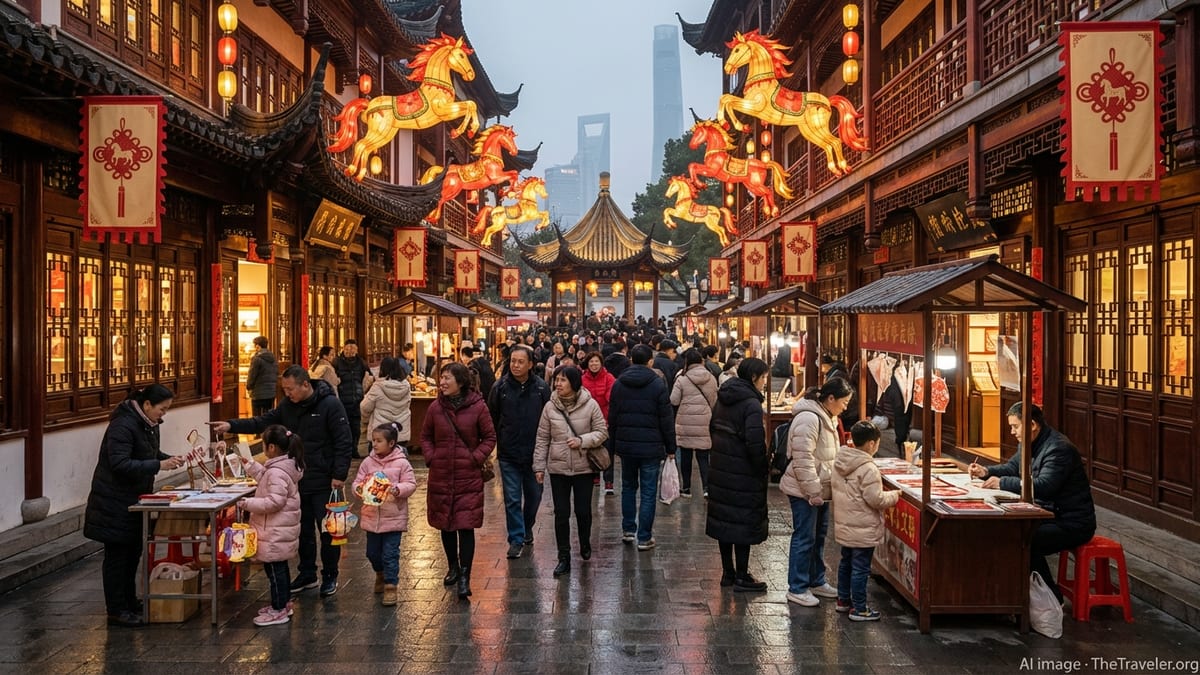
Yuyuan Garden, a perennial Spring Festival draw, served as the flagship venue. The historic bazaar district gathered nearly 100 intangible cultural heritage projects in one place, from traditional lantern craftsmanship and sugar painting to shadow puppetry and regional opera performances. Visitors could move between stalls watching artisans at work, then try their hands at making small New Year ornaments in guided workshops, turning what was once a photo-oriented visit into an interactive cultural circuit.
Across the city, museums and galleries leaned into the Year of the Horse theme. Nearly 50 special exhibitions focused on topics such as Shanghai-style qipao fashion, international exchanges and equine motifs in Chinese and Western art, while more than 60 art galleries staged over 100 exhibitions, including high-profile international collections. To bring these within reach of holidaymakers, the city introduced discounted entry schemes and a ShanghaiPass cultural tour ticket that granted access to 20 landmark venues and offered benefits at dozens of eateries.
Shanghai’s Changning District ran its own “Culture and Tourism+” carnival, weaving together fashion, art and lifestyle under the banner of a “Best Hongqiao” spring season. Seven interactive zones invited visitors to see, appreciate, tour, shop and savor, transforming a commercial area near the city’s transport hubs into a festival corridor that aimed to convert heavy transit flows into longer stays and repeat visits.
Yiwu Turns Gala Spotlight into Lasting Tourism Assets
In eastern Zhejiang Province, the trade hub of Yiwu offered a different blueprint for culture-led tourism by leveraging its role as a sub-venue for this year’s national Spring Festival Gala television broadcast. Local authorities coordinated a dense matrix of cultural tourism activities around the gala sites and five major commercial districts, aiming to turn a one-night spike in attention into enduring tourism appeal.
Over the course of the holiday, 14 towns and sub-districts launched 166 “Explore Yiwu with the Spring Festival Gala” experiences. These ranged from ancient town rooftop concerts and folk music performances to street parades and immersive storytelling sessions that highlighted Yiwu’s merchant culture. The Fotang Tourist Resort, in particular, staged intangible cultural heritage performances alongside riverside light installations, drawing more than 600,000 tourist visits and generating tourism revenue that surpassed 40 million yuan.
Yiwu also experimented aggressively with cultural and creative merchandise linked to the gala’s Year of the Horse branding. Working with designers and local craftspeople, the city developed 17 co-branded products such as woven bags and traditional rattles, complemented by more than a hundred “Yiwu Gifts” items. Pop-up stores in airports, train stations and busy shopping corridors, along with double-decker buses converted into mobile shops and a themed “Spring Festival Gala Post Office,” helped push sales of cultural products beyond 5 million yuan.
For domestic travelers, the combination of televised spectacle, on-the-ground performances and tangible souvenirs offered a layered experience that extended from screens into streets and finally into their suitcases. Tourism analysts say Yiwu’s approach illustrates how integrated cultural tourism can connect national media events with local economies, creating new reasons for travelers to anchor their Spring Festival itineraries around second- and third-tier cities.
Heritage, Nighttime Economies and New Cultural Spaces
Beyond headline cities, traditional temple fairs and historical districts saw renewed life as local governments invested in redesigning them as “open-air museums.” In Beijing, Xi’an and other ancient capitals, curated routes led visitors through clusters of folk performances, craft demonstrations and themed markets, accompanied by on-site storytellers explaining the origins of customs such as paper cutting, couplet writing and dragon dances.
Nighttime cultural tourism featured especially strongly in 2026. Many cities expanded their “night tours” with extended hours for key cultural sites, synchronized light shows on historic walls and bridges, and late-opening workshops at cultural centers where families could paint masks, make dumplings or practice calligraphy together. The goal was not only to boost evening consumption, but also to position local heritage as something to be experienced across the full day, not just in daylight hours.
Integrated cultural spaces also played a larger role. Converted industrial sites, riverfront warehouses and creative parks hosted joint programs that combined New Year markets with contemporary art installations and live music. These venues, often popular with younger travelers, offered a way to connect traditional iconography such as lanterns, zodiac animals and folk motifs with modern design and digital projections, creating backdrops that appealed to social media while still rooted in Chinese aesthetics.
In cold-climate destinations in the northeast, cultural tourism blended with winter sports and ice festivals. Scenic areas paired horse-themed snow sculptures and lantern mazes with performances of northeastern folk songs, while nearby villages organized homestay programs where guests could learn traditional pickling, paper cutting and local New Year dishes. Travel companies reported that such composite products, which speak to both lifestyle aspirations and cultural curiosity, are increasingly popular among families from southern provinces seeking full-week holiday experiences.
Digital Tools and Smart Services Reshape the Festival Journey
The Spring Festival’s reputation as the world’s largest annual migration remains intact, but digital tools are changing what those journeys look like. In 2026, mobile platforms became the backbone of integrated cultural tourism, handling everything from transportation to ticketing, navigation and in-depth interpretation of heritage sites.
Many local culture and tourism bureaus upgraded their official mini-programs ahead of the holiday. Visitors could browse recommended cultural routes categorized by interest, such as “intangible heritage for kids,” “museum nights” or “New Year on the water,” then book timed entry slots and purchase joint tickets. Once on site, the same apps pushed short audio guides, festival trivia and interactive tasks that encouraged users to collect digital stamps at key attractions in exchange for small gifts or discounts.
Robotics and artificial intelligence made cameo appearances in the cultural realm as well. The national Spring Festival Gala’s inclusion of performances featuring humanoid robots highlighted Chinese advances in robotics, even as some viewers expressed nostalgia for more traditional acts. In some tourist sites, simple service robots handled information queries or guided queue management, freeing human staff to focus on explaining cultural stories and assisting elderly visitors.
For travelers, the most visible impact of digitalization was smoother movement between experiences. Real-time maps with congestion indicators helped people decide whether to linger at temple fairs or shift to museums, while transport apps integrated shuttle services tailored to festival events. Hotels partnered with local cultural institutions to send guests curated updates on nearby performances and exhibitions, nudging them toward lesser-known venues rather than just the biggest city landmarks.
Global Echoes of China’s Cultural Tourism Push
The 2026 Spring Festival was not only a domestic story. Chinese tourists carried the integrated cultural tourism concept overseas, and foreign destinations increasingly responded with their own blends of traditional Chinese elements and local culture. In Southeast Asia, for example, parks and cultural centers hosted celebrations that combined lion dances, martial arts and calligraphy workshops with local music, crafts and cuisine.
One Chinese tourist in his 30s, interviewed while spending New Year’s Eve at a seaside restaurant on an Indonesian island, described how a spontaneously played Chinese folk song prompted cross-cultural toasts among diners from multiple countries. For him, the highlight of the trip was not shopping or sightseeing, but the chance to explain the meaning of Spring Festival customs to curious locals and fellow travelers.
Events organized by Confucius Institutes and Chinese cultural centers abroad mirrored many of the integrated experiences seen at home. Programs meshed park-style festivities with stage performances, inviting local residents and visiting Chinese communities to watch face-changing Sichuan opera, try tea ceremonies, make dumplings and practice Chinese paper cutting. Organizers emphasized explanations and hands-on participation, positioning the celebrations as educational experiences rather than one-off shows.
These overseas events form part of a broader trend in which cultural tourism becomes a two-way exchange. Chinese travelers accustomed to immersive cultural experiences at home increasingly seek similar depth when they go abroad, while foreign audiences exposed to Spring Festival customs are more likely to add Chinese destinations to their future travel plans, further reinforcing the feedback loop between culture and tourism.
Looking Ahead: From Seasonal Campaigns to Year-Round Cultural Travel
The 2026 Spring Festival underscored how far China has come in fusing cultural resources with tourism products, but it also highlighted the challenges that lie ahead. Many initiatives remain tied to the holiday calendar, raising questions about how to sustain staffing, programming and visitor interest once lanterns are taken down and families return to work and school.
Industry experts suggest that some of the most successful Spring Festival experiments will likely be scaled into permanent features. Citywide cultural passes, nighttime museum openings and heritage workshops that proved popular during the holiday are candidates for year-round adoption, perhaps in lighter forms outside peak seasons. Smaller cities that saw significant gains from festival programming may continue to develop joint branding around local crafts, historical districts and performing arts.
At the same time, there is growing recognition that integrated cultural tourism must balance commercial goals with authenticity and community needs. In some neighborhoods, residents have voiced concerns about noise, congestion and the commodification of sacred or historically sensitive sites. Officials say future planning will place greater emphasis on zoning, participation of local communities and limits on visitor numbers at fragile heritage locations.
For travelers, the direction of change is clear. Spring Festival is no longer just a backdrop for family dinners and television specials but an evolving stage for immersive cultural discovery, shaped by both national policy and local innovation. Whether they spent the 2026 holiday wandering a lantern-lit garden in Shanghai, browsing creative markets in Yiwu or sharing dumplings and stories at an overseas cultural fair, millions of people encountered a version of the festival that fused the old and the new in ways that are redefining how China celebrates, and how it travels.