

More news on this day
As a new Middle East conflict sends oil prices higher and disrupts air and sea corridors in early 2026, Gulf hubs such as Dubai and Abu Dhabi are confronting a sharp but uneven tourism setback that is testing the resilience of the region’s most ambitious destinations.
Get the latest news straight to your inbox!
Record Years Meet a Sudden Shock
Dubai and Abu Dhabi entered 2026 from a position of unusual strength. Official tourism data published in February showed Dubai welcoming about 19.6 million international visitors in 2025, its third consecutive record year and well above pre‑pandemic levels. Publicly available outlooks from banks and consultancies at the start of the year described Dubai’s tourism and aviation sectors as a primary engine for projected economic growth in 2026, supported by population gains, new attractions and a busy calendar of global events.
Abu Dhabi followed a similar trajectory, with steady growth in arrivals driven by Saadiyat Island’s museum district, expanding leisure offerings on Yas Island and a maturing mix of cultural, sports and business events. Regional analysis issued in late February highlighted the wider Gulf’s tourism and aviation sectors as key contributors to robust non‑oil growth, with Gulf Cooperation Council hubs expected to post some of the highest margins in global aviation this year.
That momentum, however, collided in late February with a rapid escalation of conflict involving Iran and its rivals. Military strikes around the Strait of Hormuz and renewed fears over the Red Sea transit corridor pushed oil prices sharply higher and triggered precautionary changes to airline routings and cruise itineraries. Within days, thousands of flights touching Gulf hubs were cancelled or rerouted, and cruise operators scaled back calls to ports inside the Arabian Gulf.
Travel industry estimates compiled in March pointed to tourism‑related losses in the wider Gulf running into the tens of billions of dollars if the disruption persists for several months. Sector bodies calculated daily hits to international visitor spending across the Middle East in the hundreds of millions, reflecting not only reduced arrivals but also higher operating costs for airlines and tour operators struggling with longer flight paths and fuel surcharges.
Airspace Disruptions Hit Gulf Hub Status
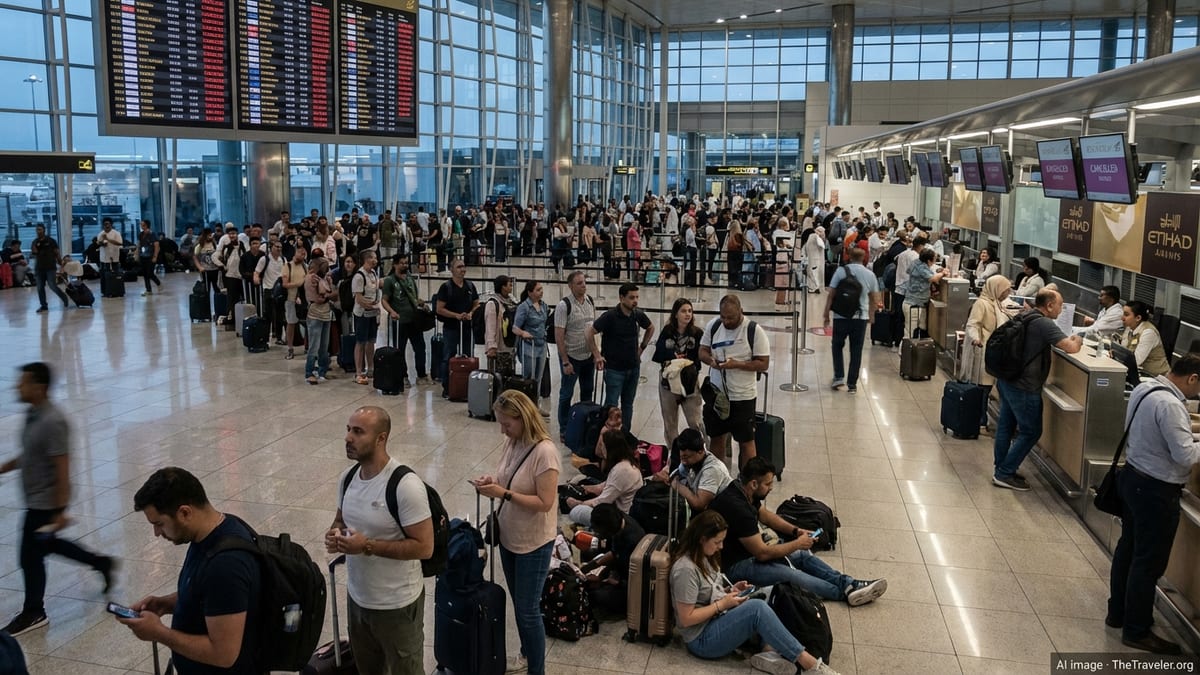
The most immediate blow for Dubai and Abu Dhabi has come through their role as global aviation crossroads. Analysis from travel data firms and aviation consultancies in mid‑March showed that the three major Gulf hubs of Dubai, Abu Dhabi and Doha, which on a typical day handle more than half a million passengers combined, suffered several thousand cancellations in the first 48 hours of the crisis, with schedules continuing to see heavy adjustment in subsequent weeks.
Long‑haul passengers from Europe, North America and Australia, who would usually connect via the Gulf, have increasingly opted for or been shifted to nonstop routes over Central Asia or alternative hubs in Southeast Asia and Europe. Reports from airline booking platforms indicate a measurable swing in demand toward destinations such as Thailand and Indonesia, as travelers seek to avoid perceived risk corridors and complex routings through disrupted airspace.
For Dubai International Airport, which in 2025 reclaimed its title as the world’s busiest international hub with more than 95 million passengers, the sudden airspace constraints represent both an operational challenge and a reputational test. Temporary suspensions of some services, longer routings for others and the need for flexible crew and fleet planning have raised costs and squeezed capacity just as carriers were planning for another year of expansion.
Abu Dhabi’s newer, but fast‑growing, terminal complex faces similar pressures. While the emirate has invested heavily in positioning itself as a premium transfer and origin‑destination market, published industry commentary suggests that its airline and airport operators now need to recalibrate growth plans, prioritizing routes that can be reliably served under changing airspace rules and aligning capacity with segments less sensitive to geopolitical headlines, such as business travel tied to energy and defense sectors.
Cruise Cancellations and Red Sea Risk Ripple Through
Beyond aviation, the Gulf’s cruise ambitions have also come under strain. The Red Sea crisis that began in 2023 had already forced repeated adjustments to itineraries linking Europe, Egypt and Gulf ports. United Nations and regional analyses released over the past year documented widespread rerouting and cancellations as operators weighed risks from attacks on commercial shipping and intermittent disruptions to key maritime chokepoints.
The latest escalation around the Strait of Hormuz has compounded those concerns. Recent reporting on the 2026 crisis described cruise ships suspending transits through the strait and scaling back operations in the northern Gulf, temporarily stranding thousands of passengers across several vessels and forcing lines to reposition ships to safer waters. While much of that disruption has centered on Saudi and Qatari ports, Dubai’s cruise terminals and Abu Dhabi’s growing cruise business have felt the knock‑on effects of weaker regional deployment.
Industry observers note that cruise tourism has been a relatively small, though fast‑growing, slice of the UAE’s overall visitor economy compared with air arrivals. Nonetheless, the sector has been a visible symbol of the Gulf’s strategy to position itself as a winter‑sun alternative to the Caribbean and Mediterranean. Extended interruptions to itineraries, combined with higher insurance premiums and fuel costs for any vessels still operating in the region, risk slowing that push at least through the current winter season.
Red Sea instability has also affected perceptions of nearby coastal destinations across the wider Middle East. Reports on previous incidents, including maritime accidents and security scares, have shown how quickly leisure travelers can pivot away from entire sea basins when safety becomes a concern. In that context, the UAE’s west‑facing Gulf shoreline and its urban resort model may offer a partial buffer, but sentiment remains fragile among cruise passengers in particular.
Domestic Demand, Events and Diversified Markets Provide a Cushion
Despite the turbulence, Dubai and Abu Dhabi retain structural advantages that many regional competitors cannot match. Analysts point to a large resident expatriate population, relatively high local incomes and well‑developed domestic leisure offerings as important stabilizers when international arrivals slow. Theme parks, retail destinations and cultural districts can tap local and regional weekend traffic, softening the blow from reduced long‑haul tourism.
Calendar strength is another line of defense. Event listings for 2026 highlight a dense program of music festivals, trade fairs, sports tournaments and aviation and business shows spread across both cities. While some events may face lower international attendance or date changes, the sheer number and diversity of gatherings provides a steady stream of reasons for regional visitors to travel, and for airlines and hotels to maintain baseline capacity.
Market diversification also helps. Over the past five years, Gulf tourism boards have targeted a wider spread of source markets across Asia, Eastern Europe and Africa, seeking to reduce dependence on any single region. Tourism promotion agencies in countries such as Thailand and others in Asia now view the Gulf both as a key source of outbound visitors and as a strategic partner, suggesting that two‑way flows will remain resilient even in periods of heightened tension.
Pre‑crisis forecasts from international tourism organizations had projected that the Middle East would again outpace global averages in 2026 in terms of visitor growth and travel spending, building on a 2025 performance that already exceeded 2019 benchmarks. While the current conflict has clearly put those projections at risk, the underlying appeal of Gulf destinations, combined with major ongoing investments in attractions and infrastructure, indicates that much of the lost activity may be deferred rather than permanently erased.
Strategic Pivots as the Peak Season Hangs in the Balance
Looking ahead to the second half of 2026, the key question for Dubai and Abu Dhabi is whether current disruptions prove to be a short shock or the start of a longer realignment in global travel patterns. Economic research houses warn that a protracted closure or intermittent disruption of the Strait of Hormuz would weigh heavily on Gulf non‑oil growth, both through higher operating costs and more cautious investor sentiment around tourism‑linked projects.
In response, destination strategies are already showing signs of adjustment. Travel trade briefings suggest a greater emphasis on regional and short‑haul markets reachable without traversing sensitive airspace, including intra‑GCC tourism and flows from the wider Middle East, South Asia and parts of Africa. Hoteliers are also reported to be leaning more heavily on long‑stay guests, from remote workers to corporate project teams, to maintain occupancy when transient tourist bookings dip.
At the same time, the Gulf’s tourism authorities continue to move ahead with visa reforms, unified visitor schemes and targeted marketing campaigns designed to keep the region top of mind for when conditions stabilize. The launch pipeline for new museums, entertainment districts and eco‑tourism projects across the UAE and its neighbors remains active, underlining the view in regional planning documents that tourism will stay central to economic diversification, even if the path is bumpier than anticipated at the start of 2026.
For now, the picture for Dubai and Abu Dhabi is one of contrast. Visitor numbers and aviation traffic that were setting records only months ago are facing their stiffest test since the pandemic, yet the scale of past investment in infrastructure and brand building has given both cities tools to absorb the hit. How effectively they deploy those tools in the coming months will determine whether 2026 is remembered as a brief setback or a turning point in the Gulf’s rise as a global tourism powerhouse.