

More news on this day
Dubai is tying its brand of sun, sea and skyline to a quieter story below the surface, using large-scale marine conservation projects and protected coastal habitats to reposition the emirate as a test bed for sustainable tourism in the Gulf.
Get the latest news straight to your inbox!
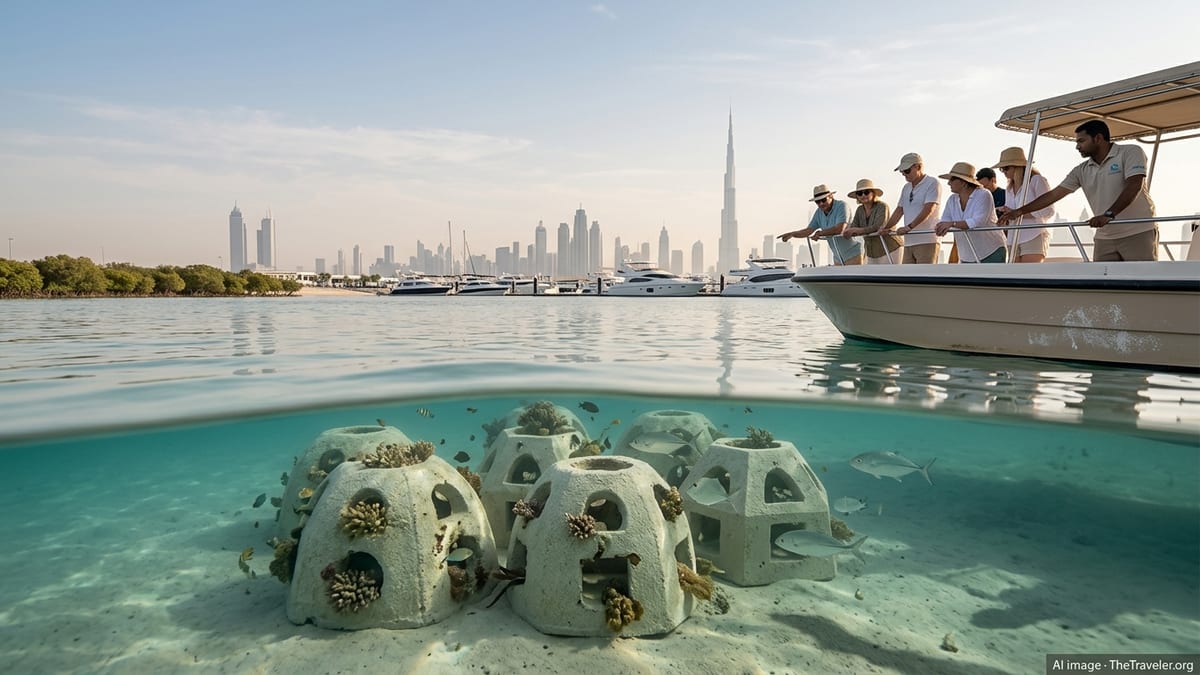
Artificial Reefs Put Marine Life at the Center of Destination Branding
Launched in 2024, the Dubai Reef initiative is emerging as one of the most visible symbols of the city’s shift toward ocean-focused sustainability. Publicly available information describes it as one of the world’s largest purpose-built reef developments, designed to increase marine biodiversity, restore fish populations and improve coastal resilience. Purpose-built modules are being deployed in phases off the emirate’s coastline, providing hard substrate for corals and shelter for fish in waters that have long been shaped by intensive coastal construction.
Recent government communications highlight that early monitoring footage from the pilot sites is already revealing a rise in marine activity around the structures, with fish aggregations and invertebrate colonisation beginning to take hold. The project is closely tied to national climate and biodiversity goals, including the UAE’s Net Zero by 2050 strategic initiative and global targets for “life below water.” By situating the reef fields off popular waterfront districts, planners are effectively turning restoration infrastructure into a future tourism asset, with potential for guided boat trips, snorkeling and diving experiences that showcase recovery rather than degradation.
The reef programme aligns with a wider push to position Dubai as a hub for sustainable yachting and marine leisure. Industry coverage points to a growing number of operators marketing lower-impact cruises, eco-focused yacht charters and wildlife-aware boating codes that restrict high-speed approaches to marine fauna. Together, these developments are helping recast the city’s coastline from a purely recreational backdrop to a living laboratory for conservation-minded tourism.
Wildlife Sanctuaries Become Urban Eco Escapes
Along the tidal edge of Dubai Creek, Ras Al Khor Wildlife Sanctuary illustrates how protected wetlands are being woven into the city’s tourism narrative. Official descriptions classify the 6.2 square kilometre site as a Ramsar-listed wetland of international importance, with salt flats, mangroves, mudflats and lagoons supporting thousands of wintering waterbirds, including the greater flamingo that has become an unofficial icon of the reserve. The sanctuary sits within sight of the downtown skyline, creating a striking visual contrast that marketing campaigns increasingly emphasise.
Municipal documents released in 2025 detail a multi-phase development plan for Ras Al Khor valued at around 650 million dirhams, aimed at improving visitor access while maintaining strict ecological protections. The plans include upgraded hides, boardwalks, viewing platforms and educational facilities designed to disperse visitor pressure and keep people on designated routes. Public information on the project notes that the sanctuary is expected to play a larger role in environmental education, school programmes and eco-tourism once works are completed.
Travel platforms and airline destination guides now routinely promote Ras Al Khor as an “eco escape” within the city, encouraging visitors to time trips with high tide to see fish and crabs among mangrove roots, or to visit in winter for peak bird numbers. Entry remains free, reinforcing its status as a public natural asset rather than an upscale attraction. The model reflects a broader Dubai strategy that treats protected areas as part of the tourism offering while retaining a conservation-first management approach.
Coastal Tourism Strategies Tie Luxury to Habitat Protection
Dubai’s tourism authorities are gradually embedding marine conservation benchmarks into how coastal resorts and attractions are planned and marketed. A 2024 sustainability report on the emirate’s visitor economy notes that eight protected areas, spanning mountain, desert, coastal and marine environments, now sit within the broader Dubai 2040 Urban Master Plan. The plan earmarks a significant share of the emirate’s land and nearshore waters as natural reserves, with quality-of-life strategies indicating that marine protected zones are expected to expand over the next decade.
Industry briefings on coastal tourism point to new mixed-use waterfront developments and beach resorts that are required to demonstrate shoreline protection, wastewater controls and habitat enhancement measures. Some hotel groups operating along Dubai’s beachfronts advertise internal targets for cutting water use, increasing renewable energy and supporting local marine research and rehabilitation programmes, positioning such work as part of the guest experience. This can include behind-the-scenes tours of conservation facilities, citizen-science activities such as beach clean-ups, and guidance on reef-safe sunscreens and wildlife interaction rules.
Specialised marine tour operators have also begun to brand themselves around lower-impact experiences. Regional travel features describe eco-boat tours that follow speed and distance limits near wildlife, night-time trips that minimise light pollution, and itineraries built around visits to protected mangroves or seagrass meadows rather than purely skyline views. These shifts suggest that what was once a niche is being pulled into the mainstream of Dubai’s marine tourism offer.
Science, Rehabilitation and Public Engagement Underpin New Experiences
Behind the visitor-facing elements, Dubai’s approach to marine conservation is increasingly anchored in scientific monitoring and species rehabilitation. Federal information on the UAE’s marine environment highlights an expanding network of marine protected areas, stricter fisheries regulations and targeted programmes for vulnerable species such as marine turtles. Within Dubai, these policies translate into localised initiatives that can be integrated into tourism products, from guided interpretation at visitor centres to curated exhibits explaining restoration techniques.
Corporate sustainability reports connected to ports and logistics operations in Jebel Ali reference pilot coral nurseries and habitat enhancement projects, some of which are linked to experimental reef structures and research partnerships. While primarily designed to mitigate industrial impacts, these projects contribute to a body of local knowledge on coral propagation, larval settlement and reef design that can inform future eco-tourism diving and snorkeling sites. They also provide material for educational displays that help visitors understand how built infrastructure and biodiversity conservation can be aligned.
At the same time, Dubai’s public-facing conservation spaces, from wetland hides to aquarium-style facilities, have been expanding their emphasis on environmental messaging. Exhibits and programming often focus on the ecological role of mangroves, seagrasses and coral reefs in protecting coastlines and supporting fisheries, as well as the risks posed by climate change and pollution. For travellers, this translates into experiences that move beyond spectacle toward a clearer understanding of how their presence and choices intersect with the health of the Gulf.
A Test Case for Blue Tourism in the Gulf
Regional observers increasingly describe Dubai as a test case for how fast-growing coastal cities can retrofit conservation into mature tourism economies. The convergence of artificial reef engineering, wetland restoration and stricter environmental planning rules is producing a form of “blue tourism” in which marine ecosystems are treated as core infrastructure rather than scenery. This represents a notable evolution from earlier phases of waterfront development that focused predominantly on land reclamation and recreational amenities.
Analysts also point out that expectations will continue to rise. As more visitors become familiar with global debates on ocean health, scrutiny of how destinations manage anchor damage, waste from marinas, water quality and wildlife disturbance is likely to intensify. In that context, projects such as Dubai Reef and the expansion of Ras Al Khor Wildlife Sanctuary will be watched closely as indicators of whether conservation outcomes can keep pace with the city’s marketing ambitions.
For now, Dubai’s trajectory suggests that Gulf tourism does not have to choose between luxury and biodiversity. By placing marine conservation projects at the centre of its brand story and gradually tightening the environmental performance of its coastal tourism sector, the emirate is seeking to show that a major global city can reinvent its relationship with the sea and invite visitors to participate in that shift.