

More news on this day
Once a regional carrier connecting Dubai to a handful of cities, Emirates has evolved into a global benchmark for luxury, comfort and service, resetting passenger expectations on long-haul travel and forcing competitors to rethink what “premium” really means in the sky.
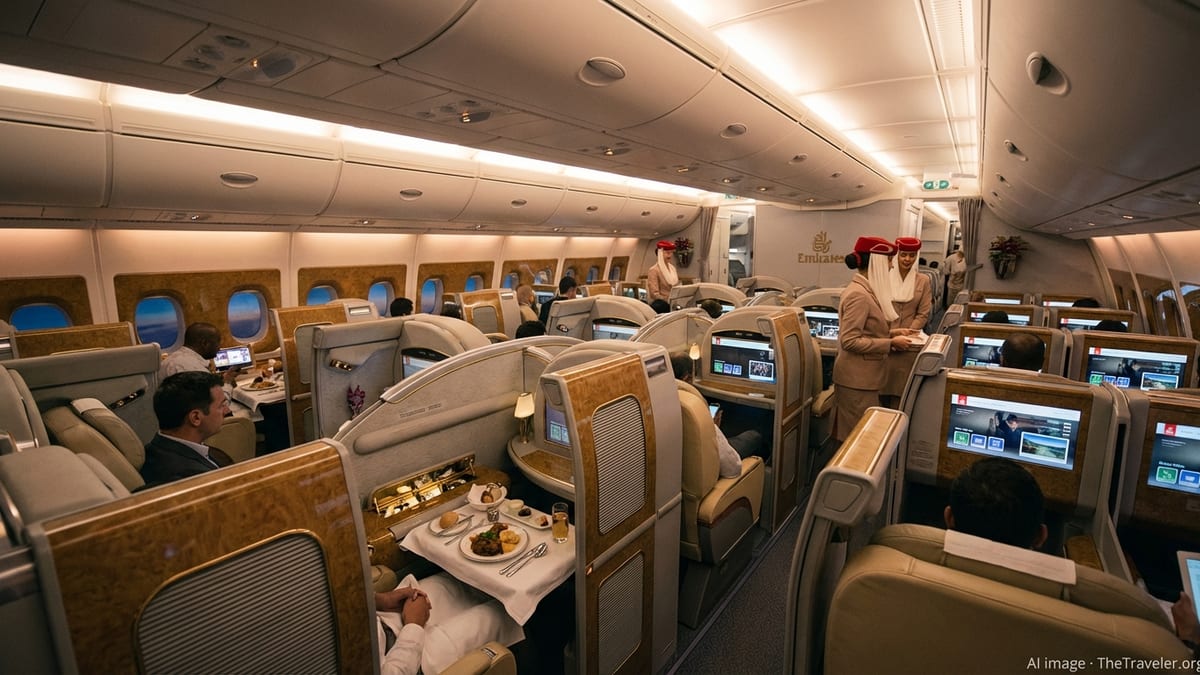
A Flagship Airline Recognized on the Global Stage
Emirates’ reputation for luxury is no longer just a marketing claim; it is sustained by a steady stream of international awards and passenger surveys that rank the Dubai-based carrier among the world’s top airlines. At the Skytrax World Airline Awards, one of the sector’s most closely watched barometers of customer sentiment, Emirates has consistently featured near the top of key premium categories, especially for first class and onboard entertainment. In 2024 the airline collected seven major Skytrax accolades, including titles for best first class comfort amenities, best first class in the Middle East and best premium economy in the region, underscoring the strength of its products at multiple price points.
Independent rankings outside traditional aviation circles are also taking note. In the 2025 Verified Air Travel Awards compiled by Forbes Travel Guide, Emirates was named Best International Airline, a notable achievement in a year that saw intensified competition across long-haul markets. That recognition reflects not just the appeal of its premium cabins, but also the overall end-to-end experience, from check-in to arrival, at a time when many travelers are more discerning about where they spend their money.
These accolades matter because they influence corporate travel buyers and leisure passengers alike, shaping route choices and loyalty decisions. When an airline repeatedly emerges near the top of industry rankings, it signals a level of reliability and consistency that goes beyond one-off marketing campaigns or flash upgrades. For Emirates, that consistency has become part of its brand identity, helping to justify premium fares while setting a reference point for rival carriers seeking to climb the same league tables.
First Class That Functions Like a Private Hotel Suite
Emirates’ first class product has long been at the center of its luxury narrative, and the airline continues to refine it as competitors introduce their own suites and enclosed cabins. On selected Boeing 777-300ER aircraft, Emirates’ so-called “Game Changer” suites are designed more like compact hotel rooms than traditional airline seats. Each suite features floor-to-ceiling sliding doors, a fully lie-flat bed with zero gravity seating inspired by luxury automotive design, individual climate controls and large entertainment screens. On some aircraft, windowless middle suites use virtual windows that project live views from outside the aircraft, preserving the sense of space and connection to the sky.
The experience extends beyond the hard product. First class travelers are offered chauffeur-driven transfers in many markets, priority and often private check-in zones, and access to premium lounges at Dubai International Airport and major global hubs. Onboard, the service model focuses on personalization: passengers can dine on demand with multi-course menus that include caviar and top-shelf champagne, choose from an extensive wine list and request turn-down service with mattress toppers and high-end bedding. Amenity kits feature designer brands, while shower spas on the Airbus A380 give passengers the chance to freshen up mid-flight, a perk still rare even among the world’s most prestigious airlines.
In a landscape where several global carriers now offer suites and sliding doors, what keeps Emirates at the forefront is the cohesion of its first class ecosystem. The airline has invested not only in headline-grabbing features, but also in smaller touches such as noise insulation, adjustable lighting and thoughtfully curated inflight entertainment. Together they create an environment that many frequent travelers describe as closer to a private jet than a commercial airliner cabin, setting expectations that ripple down to business and premium economy travelers who see first class as the standard-bearer for the brand.
Business, Premium Economy and Economy That Stretch Comfort Further
While first class garners the most attention, the strength of Emirates’ value proposition lies in the way it spreads comfort through the rest of the cabin. The airline has been rolling out a major retrofit program across its wide-body fleet, including Boeing 777s and Airbus A380s, to introduce a new generation of business class and premium economy seats. Retrofitted 777s, for example, now feature business class cabins configured in a 1-2-1 layout, giving every passenger direct aisle access, a notable improvement over older 2-3-2 configurations that required some travelers to climb over their neighbors on overnight flights.
These refreshed aircraft also bring Emirates’ increasingly popular premium economy product to more routes, including key gateways in the United States and Europe. The cabin is designed to bridge the gap between economy and business, with wide leather seats, leg rests, a generous seat pitch around 40 inches, and large entertainment screens. On high-demand routes such as Dubai to New York and services linking Newark with Athens and onward to Dubai, Emirates is steadily shifting to four-class layouts that include first, business, premium economy and economy, giving travelers a finely graded set of options depending on budget and comfort needs.
Even in economy, Emirates aims to exceed expectations by focusing on seat ergonomics, cabin design and inflight service. Recent refurbishments have introduced calmer color palettes, larger seatback screens and updated cushions that support longer periods of sitting. Combined with the airline’s reputation for generous baggage allowances and well-regarded onboard catering relative to many competitors, these incremental improvements help turn long-haul flights into more manageable experiences for passengers who are not traveling at the front of the plane.
A Hub in Dubai Built Around the Seamless Journey
Emirates’ ability to deliver a premium experience is closely tied to its home hub at Dubai International Airport, which has grown into one of the world’s busiest and most globally connected aviation gateways. The carrier’s model depends on funneling traffic through Dubai, then dispersing it across a network that spans more than 100 countries. To keep that machine running smoothly, the airline and airport operator have invested heavily in streamlining passenger flows, expanding lounges and enhancing retail and dining options tailored to international travelers who may spend several hours in transit.
Terminal 3, used almost exclusively by Emirates, is central to this strategy. Here, travelers move through dedicated check-in zones, security channels and boarding gates that are calibrated for high volumes but designed to maintain a sense of calm. For premium passengers, multiple lounges across concourses offer quiet workspaces, showers, family zones and dining areas that mirror upscale hotel buffets rather than crowded airport cafes. The scale of these lounges is striking, with some able to accommodate hundreds of passengers at peak times without feeling congested.
Beyond infrastructure, the Dubai hub plays a strategic role in making long-haul journeys feel shorter. By carefully timing banked arrivals and departures, Emirates enables one-stop connections between cities that historically required two or more stops, such as many secondary destinations in Asia and Africa linking to North America or Europe. For passengers, this network design means not only shorter total travel times, but also more consistent service standards across the journey, as most long-haul sectors are operated by Emirates aircraft rather than an array of codeshare partners.
Inclusive Design and Accessibility as Luxury in Disguise
In recent years Emirates has broadened its definition of premium travel to include accessibility and inclusivity, recognizing that for many passengers true comfort means fewer barriers, clearer information and more control over the journey. At Dubai International Airport, the airline has begun rolling out upgraded self-service kiosks and immigration technologies designed specifically with accessibility in mind. Features such as adjustable screen heights, tactile buttons, text-to-speech functionality and audio guidance via headphone jacks aim to make check-in and boarding less stressful for travelers with mobility or visual impairments.
The airline has also invested in enhancements to its so-called Smart Tunnel technology at immigration, which uses facial recognition to allow eligible passengers to clear border formalities within seconds. New dual-height camera setups are intended to ensure that children and wheelchair users are captured accurately, signaling a deliberate effort to avoid leaving any group behind as airports move toward biometric processing. Onboard, Emirates has announced upgraded mattress designs in business class that stay secured to the seat throughout the flight, reducing disruption for travelers with reduced mobility when the cabin is prepared for landing.
Complementing these physical changes is a digital Accessible and Inclusive Travel Hub, which consolidates information about special-assistance services, traveling with medical equipment, wheelchair support and guidance for neurodivergent passengers. The hub is designed to evolve as best practices change, reflecting a growing industry trend to treat accessible travel as a core service rather than an optional add-on. For Emirates, these initiatives double as competitive differentiators: when a premium product is easier to use for more people, its perceived value rises, and the airline strengthens its appeal among families, older travelers and those with specific medical or sensory needs.
Entertainment, Service Culture and the Details That Define Comfort
Beyond seats and hardware, much of Emirates’ edge comes from its emphasis on what passengers actually experience over the course of a long flight: entertainment, food, quiet and attentive service. The airline’s inflight entertainment system, branded “ice,” has repeatedly been cited as among the best in the world, with thousands of channels spanning films, television, music, podcasts and live TV in dozens of languages. For many passengers, especially on ultra-long sectors between Dubai and North America or Australasia, that breadth helps turn long hours in the air into an opportunity to catch up on global cinema or binge-watch series that are not yet widely available at home.
Cabin crew training is another element that distinguishes Emirates in customer surveys. The airline recruits a multinational cohort of flight attendants and emphasizes soft skills such as cultural sensitivity, language abilities and conflict resolution. This approach is critical when serving a passenger mix that can include families heading on holiday, business travelers working across time zones and transit passengers from regions with very different service expectations. In premium cabins, crew are encouraged to tailor the experience to individual preferences, whether that means setting up a workspace with extra power adapters or quietly preparing a bed and keeping the lighting low for passengers who want to sleep from takeoff to landing.
Dining also plays a central role in how travelers perceive value. Emirates invests in regionally inspired menus and partners with caterers who can deliver consistent quality across far-flung outstations. In first and business class, a dine-anytime concept allows passengers to decide when and how much they want to eat, matching their body clocks rather than rigid service rounds. In economy and premium economy, the airline aims to exceed the shrinking standards seen on some competitors by serving full hot meals on many long-haul sectors and offering special meals for dietary requirements that can be requested in advance. Over time, these cumulative details reinforce the perception that Emirates offers more than a seat; it offers a curated experience.
Fleet Investment and Network Expansion That Shape the Future of Travel
Emirates’ ability to sustain a high standard of onboard product hinges on its long-term fleet strategy, which has focused overwhelmingly on wide-body aircraft capable of carrying large numbers of passengers in multiple cabin classes. The airline operates one of the world’s largest fleets of Airbus A380s and Boeing 777s, and it is in the midst of a multi-billion-dollar retrofit program to refresh cabins as deliveries of new-generation aircraft such as the Boeing 777X have faced delays. Recent orders for Airbus A350s and additional 777s signal how Emirates plans to balance capacity growth with improved fuel efficiency and range flexibility in the coming decade.
These fleet moves are taking place against a backdrop of robust demand through Dubai, where passenger numbers have rebounded and surpassed several pre-pandemic benchmarks. The emirate is investing heavily in its aviation infrastructure, including plans to expand Al Maktoum International Airport into a mega-hub capable of handling well over 100 million passengers annually in the next decade. For Emirates, this growth trajectory provides the runway to add frequencies on established routes and open new ones, particularly in high-growth markets such as Africa, South Asia and secondary European cities that benefit from one-stop connectivity.
Route decisions increasingly reflect a strategy of spreading the premium product to markets where rising middle classes and expanding corporate footprints are driving demand for better travel experiences. Additional daily flights between Dubai and key cities like Cairo, for example, are designed not only to absorb local demand but also to feed long-haul services to North America, Europe and Australasia. As more of these flights operate with four-class configurations that include premium economy, the Emirates model of layered comfort options becomes accessible to a broader segment of travelers worldwide, steadily changing expectations of what long-haul flying can feel like.