

More news on this day
As conflict in the Middle East closes airspace, disrupts routes and pushes up fuel costs, Gulf carriers Etihad Airways and Qatar Airways are quietly reshaping loyalty benefits and waiver policies in ways that matter directly to business travelers.
Get the latest news straight to your inbox!
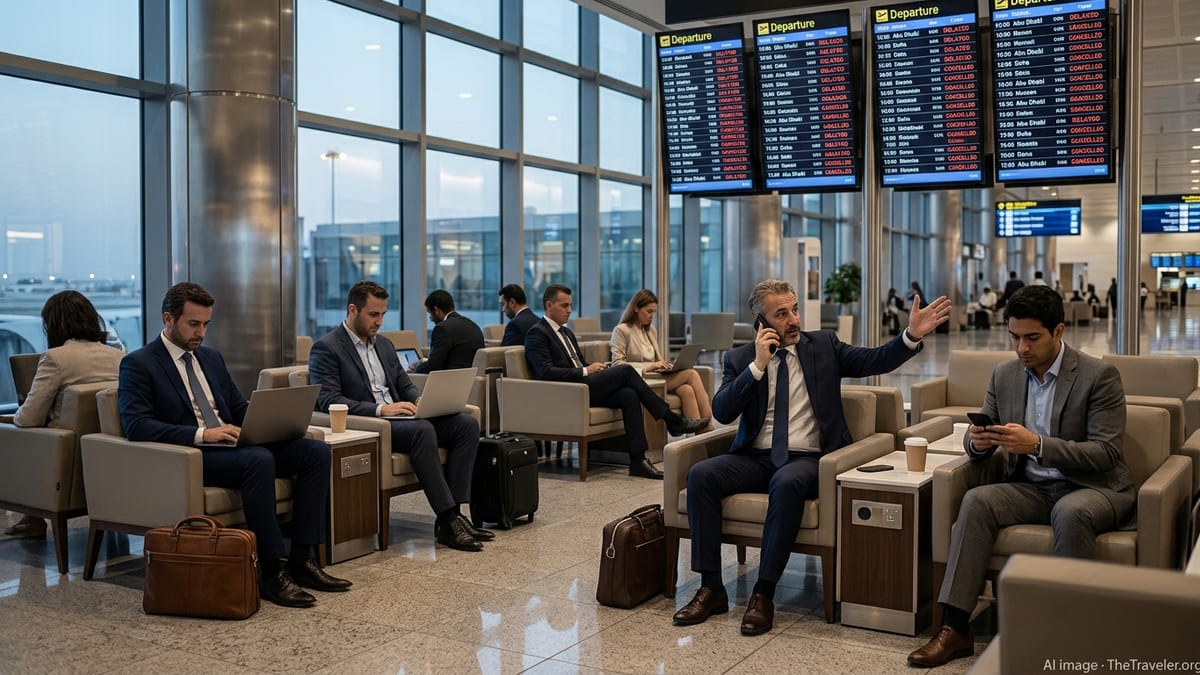
Business Travel Under Pressure in a Shifting Middle East
Escalating conflict involving Iran and neighboring states has produced some of the most severe aviation disruption in the region since the pandemic. Reports indicate that wide swathes of regional airspace have been periodically closed, forcing airlines to cancel or reroute thousands of flights and leaving travelers stranded or facing extended detours. The Strait of Hormuz crisis and associated security measures have added to already elevated operational risk and cost for carriers using key Gulf hubs.
Publicly available analysis of the 2026 Iran war and related airspace closures shows that Bahrain, Iraq, Israel, Kuwait, Qatar, Syria and the United Arab Emirates have all restricted flights at various points, squeezing capacity on core business corridors that connect Europe, Asia and Africa via the Gulf. Network airlines based in Abu Dhabi and Doha are therefore operating in an environment where schedules can shift at short notice, and where premium long haul demand coexists with heightened geopolitical risk.
At the same time, business travel demand into and within the Middle East has remained resilient. Industry and regional media coverage through late 2025 and early 2026 describes double digit growth in corporate travel spending, driven by energy projects, infrastructure investment and large events across the Gulf. This backdrop helps explain why loyalty adjustments by Etihad and Qatar Airways focus less on deep discounting and more on tactical flexibility, status protection and keeping high yield travelers within their ecosystems during a volatile period.
For corporate travel managers and frequent flyers, this combination of strong demand and fragile operations raises two immediate questions. First, how protected are premium passengers when a route suddenly becomes unusable. Second, how do evolving rules around status qualification, mileage credit and waivers affect the value of consolidating trips with a single Gulf carrier.
Etihad Guest: Tier Relief and Conflict-Related Waivers
Etihad Airways has taken relatively transparent steps to shield its loyal customers from the most disruptive effects of the current crisis. Publicly available Etihad Hub notices dated late February 2026 outline a waiver for guests impacted by what the airline describes as the “Middle East situation,” allowing rebooking on Etihad operated flights through mid March without standard penalties for eligible tickets. The carrier frames this as an extension of its standard schedule change policy, adapted to a fast moving security environment.
Alongside operational waivers, Etihad is also easing the path to elite status. Communications shared with Etihad Guest members and discussed in traveler forums in March 2026 indicate that the airline has reduced tier qualification thresholds by around 25 percent and is automatically extending existing status for members who meet the revised criteria. This approach closely mirrors the status protection measures many airlines deployed during the pandemic, and it reflects a recognition that conflict related cancellations and reroutings can make it harder for even heavy travelers to hit original mileage or tier point targets.
Etihad’s published rules and notices also reiterate general rights in cases of significant delays, cancellations or involuntary downgrades, including rebooking options and, in some jurisdictions, compensation where local regulations apply. While these protections are not specific to the current conflict, they form part of the toolkit that corporate travelers can rely on when itineraries via Abu Dhabi are disrupted. Travel managers may wish to review how these standard provisions interact with the temporary Middle East waiver language for journeys touching high risk routes.
For business travelers, the practical takeaway is that maintaining or achieving Etihad Guest status in 2026 may require fewer tier miles or segments than in previous years, while still unlocking lounge access and priority services that are particularly valuable when queues lengthen after large scale schedule changes. However, the precise benefits and eligibility conditions depend on fare type and route, so corporate travel buyers are increasingly scrutinising the fine print before steering share of wallet toward Etihad.
Qatar Airways: Privilege Club Under Scrutiny as Routes Shift
Qatar Airways, another major connector for corporate traffic between Europe, Africa and Asia, has faced similar operational headwinds as airspace restrictions ripple across the Gulf. According to published coverage of the broader regional disruption, Doha has periodically been affected by reroutings and security driven caps on overflight, reshaping some of the shortest and most popular one stop itineraries for business travelers.
Against this backdrop, the carrier’s Privilege Club program has come under close attention from frequent flyers. Publicly available information on Qatar Airways’ tier structure already highlighted a shift in recent years toward a points based system that can make it harder for passengers traveling on certain codeshare or discounted corporate fares to accumulate qualifying points. Online traveler discussions in 2025 and 2026 describe cases where government or corporate tickets booked under partner codes earn reduced or no Qpoints, complicating status retention even for passengers who fly frequently on Qatar aircraft.
In the current conflict environment, this dynamic is especially sensitive. Some recent traveler accounts suggest that Privilege Club status can still improve access to rebooking channels and alternative routings during mass disruptions, but that lower tier or non member passengers may struggle to reach call centers or secure favorable options when flights are suddenly canceled. While such reports are anecdotal rather than formally documented policy, they are contributing to a perception that elite status with Qatar Airways is becoming more important as a resiliency tool.
At the same time, Qatar Airways has not yet mirrored Etihad’s broad public move to reduce tier qualification thresholds in response to the 2026 crisis. Any temporary waivers or flexibilities appear to be more targeted, often tied to specific flights, dates or destinations rather than published as region wide loyalty relief. Corporate buyers therefore face a more fragmented landscape when modelling how much flexibility Privilege Club offers their travelers on high risk routes.
What Corporate Travelers and Travel Managers Should Prioritize Now
The rapid pace of change in Middle Eastern airspace means that static travel policies can quickly become outdated. Industry reports note that tens of thousands of flights in the region have been canceled or rerouted since the latest phase of the conflict escalated, creating a level of operational unpredictability that sits uneasily with the tight schedules of senior executives, technical specialists and project teams. In this context, the structure of a carrier’s loyalty and waiver policies becomes a core risk management tool rather than a purely marketing feature.
For itineraries routed via Abu Dhabi, Etihad’s decision to lower tier thresholds and formalize a conflict related waiver window through March 2026 suggests a strategy focused on retaining high value customers even if their flown mileage temporarily dips. Travelers who are close to a status boundary may find that a small number of additional segments now deliver benefits that significantly ease disruptions, from lounge access during long reroutes to priority handling when seats on alternative flights are scarce.
For travel via Doha, the picture is more nuanced. Privilege Club remains valuable for travelers able to book qualifying fares directly with Qatar Airways, especially on long haul premium cabins where tier benefits are most visible. However, corporate and government customers whose tickets are frequently issued under partner codes may earn fewer qualifying points, reducing their ability to rely on status as a buffer against conflict driven irregular operations. Travel managers may need to work more closely with their agencies and with Qatar Airways’ published earning charts to understand where loyalty value is being diluted.
Across both airlines, one consistent theme in publicly available guidance is the emphasis on checking the latest waiver pages and booking conditions for each ticket rather than assuming uniform protections. As the Middle East conflict continues to evolve, the fine details of eligibility windows, permitted rerouting and fare class exclusions can change with little notice. For businesses that rely on Gulf hubs to connect teams and projects, real time policy tracking and a clear view of Etihad and Qatar Airways loyalty mechanics are becoming as important as traditional considerations such as schedule and onboard product.