

More news on this day
From revived night trains between capital cities to faster cross-border routes funded by Brussels, Europe’s high-speed rail network is entering a pivotal year in 2026 that could reshape how millions of tourists move around the continent.
New Cross-Border Routes Put Trains at the Heart of City Hopping
Timetable changes and freshly announced services for 2026 are turning Europe’s rail map into a more seamless web of city connections, directly targeting leisure travelers. One closely watched launch is the Paris to Berlin night train, which European Sleeper plans to operate three times a week from March 26, 2026, routed via Brussels. The service restores an overnight link that many travelers relied on before a previous night train on the corridor was withdrawn in late 2025, and it plugs Paris, Brussels and Berlin into a single overnight tourism corridor.
The Belgian-Dutch cooperative is also preparing a Brussels to Cologne to Zurich to Milan overnight train, with operations scheduled to begin on September 9, 2026, according to a recent company press release. That route would create an overnight rail spine from the Low Countries through the Rhine valley to the Alps and northern Italy, effectively stitching together several of Europe’s most visited regions on a single sleeper train.
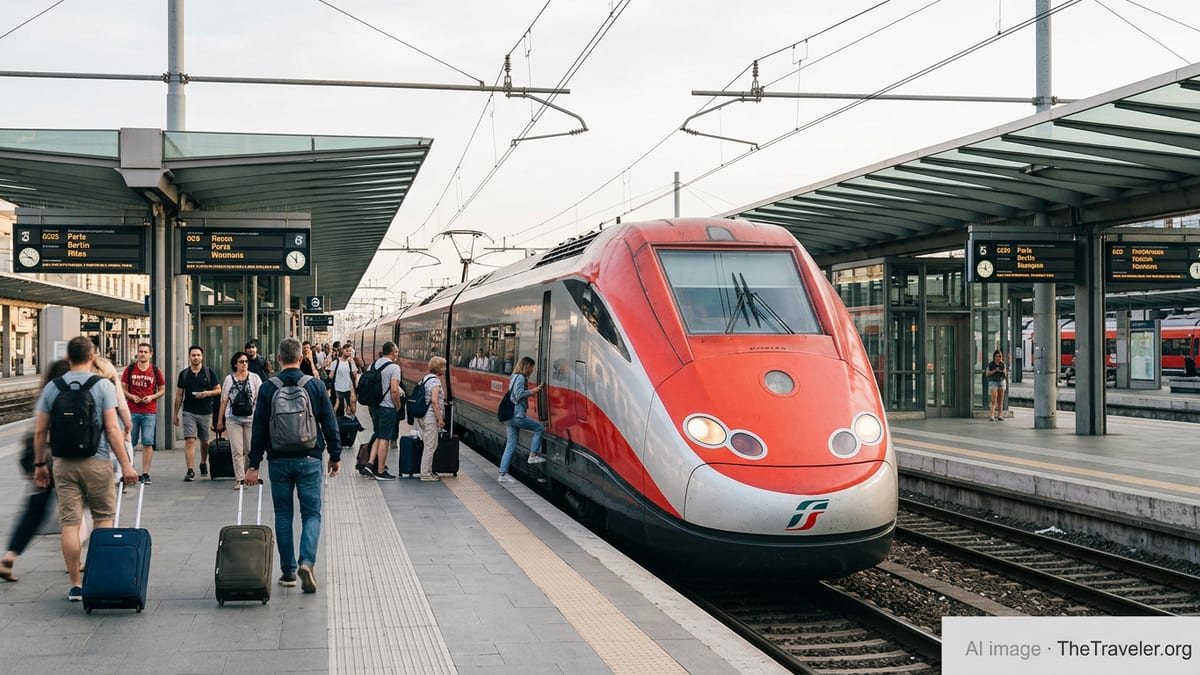
Other national operators are adding capacity and speed on daytime high-speed routes that serve as the backbone for tourism flows. Trenitalia’s Frecciarossa service between Paris and Milan, which is scheduled to be fully restored and ramped up through 2025, is being positioned as a key axis for Italian and French tourism in 2026, with additional frequencies and competitive journey times of around seven hours between the two cities. Industry analysts say these cross-border corridors are increasingly designed with weekend trips, multi-country rail passes and city-break tourism in mind.
EU Policy Push Gives Rail a Competitive Edge Over Short-Haul Flights
Behind the burst of new cross-border trains is a deliberate policy shift at European level. In November 2025, the European Commission adopted a high-speed rail action plan aimed at accelerating construction of long-planned lines and improving existing ones. The plan builds on the Trans-European Transport Network, but with a sharper focus on making rail a more attractive alternative to short-haul flights by cutting journey times between major cities.
Commission documents highlight future links such as Paris to Lisbon via Madrid and a six-hour rail journey between Sofia and Athens as emblematic goals for the 2030s. While many of these projects will not be complete in 2026, the political signal matters now: member states are being pushed to prioritize rail investment and remove regulatory barriers that slow cross-border services. A dedicated 2026 research call under the Europe’s Rail program will fund next-generation rolling stock and operations, while new EU rules scheduled for 2026 are set to simplify cross-border train driver certification, easing the path for operators to expand international services.
Tourism bodies across the continent are seizing on this shift. National and regional tourism boards are increasingly marketing rail as the default mode for multi-country trips, especially where high-speed lines already offer competitive travel times. Rail operators, in turn, are working more closely with destination marketers to package tickets with hotels and cultural attractions, betting that policy momentum and consumer demand for low-carbon travel will converge in 2026.
Capacity, Competition and New Players Transform the Passenger Experience
The hardware of Europe’s high-speed revolution is also changing rapidly. In late 2025, Eurostar confirmed a major order for up to 50 new Alstom high-speed trains from the Avelia Horizon family, designed to run in as many as six countries, including France, the United Kingdom, Belgium, the Netherlands, Germany and Switzerland, and through the Channel Tunnel. The additional fleet is intended to lift Eurostar’s annual passenger numbers from about 20 million in 2025 to around 30 million by 2030, significantly expanding international high-speed capacity that is heavily used by tourists.
On domestic networks, competition is intensifying as new entrants challenge former monopolies. In France, Trenitalia’s red-liveried Frecciarossa trains on routes such as Paris to Lyon and Paris to Milan have put price and service pressure on incumbent SNCF, which has responded with its own expansions and promotions. Similar dynamics are playing out in Spain, where iryo and other private high-speed players are shaking up routes linking Madrid, Barcelona and the Mediterranean coast. For tourists, this competition is translating into lower fares on some routes, more frequent departures and a wider range of onboard experiences, from low-cost offerings to premium business-style cabins.
Infrastructure upgrades planned to come on stream around 2026 add another layer of change. In Italy, the long-awaited Tortona to Genoa high-speed and high-capacity line, known as the Third Pass, is slated for completion by 2026, cutting travel times between the Ligurian coast and the northern rail hub around Milan. While designed partly for freight, the corridor is expected to make it easier for tourists to combine city stays in Milan or Turin with coastal getaways on the Italian Riviera using rail instead of rental cars.
Night Trains Emerge as the Sleeper Hit of Sustainable Tourism
Alongside daytime high-speed services, a renaissance in night trains is giving Europe a distinctive tourism product that airlines cannot match. After the cancellation of the Paris to Berlin Nightjet in December 2025, rail enthusiasts feared a setback for overnight travel. But European Sleeper’s plan to step into the gap from March 2026, and to expand further to Milan later in the year, has been widely read as a sign that entrepreneurial operators see strong demand in the leisure market.
Travel media outlets have already begun profiling 2026’s new sleeper services, highlighting routes such as Brussels to Milan, Warsaw to the Croatian coast and upgraded night trains in central Europe as “bucket-list” experiences in their own right. National railways, including Austria’s ÖBB, are focusing less on launching completely new lines in 2026 and more on improving comfort and reliability, introducing refreshed carriages, better onboard catering and improved digital booking tools. These upgrades are targeted squarely at tourists willing to pay a premium for a lower-carbon, more romantic way to cross the continent overnight.
For younger travelers and families, the economics of night trains can also be compelling. By combining transport and accommodation in a single fare, overnight services allow visitors to maximize time on the ground in destinations like Berlin, Prague or Milan. As rail passes and dynamic pricing tools become more sophisticated, operators hope to fill berths year-round, smoothing out seasonal tourism peaks.
Air-Rail Partnerships and Digital Tickets Simplify Multi-City Itineraries
One of the big bets for 2026 is that travelers will no longer need to choose between flying and high-speed rail, but will instead mix the two using a new generation of combined tickets. A recent agreement between Italy’s FS Italiane group and ITA Airways, signed in early 2025, offers a taste of what is to come: so-called train plus air tickets that link high-speed services in Spain, operated by iryo, with international flights. The deal allows passengers to book a single itinerary that covers both their flight and connecting high-speed train, with coordinated schedules and protection in case of delays.
Similar partnerships are emerging elsewhere as airlines seek to align with climate goals and free up scarce airport slots by shifting short feeder flights to rail. For tourists planning multi-city journeys, this offers the prospect of arriving in Europe by air, then continuing around the continent by high-speed train on a single ticket, with through-checked baggage and simplified customer service.
Digital platforms are racing to keep pace with this more integrated landscape. Independent booking sites specializing in rail are expanding inventories of cross-border high-speed and night trains, while national operators are upgrading their own apps to sell foreign services and rail passes directly. The result is a booking environment in 2026 that is expected to look more like that of budget airlines in the early 2010s, but with a stronger emphasis on multimodal journeys.
For Europe’s tourism industry, the stakes are high. With governments tightening climate targets and travelers increasingly conscious of their carbon footprint, the ability of high-speed and overnight trains to offer fast, comfortable and relatively low-emission journeys may determine who wins the battle for the continent’s city hoppers in 2026 and beyond.