

More news on this day
Across France’s motorways and national roads, the understated brown signs that punctuate the landscape are evolving from simple markers into curated cultural gateways, inviting drivers to turn routine journeys into detours through history, heritage and local identity.
Get the latest news straight to your inbox!
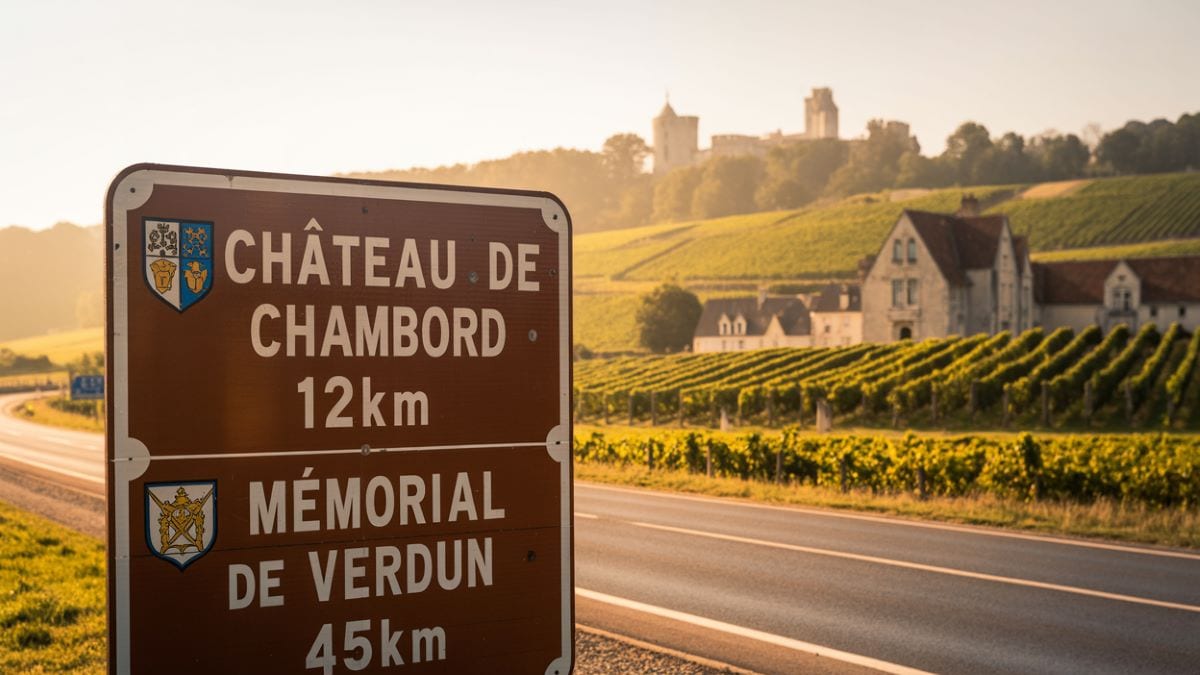
Image by Travel And Tour World
From Traffic Aid To Cultural Gateway
France’s brown tourist road signs, officially known as cultural and tourist information signs, emerged in the 1970s alongside the rapid expansion of the motorway network. Publicly available historical material indicates that transport planners saw them as a way to break the monotony of long drives while pointing travelers toward nearby landmarks, villages and landscapes.
Regulatory texts later codified this role, defining a dedicated family of “panneaux d’animation culturelle et touristique” with a brown background and white graphics to distinguish them from standard blue or green directional signage. The color choice, often interpreted by designers and historians as a reference to earth and place, helped embed an association between brown signs and heritage in the minds of drivers.
Over time, the signs have multiplied along major axes such as the A6 between Paris and Lyon, the A7 toward the Mediterranean and the Atlantic-facing A10. Rather than simple labels, they now function as short narratives in motion, hinting at cathedrals, wine routes, Roman remains, fortified towns or natural parks that lie within a short drive of the carriageway.
This evolution has turned France’s strategic road network into a kind of open-air index of national culture. For international visitors arriving by car or rental vehicle, the brown signs frequently constitute their first invitation to explore destinations beyond the best-known city centers.
Designing A Scenic Journey At 130 km/h
The effectiveness of the brown signs depends on strict design rules refined over several decades. Guidance shared by motorway operators and departmental authorities shows that panels must be legible in about three seconds, the time it takes for a driver at 130 km/h to recognize a symbol, read a place name and decide whether to note an exit number.
Most large motorway signs follow a three-part layout. At the top, the site name appears in white on a darker brown band. The central field carries a stylized illustration intended to be both attractive and instantly readable, while a secondary motif or logo at the bottom may reference local themes such as wine, forests or coastal landscapes.
Recent renewal campaigns, including projects on the A71 in the Cher department, the A31 in the Vosges and new panels unveiled in 2024 and 2025 in Deux-Sèvres, illustrate a broader shift toward contemporary illustration and coordinated graphic charters. Departments and motorway concessions are increasingly commissioning illustrators to create families of panels that form a coherent visual story along a corridor.
This design effort is not purely aesthetic. Clear, attractive imagery is seen by tourism specialists as a way to maintain driver attention without causing distraction, while also ensuring that the region’s key attractions stand out in a dense visual environment of standard road signs and commercial billboards.
Curating Culture, History And Local Identity
Behind each brown sign lies a selection process that combines national rules with local priorities. Methodological guides referenced by heritage organizations describe how departments, tourism boards and heritage bodies submit proposals that must meet criteria of cultural, historical or natural significance, and demonstrate enduring interest rather than short-lived appeal.
The result is a curated gallery of sites that range from major monuments to more discreet heritage. Motorists may encounter panels for medieval abbeys in Burgundy, Renaissance palaces in the Berry region, the Route des Grands Crus vineyards in Côte d’Or, or memorial sites linked to key episodes of French history. In the Vosges, for example, a series of renewed panels highlights both religious heritage and emblematic figures, turning a 48 kilometer stretch of the A31 into a condensed lesson in regional identity.
For smaller destinations far from traditional tourist circuits, being featured on a brown sign can represent a powerful form of recognition. Case studies reported in regional media show local debates when applications are accepted or refused, as communities seek visibility on busy corridors that may carry millions of vehicles a year.
The signs also reflect a growing interest in intangible and landscape heritage. Some recent projects foreground themes such as river valleys, bocage countryside, forest massifs or World War battlefields, suggesting to motorists that the story of a territory lies as much in its geography and memories as in its monuments.
Economic Stakes Along The Motorways
Beyond their symbolic role, brown signs carry clear economic ambitions. Departmental press material from recent renewal programs in eastern and western France repeatedly links the investment to strategies for boosting overnight stays, restaurant visits and ticket sales at cultural sites located within roughly 30 kilometers of motorway exits.
The production and installation of each large-format panel can reach several tens of thousands of euros, according to figures shared by local authorities in Deux-Sèvres. To justify these costs, departments emphasize the potential to convert transient motorway traffic into local tourism by encouraging travelers to break their journey for a few hours or even add an extra night’s stop.
Motorway operators, for their part, present the panels as part of a broader effort to “animate” journeys and underline their role as partners in regional development. Some groups, including major concessionaires active in central and eastern France, have launched multi-year programs to renew entire series of aging signs, insisting on collaboration with territorial authorities to choose emblematic sites.
While comprehensive national data on the signs’ economic impact remain limited, regional tourism bodies increasingly treat them as one tool among others in destination marketing. The fact that recent communication campaigns highlight the panels themselves as a tourist topic suggests that the brown signs are entering a second life as both markers and attractions.
A Distinctive French Model With Global Echoes
France is far from alone in using brown signs to guide visitors to cultural and natural attractions. Across Europe and beyond, brown is widely recognized as the color of tourist information on roads, with similar practices in countries such as Italy, the United Kingdom and Germany. International overviews of tourist signage note that France introduced its system in the mid-1970s, placing it among the early adopters of a now-global convention.
What sets the French example apart, specialists argue in published analyses, is the scale and narrative ambition of the motorway panels. Rather than only indicating individual attractions, many French brown sign programs aim to tell the story of a territory across a sequence of images, from prehistoric sites to contemporary festivals, from coastal marshes to mountain passes.
This narrative approach aligns with broader trends in cultural tourism that emphasize thematic routes and slow travel. As travelers seek more meaningful experiences between major cities, the brown signs offer an accessible entry point to lesser-known destinations, often reachable within a short detour.
For international visitors renting a car, the brown signs can become an informal itinerary planner, suggesting stops on the way from Paris to Provence or from Bordeaux to the Loire Valley. For French residents, they reinforce a sense that national roads map not only geography but also a shared cultural landscape, continuously updated as new panels are installed or redesigned.