

More news on this day
Newly released measles data from 2024 and 2025 point to a sharp global resurgence of the highly contagious virus, with international travel and booming tourism acting as powerful accelerators of cross-border spread just as vaccination coverage has faltered in many regions.
Get the latest news straight to your inbox!
Resurgent Measles Puts Hard-Won Progress at Risk
Publicly available figures from international health agencies show that suspected and confirmed measles infections climbed steeply worldwide in 2024 and 2025, reversing years of steady decline. Global surveillance data compiled by the World Health Organization indicate hundreds of thousands of suspected cases in 2025 across more than 170 countries, with nearly half confirmed, highlighting a resurgence driven by persistent immunity gaps and health system strain.
In the Americas, recent regional updates describe an eleven to thirty-fold jump in confirmed measles cases in 2025 compared with the same period a year earlier. Reports from the Pan American Health Organization note that transmission has been re-established in several countries that once held elimination status, a development that underscores how quickly measles can return when vaccination coverage dips.
Europe and Central Asia have faced similar turbulence. UNICEF and WHO analyses for 2024 found tens of thousands of infections across the region, with large outbreaks concentrated in communities with low coverage. Preliminary 2025 data from European surveillance networks indicate that overall case counts have started to fall from the 2024 peak, yet transmission continues in numerous countries and the risk of fresh outbreaks remains high where immunity gaps persist.
Although measles vaccination has prevented an estimated tens of millions of deaths since the 1970s, reports from WHO, UNICEF and partner organizations warn that the combination of pandemic-era service disruptions, funding pressures and declining confidence in vaccines has left many countries below the 95 percent two-dose coverage threshold needed to prevent sustained transmission.
Tourism, Mobility and the Mechanics of Cross-Border Spread
Travel-related infection is a central thread running through recent measles reports. Analyses from the United States Centers for Disease Control and Prevention emphasize that most outbreaks in countries with otherwise strong health systems still begin with a traveler exposed abroad who returns home while infectious. From there, the virus can spread rapidly if it reaches pockets of unvaccinated or under-vaccinated people.
Investigations of the 2025 measles surge in the Americas, including in Mexico, Canada and multiple US states, repeatedly cite international journeys as critical sparks. In Mexico, for example, regional summaries describe index cases with recent travel histories, followed by rapid local spread. European public health bulletins similarly highlight imported infections tied to trips within the region and to destinations in Africa and Asia, sometimes linked to tourism, religious pilgrimages or family visits.
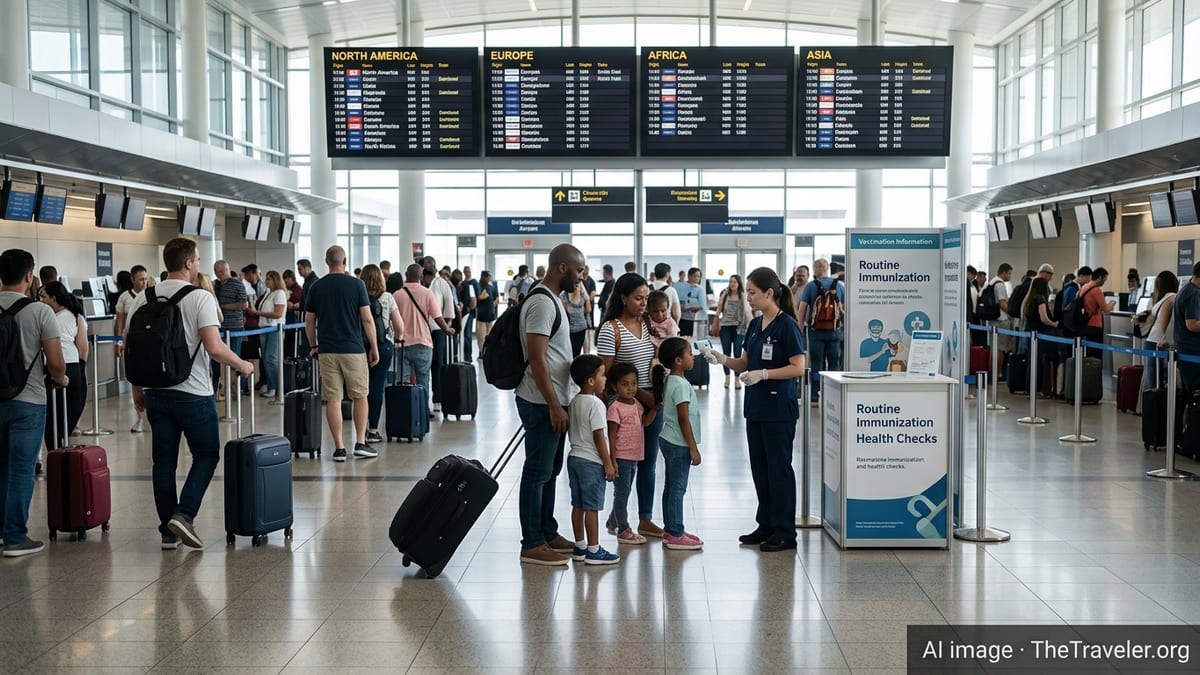
The modern travel environment intensifies this risk. Commercial air routes now connect cities with high measles circulation to destinations where the disease had become rare, and travel volumes have rebounded strongly since pandemic-era restrictions were lifted. Reports from travel medicine and surveillance networks note that exposure can occur not only at the destination but also in airports, aircraft cabins and transit hubs, where crowded indoor conditions favor the airborne virus.
Tourism boards and airlines typically do not track measles risk directly, but health advisories directed at travelers increasingly reference popular leisure corridors such as transatlantic city breaks, Caribbean cruises and multi-country backpacking routes. Where vaccination gaps overlap with these busy circuits, even a single infectious traveler can trigger a cascade of cases far from the original hotspot.
United States and Europe: Travel-Linked Outbreaks Test Elimination Goals
The United States illustrates how international mobility can undermine elimination achievements. CDC data show that 2025 brought the largest national measles tally in more than three decades, with more than 2,000 confirmed cases across dozens of states and nearly 50 documented outbreaks. Analyses of early 2025 surveillance data indicate that the majority of outbreaks were seeded by imported cases, then amplified in communities with low routine immunization coverage.
One of the most closely watched events was a large outbreak centered in West Texas that began in January 2025. Subsequent reporting linked onward spread to neighboring US states and northern Mexico, as well as to cases in Canadian provinces. Publicly available case investigations describe travel for work, family visits and cross-border commerce as common features among early infections, illustrating how everyday mobility across regional corridors can quickly turn a localized problem into a multinational one.
European data reveal related dynamics. A comprehensive 2024 measles surveillance report from the European Centre for Disease Prevention and Control found that a substantial share of confirmed cases had travel links within Europe or to non-EU countries where the virus was circulating. While most 2025 cases in the European Union and European Economic Area appear to be due to community transmission, the same analysis stresses that imported infections remain a persistent threat, especially in countries where subnational vaccination rates have slipped below 95 percent.
For both regions, the convergence of travel-related introductions and clusters of undervaccinated residents has created conditions where measles can circulate long enough to jeopardize elimination status. That risk has prompted renewed messaging from health agencies urging travelers to verify that they are fully vaccinated before departure, with special emphasis on families planning international vacations and students attending overseas programs.
Vaccine Gaps, Pandemic Aftershocks and Tourism Recovery
Behind the current numbers lie structural vulnerabilities that intersect directly with the rebound in global tourism. During the height of the COVID-19 pandemic, many countries reported disruptions to routine childhood immunization, outreach campaigns and disease surveillance. WHO and UNICEF analyses estimate that millions of children missed at least one dose of measles-containing vaccine between 2020 and 2022, creating cohorts of susceptible adolescents now old enough to travel or attend mass gatherings.
At the same time, tourism has recovered faster than immunization systems in several regions. Destination countries eager to revive visitor arrivals have focused on easing entry rules and promoting attractions, while catch-up vaccination campaigns have lagged because of funding constraints, health worker shortages and competing priorities. This mismatch means more potentially susceptible travelers are circulating through areas where the virus still finds room to spread.
In parts of Africa, the Middle East and South Asia, where health systems face conflicts or chronic underinvestment, large outbreaks have continued, with international agencies reporting tens of thousands of suspected cases in 2025 alone. Travelers visiting friends and relatives, humanitarian workers and business travelers frequently move between these hotspots and cities in Europe, North America and the Gulf, forming invisible epidemiological bridges.
Experts contributing to global immunization assessments describe measles as an indicator of broader system stress. When measles flares, they argue, other vaccine-preventable diseases such as polio and diphtheria are more likely to follow. For tourism-dependent economies, recurrent outbreaks can also carry reputational and economic risks, prompting travel advisories and undermining confidence in local health infrastructure.
What Health Data Mean for Future Travelers
Recent surveillance updates are increasingly framed in language that speaks directly to travelers. The CDC has revised guidance to recommend that virtually all international travelers be fully vaccinated against measles, regardless of destination, and that people confirm their status at least two weeks before departure. European and American regional agencies similarly stress that pre-travel health checks should routinely include measles vaccination review, particularly for children and young adults.
For travelers, the data carry several practical implications. First, measles risk is no longer confined to destinations traditionally labeled as high risk. Outbreaks in recent years have affected major cities, resort areas and transport hubs in high-income countries, meaning that a weekend city break or ski holiday can pose unexpected exposure if vaccination is incomplete.
Second, interconnected itineraries magnify uncertainty. Multi-country trips, cruises and long-haul routes increase the chances of sharing enclosed spaces with an infectious passenger at some point along the journey. Since measles can be transmitted before the characteristic rash appears, visible illness is an unreliable warning sign.
Finally, the current resurgence has prompted calls from global organizations for sustained investment in routine immunization, catch-up campaigns and travel-relevant communication. As tourism continues to expand, health agencies argue that the path to safer global mobility runs through stronger vaccine coverage at home and abroad, updated travel advice and closer coordination between the health and tourism sectors.