

More news on this day
Across Asia Pacific, a quiet revolution is unfolding in the skies as India and Singapore lead a shift toward smaller, more efficient aircraft that promise cheaper, more frequent connections between second tier cities and major hubs. For travelers, it means growing options for short hop flights, new airlines entering the market, and a wave of airport upgrades that could make once remote destinations far easier and more affordable to reach.
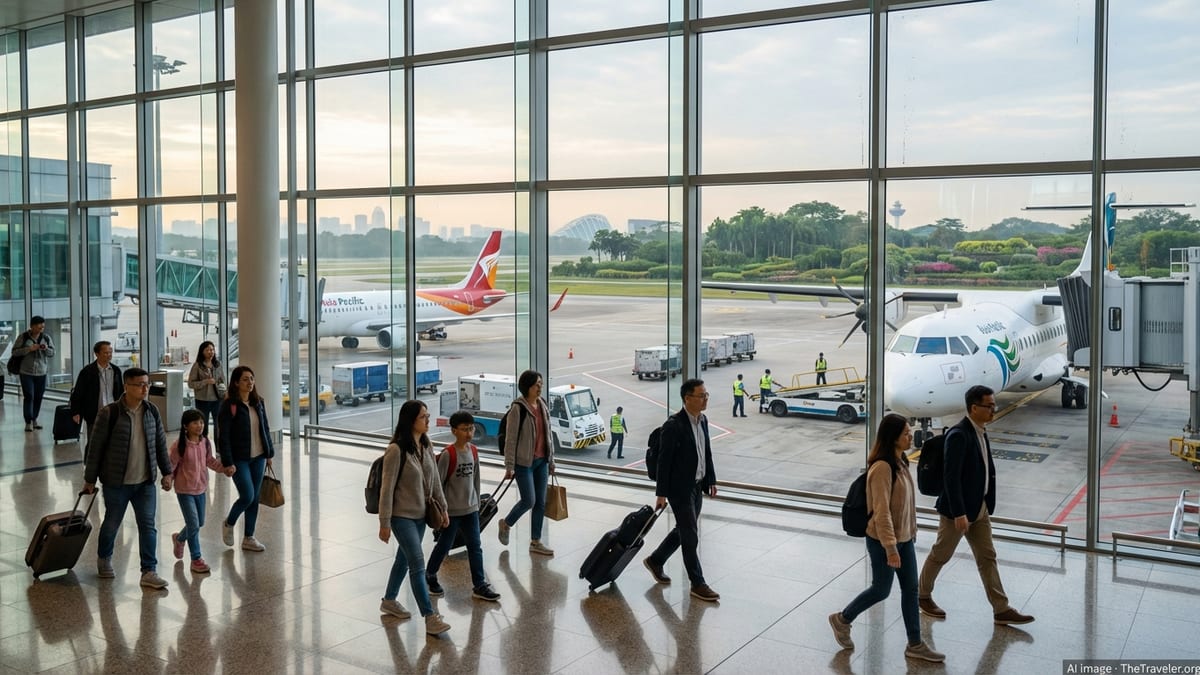
Regional Jets, Turboprops and a Market on the Move
After a decade defined by the expansion of large narrowbody jets, Asia Pacific is now at the center of a new growth cycle for regional aircraft, particularly 70 to 150 seat jets and turboprops. Industry forecasts from manufacturers such as Embraer point to more than a thousand new sub 150 seat regional jets and several hundred turboprops entering Asia Pacific fleets over the next two decades, reflecting a shift toward thinner, high frequency routes that cannot yet justify larger aircraft but where travelers are demanding better connectivity.
Turboprops, once seen as an outdated workhorse, are returning to favor as airlines look for aircraft that can operate economically on short sectors of 200 to 600 kilometers. Data drawn from market analyses using sources such as Cirium and ATR show that Asia Pacific already accounts for a large share of the world’s active turboprop fleet, and is expected to drive the strongest growth in the coming years. This reflects both the geography of the region, with thousands of islands and remote towns, and the rapid expansion of middle class travel beyond major metropolitan areas.
For travelers, the technical details translate into something simple but significant: more point to point routes with smaller planes, often at competitive prices and at times of day that suit business, medical, and family travel. Rather than funneling through a small number of megahubs on larger jets, passengers are increasingly likely to find direct services linking secondary cities to regional centers, especially in India and Southeast Asia.
India’s UDAN Scheme and the Race to Connect Tier 2 and Tier 3 Cities
No market better illustrates the new regional aircraft dynamic than India. Under the government’s Regional Connectivity Scheme, branded UDAN, New Delhi has spent the past decade subsidizing flights to underserved and unserved airports, effectively underwriting the economics of using turboprops and small regional jets on thin routes. Officials say UDAN has already supported hundreds of routes and carried tens of millions of passengers, many of whom were flying for the first time, while helping to more than double the number of operational airports in the country.
The government has now committed to extending and expanding UDAN well beyond its original timeline. Policy announcements in 2025 outlined plans to connect around 120 additional destinations over the coming decade and to keep the scheme running beyond 2027 under an expanded framework. Recent speeches by the civil aviation minister at industry forums in early 2026 have reinforced that message, tying UDAN to a broader ambition of growing India’s network of airports from roughly 160 today to as many as 350 within 20 years.
On the ground, this is visible in a steady stream of airport upgrades and new projects across states such as Bihar, Karnataka and the Northeast. The Airports Authority of India has issued tenders to lengthen runways at smaller fields and enable them to handle larger turboprops and regional jets, while state governments are pushing ahead with new greenfield airports to plug gaps in their networks. Each incremental runway extension or night flying certification opens the door to airlines deploying aircraft such as the ATR 72 or smaller regional jets on new routes under UDAN or purely commercial models.
Crucially for price sensitive Indian travelers, the UDAN framework caps fares on many of these routes and uses viability gap funding to make low prices sustainable for airlines. That, combined with competition among carriers and the entry of new regional operators, is helping to keep short haul tickets affordable even as fuel costs and airport charges rise elsewhere in the system.
New Indian Regional Airlines and the Turboprop Resurgence
The policy push has coincided with a new wave of regional airlines that see opportunity in operating smaller aircraft into cities overlooked by the country’s big low cost and full service carriers. Recent approvals granted to start ups such as Shankh Air in Uttar Pradesh and Al Hind Air in Kerala, both tied into the UDAN framework, point to a more diverse competitive landscape in which local operators tailor networks to state level demand rather than fighting for slots at the biggest hubs.
These carriers are expected to rely heavily on modern turboprops equipped for short runways and quick turnaround times, allowing them to offer multiple daily rotations on routes that may carry only a few dozen passengers per flight. Industry fleet data already show IndiGo and other incumbents expanding or refreshing their ATR 72 fleets to capture regional demand. Analysts say this “turboprop resurgence” is being driven by both economics and policy nudges, since these aircraft burn significantly less fuel on short sectors compared with jets and can operate from airfields that would be inaccessible to larger planes.
For travelers, this means more options out of smaller cities such as Gorakhpur, Varanasi, Kochi or Imphal without having to backtrack through Delhi or Mumbai. It also opens up new itineraries combining rail and regional air travel, allowing passengers to fly into a regional airport on a turboprop and then continue by road or train to nearby tourist or business destinations. As more regional carriers launch and competition intensifies, industry watchers expect introductory fares, promotional campaigns and loyalty tie ups that could further reduce the cost of exploring lesser known parts of India.
There are challenges. Small airlines remain vulnerable to fuel price spikes and currency volatility, and several earlier regional ventures in India struggled or shut down. Regulators are therefore paying close attention to safety oversight, financial fitness and fleet standardization as they approve new entrants. But with government backing, improving infrastructure and growing demand from smaller cities, the environment is more favorable than in previous cycles.
Singapore’s Changi as a Regional Gateway for Affordable Short Haul Travel
While India is focused on stitching together its domestic map, Singapore is doubling down on its role as a premium but highly efficient regional hub. Changi Airport already serves as a key connecting point for travelers flying between India, Southeast Asia and the wider Asia Pacific region, and a large share of those itineraries involve regional aircraft operated by low cost and full service carriers based in Singapore, Malaysia, Indonesia and Thailand.
In recent years, Singapore based low cost airlines have grown their fleets of Airbus A320 and A321 family jets as well as smaller aircraft serving shorter regional sectors. From Changi, travelers can reach dozens of secondary cities across Malaysia, Indonesia, Vietnam, the Philippines and Thailand on flights of two to four hours, often at competitive prices during sales and off peak periods. These routes are increasingly complemented by point to point services linking Indian cities directly to Southeast Asian leisure destinations, further expanding affordable options for holidaymakers and small business travelers.
Singapore’s government is also positioning the city state as a center for the next generation of sustainable regional aviation. A landmark policy decision announced in early 2026 will see a mandatory sustainable aviation fuel levy added to tickets sold from April 2026 for flights departing from Changi from October that year. While the levy will increase costs modestly, officials argue that early investment in cleaner fuel will stabilize long term pricing and give airlines operating smaller, more efficient aircraft a comparative advantage on regional routes.
For passengers, Changi’s combination of efficient transfers, competitive low cost capacity and a growing focus on sustainability means it is likely to remain one of the most convenient transit points for affordable regional travel, particularly for Indians connecting to Southeast Asia or Australasia. Travelers can often mix and match a full service long haul ticket into Singapore with a low cost, short haul sector onward, using regional aircraft to reach destinations that would previously have required complex or expensive routings.
Asia Pacific Demand Forecasts and What They Mean for Fares
Industry demand forecasts suggest that Asia Pacific will remain the fastest growing regional aircraft market through at least the mid 2040s. Embraer’s latest market outlook projects that the region will require more than a thousand new sub 150 seat regional jets and several hundred turboprops over the next 20 years to support rising demand and replace older fleets. ATR’s long term forecast, meanwhile, highlights Asia Pacific and neighboring regions as hotspots for turboprop growth as airlines seek lower fuel burn and the flexibility to open new routes.
Capacity growth on this scale generally exerts downward pressure on fares, especially on competitive routes where multiple carriers operate similar aircraft types. As airlines add regional jets and turboprops, they can increase frequency rather than simply upgauge to larger single aisle jets, which tends to improve schedule choice and make yield management more flexible. The result is more off peak seats that must be filled, often through discounted fares and flash sales that benefit budget conscious travelers.
However, fares are also shaped by constraints on airport infrastructure, crew availability and fuel costs. In markets where smaller airports are slow to upgrade runways, terminals or navigation equipment, the supply of regional capacity may lag demand, keeping prices elevated. That is why India’s aggressive airport expansion plans, and Singapore’s continued investment in Changi’s terminals and airfield capacity, are viewed as critical enablers of affordable travel rather than simple prestige projects. The more efficiently these hubs and spokes can process regional aircraft, the more likely it is that airlines will deploy additional capacity and sustain lower average fares.
Travelers should also be aware that while base fares on regional aircraft can be low, ancillary fees for baggage, seat selection and onboard services often make up a growing share of total trip costs. Comparing full trip pricing across airlines and taking into account ground transport to and from smaller airports remains essential when evaluating the true value of a regional flight.
Infrastructure, Policy and the Passenger Experience
The shift toward regional aircraft is being reinforced by a wave of infrastructure and policy measures across Asia Pacific designed to bring aviation closer to smaller communities. In India, regional airports are adding facilities such as digital biometric boarding systems, low cost food outlets and better Wi Fi with an explicit focus on keeping travel affordable and convenient for first time flyers. Some states are pairing new airport projects with industrial and tourism zones, betting that improved connectivity will draw investment and visitors.
At the same time, operational upgrades are quietly transforming the viability of many routes. The installation of modern navigation aids and runway lighting at airports in states like Karnataka is enabling night operations, effectively doubling the number of slots available for regional flights in some locations. For airlines, that opens the possibility of early morning and late evening departures that appeal to business travelers, improving aircraft utilization and supporting sharper fare competition.
In Singapore and other Southeast Asian hubs, regulators are focusing on balancing growth with environmental and community concerns. Policies around sustainable aviation fuel, noise management and efficient airspace use all feed into how and where regional aircraft can operate. Airlines that invest in newer, quieter and more fuel efficient turboprops and jets may gain preferential access to slots, helping them craft schedules that are attractive to cost conscious travelers while maintaining compliance with tightening environmental standards.
Passengers are likely to notice tangible improvements as these policies filter through. Shorter connection times at hubs, more punctual operations at smaller airports and smoother security and boarding processes all reduce the hidden “time cost” of travel, making regional flying a more attractive alternative to long road or rail journeys, even when prices are similar.
How Travelers Can Take Advantage of the New Regional Map
For travelers across Asia Pacific, and especially in and out of India and Singapore, the emerging regional aircraft market translates into new ways of planning trips. Instead of defaulting to megacity pairings such as Delhi to Singapore or Mumbai to Bangkok, passengers can increasingly consider itineraries that start or end in smaller cities where flights are shorter and sometimes cheaper. For example, an Indian traveler from a tier two city may be able to fly on a turboprop to a nearby regional hub, connect to a low cost carrier bound for Singapore, and then onward to a secondary Indonesian island, all within a single day of travel.
Because competition and capacity growth are not uniform, value hunting becomes more important. Routes supported by schemes such as UDAN, or with multiple regional carriers operating similar aircraft, are likelier to see regular sales and lower average fares. Conversely, thin monopolistic routes, even on small turboprops, may remain expensive. Monitoring seasonal patterns, booking in advance for peak holiday periods and remaining flexible about origin or destination airports can help travelers tap into the most attractive regional deals.
There is also a qualitative dimension to consider. Modern turboprops and regional jets offer quieter cabins, improved interiors and, in many cases, better views on low altitude segments than larger jets. For leisure travelers, particularly those exploring coastal or mountainous parts of Asia, the flight itself can become part of the experience. At the same time, shorter taxi times, quicker boarding and smaller terminals often mean less time spent in queues, which can offset any lingering perceptions about propeller aircraft being slower or less comfortable.
As India works to knit together its vast domestic market and Singapore consolidates its status as a regional gateway with a growing emphasis on sustainability, the Asia Pacific skies are steadily filling with smaller, smarter aircraft. For travelers willing to look beyond traditional trunk routes, the regional boom offers a widening menu of affordable, flexible and often more interesting ways to move around one of the world’s most dynamic regions.