

More news on this day
Almost nine years after Kenya’s Standard Gauge Railway opened between Mombasa and Nairobi, the Chinese-built line has evolved from a flagship construction site into a workhorse of the country’s economy and a defining symbol of deepening ties between Nairobi and Beijing.
A Flagship of a New Era in Kenya-China Cooperation
When the 472-kilometre Mombasa–Nairobi Standard Gauge Railway (SGR) was inaugurated in May 2017, it was billed as Kenya’s most ambitious infrastructure project since independence and a centrepiece of China’s Belt and Road Initiative in East Africa. Built by China Road and Bridge Corporation with preferential loans from Chinese policy banks, the line was intended to replace the ageing metre-gauge track and provide a high-capacity corridor linking the port of Mombasa to the capital and inland markets.
The SGR quickly took on outsized political and diplomatic significance. Chinese and Kenyan officials framed it as a “win-win” project that married Kenya’s Vision 2030 development blueprint with China’s push to internationalise its rail standards and export its industrial capacity. The railway’s design, construction techniques and operating model all drew heavily on Chinese standards, making it a showcase for China’s rail industry on the African continent.
For Kenya, the project was about more than steel and concrete. It represented a bet that modern rail could reverse decades of underinvestment in transport infrastructure, cut logistics costs that had long hampered manufacturers and traders, and anchor a broader economic corridor stretching into the Great Lakes region. The line’s evolution since 2017, and the debates it has sparked, now define a central chapter in the story of contemporary Kenya-China relations.
Moving Millions: Passenger and Cargo Growth Reshapes Trade
Operational data in recent years highlights how the SGR has become embedded in Kenya’s transport system. The line has moved more than 15 million passengers and over 40 million tonnes of cargo since opening, according to operator Afristar and official Kenyan statistics, with traffic volumes steadily rising as services matured and extensions came online toward Naivasha.
Freight has been the primary revenue driver. Kenya National Bureau of Statistics figures show SGR cargo volumes climbing from about 6.1 million tonnes in 2022 to roughly 6.5 million tonnes in 2023, helped by tighter enforcement of rail evacuation rules at the Port of Mombasa and growing confidence among importers. By 2024, freight volumes hovered around 6.5 million tonnes before surging to approximately 7.5 million tonnes in 2025, reflecting further consolidation of rail’s role in moving containerised cargo inland.
Passenger services, marketed under the Madaraka Express brand, have also transformed domestic travel between the coast and the capital. Ridership rose from just under 8 million passengers over the line’s first five years to annual totals exceeding 2.7 million in recent seasons. Even after a fare hike in early 2024 briefly dented demand, latest data indicate a rebound in 2025 as travellers adjusted to higher prices in exchange for reliability, comfort and predictable journey times compared with long-distance buses.
The result has been a marked uplift in railway earnings. Kenya Railways and national statistics show SGR revenue growing from about 15 billion shillings in 2022 to 18.1 billion in 2024 and 21.4 billion in 2025, an 18.6 percent year-on-year increase driven by both freight and passengers. The revenue trajectory underscores how the line has shifted from a politically symbolic project toward a more commercially grounded operation, even as it continues to rely on state backing to meet its substantial financing obligations.
Economic Ripple Effects From Port to Hinterland
Beyond headline traffic figures, the SGR’s most tangible legacy lies in how it has reshaped economic geography along the Mombasa–Nairobi corridor. By significantly cutting transit times and offering scheduled services, the line has lowered logistics costs for manufacturers and traders, particularly those reliant on imported raw materials and containerised exports.
Manufacturers’ associations in Kenya report that firms now routinely use rail to move bulk inputs such as clinker, steel, grains and industrial chemicals from Mombasa to inland depots, reducing pilferage and damage compared with road haulage. The activation of the SGR link at Longonot, connecting to the rehabilitated metre-gauge line towards Malaba on the border with Uganda, has also enabled more seamless multimodal movements, opening the door for greater use of rail in regional trade.
The Port of Mombasa has felt the impact as well. Cargo throughput at the port has climbed in parallel with rising SGR freight volumes, and dedicated inland container depots in Nairobi and Naivasha have emerged as logistics hubs anchoring warehouses, industrial parks and service businesses. Government planners see these nodes as seeds of future special economic zones designed to capture more value from imports and re-exports before goods disperse into the wider region.
Tourism and domestic travel have also benefited. The SGR’s route through Tsavo National Park has given domestic and international visitors an alternative way to access coastal resorts and wildlife destinations, supporting hotels and tour operators along the corridor. The predictable six-hour journey between Nairobi and Mombasa has proved particularly popular with families and business travellers seeking a safer, more comfortable alternative to overnight highway buses or short-haul flights.
Jobs, Skills and Technology Transfer Along the Line
From the outset, both Kenyan and Chinese officials promoted the SGR as a platform for skills transfer and local capacity building, not just a transport asset. During construction, the project created tens of thousands of direct and indirect jobs, employing local workers in civil works, station building, track laying and ancillary services. Operator Afristar has said the project supported roughly 74,000 jobs at various stages, including in supply chains and supporting industries.
A structured training program has been a hallmark of the cooperation model. More than 2,800 Kenyan technicians, engineers and managers have undergone instruction in standard-gauge railway technology, signalling, operations and maintenance, both in Kenya and at partner institutions in China. Many now occupy critical roles in driving trains, maintaining rolling stock, managing control centres and overseeing safety systems.
This localisation drive has accelerated as the original eight-year operations contract with Afristar moves toward completion. Kenya Railways now oversees the majority of day-to-day operations and is preparing for a full handover of management functions. Staff have been gradually assuming responsibilities once held by Chinese specialists, from scheduling and ticketing to locomotive maintenance and dispatch, turning the SGR into a living classroom for Kenya’s next generation of rail professionals.
The skills acquired are expected to have spillover benefits beyond the Mombasa–Nairobi line. As Kenya upgrades sections of its metre-gauge network and pursues new urban commuter rail initiatives, officials say the SGR-trained workforce will form the backbone of a more integrated, modern rail system capable of supporting broader industrialisation goals.
Debt, Politics and Debates Over Value for Money
The SGR’s transformative impact has not shielded it from controversy. At an estimated cost of about 464 billion shillings, financed largely through loans from China’s Exim Bank, the line is widely cited as Kenya’s most expensive infrastructure project. Servicing that debt against a backdrop of currency volatility and fiscal pressures has been a recurring theme in public debate and political campaigns.
Critics have questioned whether revenue from freight and passenger operations can ever fully cover operating costs and debt repayment, arguing that the project may impose a long-term burden on taxpayers. Concerns have also been raised over procurement transparency, contract terms and the economic assumptions underpinning the original feasibility studies, including expectations of rapid freight growth and regional extensions that have yet to materialise fully.
Supporters counter that large-scale transport infrastructure should be judged over decades, not a few financial years, and point to the broader macroeconomic gains. Studies cited by Chinese and Kenyan officials suggest the SGR has added between 1.5 and 2 percent to Kenya’s gross domestic product by catalysing investment, improving connectivity and raising productivity along the corridor. They argue that these indirect gains, combined with rising direct revenues, strengthen Kenya’s capacity to meet its obligations over time.
The political narrative has evolved alongside the economics. President William Ruto, once a vocal critic of some aspects of the SGR project while in opposition, has recalibrated his stance since taking office in 2022. On recent visits to Beijing, he has praised China’s role in building the railway and signalled that Nairobi will seek to renegotiate loan terms, extend the network and deepen cooperation in rail operations and technology, rather than distance itself from the project.
Environmental and Social Footprint on a Sensitive Corridor
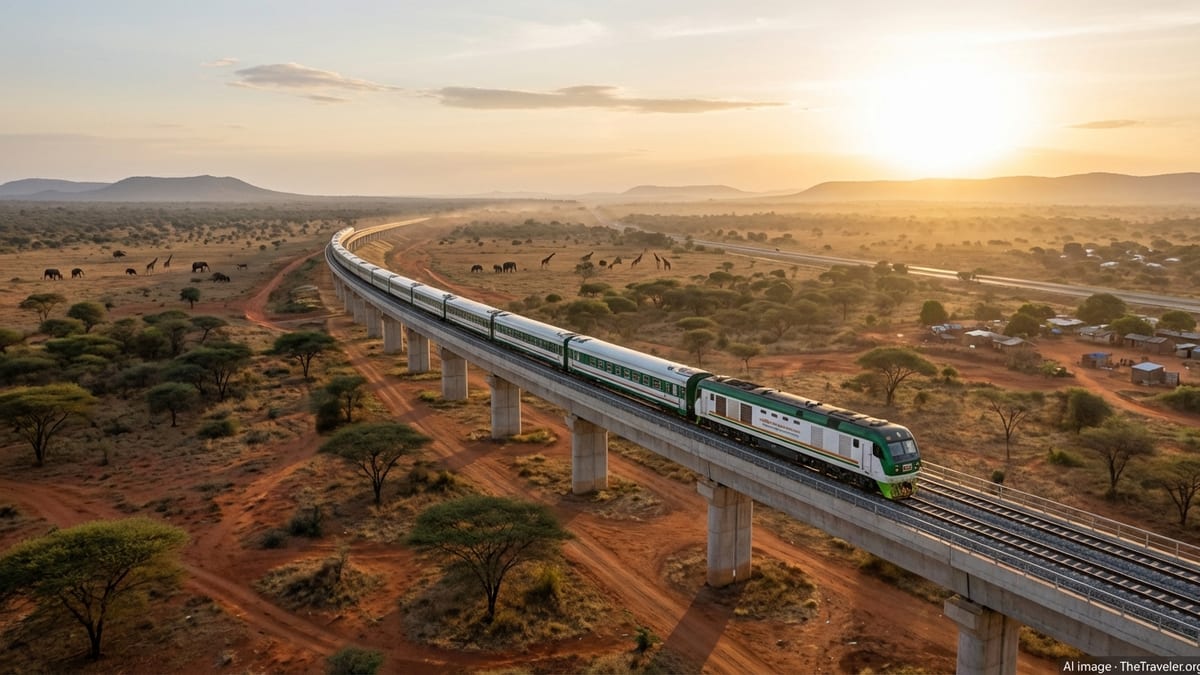
Cutting across wildlife-rich landscapes and densely populated settlements, the SGR has had to navigate complex environmental and social terrain. Nowhere is this more evident than in Tsavo National Park, where the line traverses some of Kenya’s most important elephant and big cat habitats. Conservationists initially warned that fencing, noise and train movements could fragment ecosystems and disrupt animal migration routes.
In response, designers incorporated a series of underpasses, overpasses and elevated sections intended to allow wildlife crossings, along with fencing to reduce collisions. Subsequent monitoring by park authorities and independent researchers has indicated that while some disruptions occurred during construction and early operations, many species have adapted to the new structures, using underpasses and viaducts to move across the corridor. The line’s electrification-ready design and potential to shift freight from trucks to rail are also cited as long-term environmental benefits, with lower per-tonne emissions and reduced road accidents.
On the social front, communities along the route have experienced a mix of opportunities and challenges. New stations at towns such as Voi, Mtito Andei and Athi River have spurred small businesses, real estate developments and services catering to travellers and railway workers. However, land acquisition, resettlement and compensation disputes have lingered in some areas, highlighting tensions that often accompany large greenfield infrastructure schemes.
Officials argue that lessons learned from the SGR’s environmental and social management are now informing subsequent projects, including upgrades to metre-gauge lines and planned urban commuter rail. For proponents of China’s Belt and Road Initiative, Kenya’s efforts to integrate ecological safeguards and community engagement into a large, cross-country rail project are held up as evidence that such schemes can be made more sustainable over time.
From Mombasa to the Region: Future Prospects and Strategic Stakes
The Mombasa–Nairobi SGR was conceived as the first phase of a larger standard-gauge network stretching towards Malaba on the Ugandan border and potentially linking to neighbouring countries in the Great Lakes region. While financing and political hurdles have delayed full realisation of that vision, partial extensions toward Naivasha and the interconnection with metre-gauge lines have kept the regional dimension alive.
Kenyan officials continue to position the SGR as a backbone of the Northern Corridor, competing with alternative routes through Tanzania and other coastal states for landlocked markets in Uganda, Rwanda, South Sudan and eastern Democratic Republic of Congo. The success of the line in capturing cargo that might otherwise travel by road will help determine how much of that trade flows through Mombasa versus rival ports in the years ahead.
For China, the railway remains a signature example of its infrastructure diplomacy in Africa. Beijing highlights the SGR in official statements as proof that Chinese finance, technology and project management can deliver transformative assets abroad. As China recalibrates its Belt and Road Initiative to place more emphasis on project quality, debt sustainability and local partnerships, the lessons drawn from Kenya are likely to shape future rail investments on the continent.
Against this backdrop, the Mombasa–Nairobi SGR has become more than a transport link. It is a test case for how large, loan-financed infrastructure projects negotiated during a period of abundant global liquidity can be managed in an era of tighter financing conditions, shifting geopolitics and rising scrutiny of foreign influence. The line’s performance over its first decade of operation will inform not only Kenya’s economic trajectory, but also how African governments and China design the next generation of cooperation.
A Modern Milestone Still in Motion
Nearly a decade on, the SGR’s story is still unfolding. Revenue figures show a railway that is steadily strengthening its commercial footing, even as debates persist over tariffs, cost recovery and the balance between freight and passenger services. The integration of SGR and metre-gauge networks is beginning to deliver the seamless, multimodal connectivity planners long promised, but further investment in last-mile links and logistics facilities will be needed to unlock the full potential of rail-based trade.
The partnership underpinning the railway is also evolving. Kenya’s gradual assumption of operational control reflects a broader shift from turnkey, contractor-led arrangements to more locally owned and managed models of cooperation. Chinese firms remain central as technology partners, financiers and equipment suppliers, yet Kenyan institutions and professionals are increasingly in the driver’s seat.
As trains continue to snake through Tsavo’s savannahs and across the Athi plains toward Nairobi, the Mombasa–Nairobi SGR stands as a visible reminder of the stakes and possibilities in Kenya-China cooperation. Its concrete sleepers and steel rails carry not only containers and commuters, but also the weight of expectations about how infrastructure, diplomacy and development can intersect in a rapidly changing world.