


I had been staring at photographs of the Initiation Well at Quinta da Regaleira for years before I finally saw it in person. In my head, it was a near-mystical place in the hills above Sintra, all mossy stone and secret tunnels. The reality turned out to be more complicated: crowds, time pressure, confusing transport, and a surprising amount of queueing mixed in with the beauty.
If you are trying to decide how long you actually need there, my visit made one thing very clear. The difference between a rushed, frustrating stop and a memorable experience is measured in hours, not minutes, and in how you structure your day around this single site.
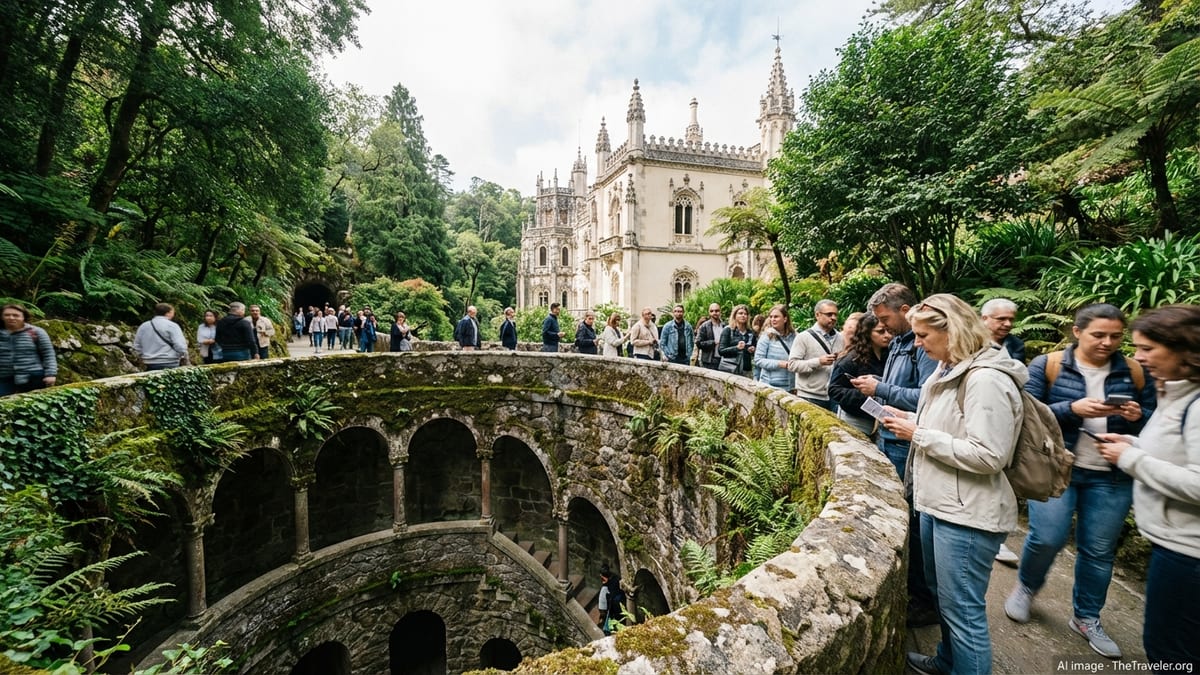
How Long Do You Really Need at Quinta da Regaleira?
Before going, I kept seeing glib answers online suggesting “1 to 2 hours” was plenty. After actually walking the estate, I would only agree with that if you are either in a huge rush or do not care about anything beyond the Initiation Well and a quick palace peek. For a first visit where you want to see the main highlights without feeling constantly hurried, I found that 3 hours inside the grounds was the minimum that felt reasonable. Anything less and I was skipping things that looked interesting simply because I did not have the mental bandwidth to zigzag back.
The estate is not enormous compared with somewhere like Pena Park, but it is deceptively dense. The gardens run up and down a hillside, full of small paths, grotto entrances, towers, and viewpoints that are easy to miss if you only stick to the main arteries. I spent almost two hours just between the wells, tunnels, lakes, and surrounding gardens, without really lingering in the café or sitting to sketch. The palace interior itself took roughly 20 to 30 minutes at a moderate pace, not counting the queue to get in. The chapel and its adjacent viewpoints added another 20 minutes.
If you are the sort of traveler who likes to photograph slowly, read the information displays, and stand in quiet corners for a moment, I would say budget 3 to 4 hours inside Quinta da Regaleira. Add transport and ticket logistics on top of that. My own window from leaving Sintra station to walking back through the old town stretched closer to 5 hours, and I was glad I had not tried to cram in another major site the same morning.
Tickets, Entry Times, and the Reality of Queues
On paper, Quinta da Regaleira is straightforward. It is open daily from 10:00 to 18:30 between October and March, and until 19:30 from April through September, with last entrance posted as 17:30 throughout the year. The palace and chapel close 30 minutes before the garden does, a detail I saw mentioned but did not fully appreciate until I watched staff begin quietly shepherding people out at the end of the day. Buying dated e-tickets is strongly recommended and, in 2026, essentially standard: they are valid for a specific day and time slot, with no refunds or exchanges except in the case of an unscheduled closure.
In practice, the timed entry system reduced, but did not eliminate, waiting. I arrived a little after my slot to find a long but orderly line snaking from the gate down the hill. The queue moved in waves as staff scanned tickets, and I was inside in about 15 minutes. That was not terrible, but it did feel slightly absurd given I had already committed to a fixed time and pre-purchased my spot. I saw people trying to buy on the day at the ticket office and their line moved even slower. If you do not want your morning dictated by a ticketing website, this rigid system may frustrate you.
Once inside, there was a second layer of soft queuing around the iconic spots. The Initiation Well had a clear line that wrapped partway around the rim. You shuffle along in single file, stopping every few steps for someone’s photograph. Going down the spiral, I was sandwiched between a tour group and a family with small children. The romantic, solitary descent you see in travel photos is not how it plays out at midday in high season. If you really want that emptier feeling, you need to aim for the first slot of the day and head straight for the well, or come in low season and accept the risk of more rain and shorter hours.
How I Spent My Time Inside (And What I Would Change)
I gave myself three and a half hours between my ticket time and when I planned to walk back toward the station. My loose plan was: well and tunnels first, then lakes and gardens, then palace and chapel, and finally a short coffee break near the exit. That structure mostly worked, but I still underestimated how much time would bleed away in subtle ways.
The first ninety minutes disappeared in the lower garden. I waited to descend the Initiation Well, slowly circled down the spiral, followed the subterranean passages out to the lake, ducked into side tunnels, and climbed a small tower with views back over the palace. None of this was rushed, but it was hardly lethargic either. At a certain point, when I realized my “1 hour in the gardens” estimate had already blown out, I had to start triaging paths: if it did not obviously lead to a marked feature, I reluctantly skipped it.
The palace interior surprised me by being both prettier and more constrained than I expected. The ornate woodwork, stained glass, and sculpted ceilings are gorgeous in places, but the visit route is clearly controlled. You move through roped-off rooms relatively quickly, and there are not many interpretive panels. I spent maybe 20 to 25 minutes inside, and even if it had been empty, I do not think I would have stretched it past 40. It felt like a decorative frame for the gardens rather than a destination in its own right. If I went back, I would still visit the palace, but I would mentally weight my time budget even more heavily toward the outdoor areas.
Where I misjudged things most was at the end. I planned to grab a coffee, revisit one or two corners I had rushed, and slowly make my way out. Instead, by the time I reached the café my feet were sore, the line for drinks was long, and staff were already hinting that the palace would close shortly. I ended up gulping a quick espresso and giving up on the idea of a final wander. If I had to redo the day, I would either arrive at opening time or give myself at least another hour before needing to catch a train back to Lisbon.
Crowds, Atmosphere, and When to Go
There is no getting around it: Quinta da Regaleira is incredibly popular, and that popularity shapes the experience. I visited during the shoulder season, not peak summer, and the estate still felt busy from late morning through mid-afternoon. The paths around the wells, the lakes, and the key viewpoints were in constant use. It was possible to find quieter pockets in less photogenic corners, but there was always background noise. Anyone hoping for meditative solitude in the tunnels will be disappointed unless they hit a rare lull.
The upside is that the place does absorb people better than some of Sintra’s other major sites. The gardens are layered, with multiple routes and levels, which helps disperse the crowd. Once I let go of the fantasy of having the well to myself, the mood shifted from frustration to something closer to bemused acceptance. Watching other visitors react to the tunnels, get slightly lost, and pop out somewhere unexpected became part of the entertainment. Still, if you are severely crowd-averse, three hours here in the middle of the day could feel like a long time.
From a timing perspective, the estate opens at 10:00. Staff start closing interior spaces about half an hour before the posted garden closing time, which means that if you breeze in at 17:20 for the last entry slot in winter, you will not see much beyond the immediate grounds. Based on my visit and conversations with staff, the most comfortable window is from opening until early afternoon, ideally starting right at 10:00. By late morning the queue at the Initiation Well swells, but the estate as a whole is still warming up. Summer brings extended hours until 19:30, which gives you a little more leeway, but it also brings heavier crowds and hotter, stickier weather in the enclosed tunnels.
If I were planning again, I would choose either a cool weekday in the low season and accept some drizzle, or a summer visit with a strict early start. What I would not do is roll up at 11:30 on a sunny Saturday and expect a quick, relaxed hour-long wander. That combination is almost guaranteed to produce bottlenecks at every point you have seen in photos.
Getting There: Time Lost Before You Even Arrive
One thing I underestimated was how much of my “Quinta da Regaleira time” would be eaten by logistics before I even reached the gate. I took the standard route: a 40-minute commuter train from Lisbon’s Rossio station to Sintra, followed by the journey from Sintra station up to the estate. The train itself was easy and cheap, but the queues at Rossio ticket machines and the general crush of people all heading to Sintra added another 20 to 30 minutes. That is not the estate’s fault, but it matters when you are trying to slot a visit into a single day.
From Sintra station, I had the choice of walking, taking the tourist bus, or hiring a rideshare. Walking is technically free and scenic, but it is about 1.8 kilometers and uphill in sections. In cooler weather with comfortable shoes, that is manageable. With a midday sun and lots of other palaces on the agenda, it can feel like a slog. The 435 tourist bus runs a loop from the station, past the National Palace and Quinta da Regaleira, out toward other sites, and back. It operates roughly every 15 minutes, but the one-way loop and traffic can make the actual ride surprisingly slow for the distance involved, and tickets are not cheap for what is, in essence, a short hop.
I compromised: I walked into the historic center, then caught the 435 from there. By the time I boarded, waited in traffic, and hopped off at the stop near the entrance, I had spent almost 45 minutes on the “Sintra town to Quinta da Regaleira” segment alone. In hindsight, if Quinta da Regaleira is your main or only goal for the day, I would either do the full walk from the station and count it as part of the experience, or bite the bullet and call a rideshare or taxi from the station to the gate. That will not be much faster on a very congested day, but at least you avoid the dance of tourist bus tickets and waiting in a crowded loop.
However you get there, build in at least an hour from the time you enter Rossio station in Lisbon to the time you are realistically likely to be at the estate gate, and more if you are traveling in peak season. It is very easy to look at the raw timings and think, “Forty minutes on the train and a quick bus or walk” when the lived experience is much closer to 90 minutes door to door. That time has to come from somewhere, and it usually comes out of how relaxed you feel once you are actually inside the grounds.
Is It Worth Visiting on a Packed Sintra Day Trip?
Sintra punishes over-ambition. On paper, seeing Pena Palace, the Moorish Castle, and Quinta da Regaleira in a single day is just about possible. In reality, combining all three often means seeing each of them in a rushed, slightly irritable state. I tried to pair Quinta da Regaleira with one other major site and even that felt borderline. By the time I factored in trains, buses, queues, and the sheer mental load of navigating through crowds, my day was very full.
If you treat Quinta da Regaleira as a “quick stop” between headline palaces, you can physically march through in 60 to 90 minutes and tick off the major visuals. I watched multiple tour groups do exactly that: straight to the well, quick circuit of the lakes, a brisk walk past the palace façade, and then back on the bus. They technically “saw” it, but they did not seem to have much time to absorb or enjoy it. If your time in Sintra is truly limited to a single day and you are set on Pena Palace, I would honestly consider saving Quinta da Regaleira for another trip rather than reducing it to a photo-op.
On the other hand, if mystical gardens and symbolic architecture interest you more than steep hikes and hilltop castles, I would absolutely make Quinta da Regaleira your anchor and let the rest of the day orbit around it. Spend three or four hours here, then treat anything else you manage to see as a bonus rather than an obligation. I found that shift in mindset made the experience feel richer and less like I was racing a checklist.
Good, Bad, and In Between: A Balanced View
There were moments at Quinta da Regaleira that genuinely lived up to the myth. Stepping out of a dark tunnel onto a small stone bridge over the lake, with ferns and dripping water all around, felt as theatrical as I hoped. Looking down from the top of the well, once I had finally edged my way to the rim through the crowd, gave me that odd shiver of vertigo and wonder I had been looking for. In those snippets, the place felt like the mysterious estate of my imagination, and I was willing to forgive quite a lot.
There were also frustrations. The pathways can bottleneck quickly, and the one-way flow around the well means that one slow group in front of you affects everyone behind. Signage inside the estate is functional but not especially generous with context, so unless you read up beforehand or rent an audio guide on-site, some of the symbolism and history stays at the level of vague mystery rather than meaningful narrative. The café, while convenient, is basically a standard tourist operation; prices felt high for the quality, and the line moved slowly. I ended up wishing I had brought more snacks and treated the café purely as a backup.
In between those highs and lows is a lot of low-level compromise: accepting that your photos will include strangers, that you will occasionally backtrack, that some corners you meant to explore will remain unvisited. For me, the beauty of the gardens outweighed the annoyances, but I would not describe the experience as tranquil. It was fascinating and at times magical, but also undeniably commercial and crowded. Whether that balance feels acceptable will depend on how much you value the site’s unique atmosphere versus how much energy you have for managing logistics and people.
The Takeaway
If I strip away the romance and look at my day at Quinta da Regaleira purely in terms of time and return, I would still say it was worth it, but only because I gave it enough space in the schedule. The estate rewarded lingering, noticing small details, and letting myself wander off the main path whenever something caught my eye. The moments that felt rushed or stressful almost always traced back to my own decision to stack too much into one day and underestimate the friction of getting around Sintra.
If you are planning a visit, I would suggest this rule of thumb. Allocate at least 3 hours inside the grounds themselves, plus at least 2 hours for trains, buses, and queues on either side. Book a timed ticket in advance, aim for a morning slot, and arrive as close to opening as you can comfortably manage. Wear shoes you are happy to climb and descend in, bring water, and do not expect to have the wells or tunnels to yourself. If you can accept a lively, sometimes chaotic atmosphere in exchange for genuinely distinctive scenery and design, Quinta da Regaleira can be one of the most memorable parts of a Sintra trip.
Who is it best for? Curious travelers who like layered places, who enjoy exploring gardens as much as grand rooms, and who are willing to trade some serenity for the chance to walk through a very theatrical piece of architecture and landscape design. It is less ideal for anyone with very limited mobility, severe crowd aversion, or a packed itinerary that leaves no room for delays. Under the right conditions, though, and with realistic expectations about how long you genuinely need, it is a place that stays with you long after you leave the tunnels and step back into the regular light.
FAQ
Q1. How many hours do I really need inside Quinta da Regaleira?
In my experience, 3 hours inside the estate is the minimum for a comfortable first visit that includes the Initiation Well, tunnels, lakes, gardens, the chapel, and a quick look at the palace interior. If you like to photograph slowly or sit and soak in the atmosphere, plan for 3 to 4 hours.
Q2. Is it possible to see Quinta da Regaleira in one hour?
It is technically possible to rush through in about an hour, especially with a guided tour that beelines for the main sights, but it will feel superficial. You will likely manage the Initiation Well and a quick pass through part of the gardens, but you will skip a lot of smaller paths and details that make the place interesting.
Q3. What are the current opening hours and last entry times?
When I visited, Quinta da Regaleira was open daily from 10:00 to 18:30 from October to March and until 19:30 from April to September, with last entry at 17:30 year-round. The palace and chapel closed about 30 minutes before the garden, so arriving near last entry left very little time to see the interiors.
Q4. Do I need to book tickets in advance, or can I buy them at the gate?
I strongly recommend booking dated e-tickets in advance. Same-day tickets at the gate were available but involved longer queues, and entry is controlled by time slots. The tickets are valid only for the day and time you choose and are generally non-refundable or exchangeable except if the estate closes unexpectedly.
Q5. How much time should I allow to get there from Lisbon?
From central Lisbon, I needed roughly 40 minutes on the train to Sintra, plus anywhere from 30 to 50 minutes to navigate crowds, walk or bus up from Sintra station, and queue at the entrance. In total, I would allow at least 1.5 hours from entering Rossio station in Lisbon to actually being inside Quinta da Regaleira.
Q6. Is Quinta da Regaleira suitable for a quick stop on a busy Sintra day trip?
If you already plan to visit Pena Palace and the Moorish Castle on the same day, adding Quinta da Regaleira as a quick stop will probably make the whole day feel rushed. I found it worked much better as one of two main sites, or even as the single focus of a half-day visit, rather than something you squeeze in between bigger palaces.
Q7. Are the tunnels and wells very crowded, and can I avoid the lines?
The Initiation Well and the main tunnel network were the most crowded parts of my visit, with steady queues and slow-moving lines. The only realistic ways to reduce the crowds are to book an early time slot and head straight for the well, or to visit in the low season when overall visitor numbers drop, accepting that weather may be less predictable.
Q8. Is it better to walk from Sintra station or take the tourist bus?
Walking from Sintra station to Quinta da Regaleira takes around 25 minutes and involves some uphill sections, but it is straightforward and free. The 435 tourist bus saves you some effort but can be slow due to its one-way loop and traffic, and tickets are not cheap for the distance. On balance, if you are reasonably fit and the weather is mild, I preferred walking and treating it as part of the outing.
Q9. Can I combine Quinta da Regaleira with Pena Palace in the same day?
Yes, it is possible to see both in a single day, but only if you start early, pre-book tickets, and accept a fairly intense schedule. I would recommend doing Pena Palace first thing in the morning, then heading down to Quinta da Regaleira for a solid 3 hours. Even with that plan, it will be a full, tiring day rather than a relaxed one.
Q10. Would I visit Quinta da Regaleira again, and would I change anything?
I would visit again, but I would change how I structured the day. Next time I would book the first ticket slot of the morning, walk from the station, bring my own snacks, and dedicate at least 4 hours door to door just for Quinta da Regaleira, treating any other Sintra sights that day as optional extras rather than fixed goals.