

Understanding how long it really takes to obtain residency in Mexico is critical for relocation planning, contract negotiations, school enrollment, and household logistics. Processing times vary widely by consulate, by local immigration office in Mexico, and by individual case details, but reliable ranges and common bottlenecks can be identified. This briefing focuses on realistic end-to-end timelines from first residency appointment to card issuance and onward progression to permanent status, to help prospective residents decide whether and when relocation to Mexico is practically feasible.
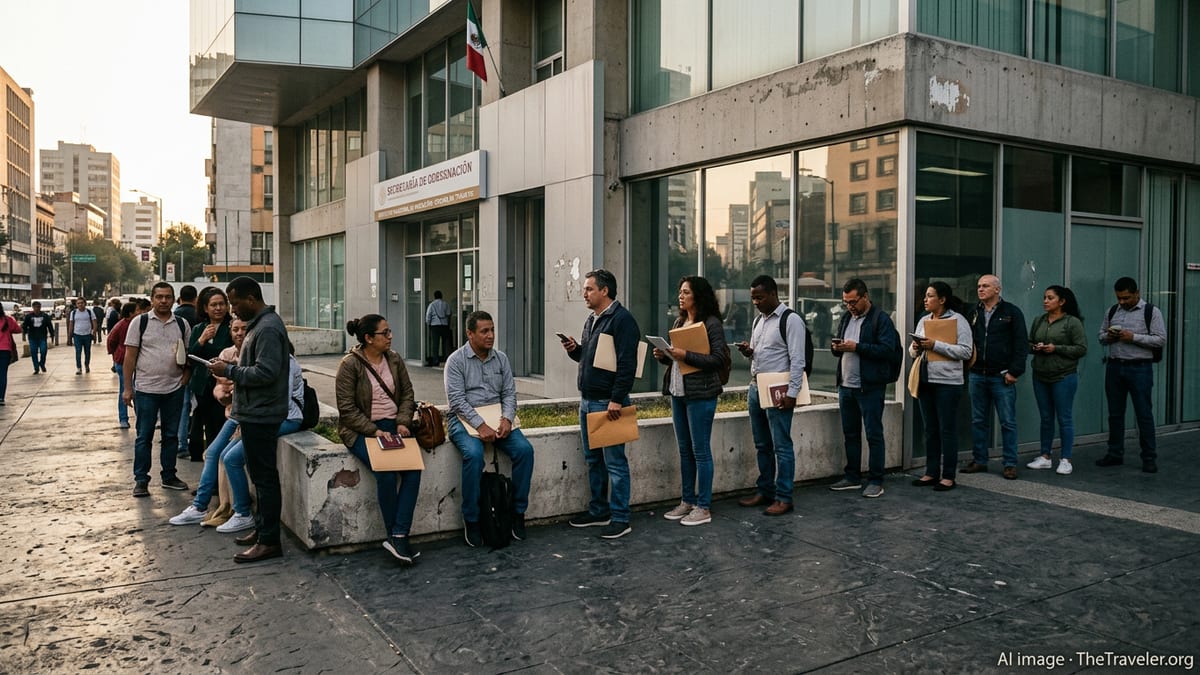
Overview: What “Residency in Mexico” Means for Timelines
For relocation planning, “getting residency in Mexico” usually refers to securing a physical resident card issued by the National Migration Institute (INM) after starting the process at a Mexican consulate abroad. In most cases, this process is split into two distinct phases: initial visa approval at a consulate and in-country processing (canje) where the visa sticker is exchanged for a residency card.
Timeframes differ between temporary residency and permanent residency. Temporary residency is often obtained first and then converted to permanent status after several years, except for applicants who qualify directly for permanent residency, for example via higher income thresholds or certain family connections. The time to obtain the first resident card is measured in weeks or a few months, while the time to reach permanent resident status is typically measured in years of continuous legal stay.
Processing times are not fully standardized. Recent practice shows consular decisions generally measured in days to a few weeks, and in-country canje processing typically measured in 2 to 6 weeks, with occasional longer delays in high-volume offices or during policy transitions. Applicants should plan for variation rather than expecting the fastest published timelines.
In addition, accumulated years in temporary status are relevant for future options such as conversion to permanent residency and eventual naturalization. For decision-makers, the practical question is not only how long it takes to receive the first card, but also how long until more stable or indefinite status becomes available.
Step 1: Timeframes at Mexican Consulates Abroad
The residency process normally starts at a Mexican consulate or embassy outside Mexico. Applicants must first secure an appointment, attend an interview, and, if approved, receive a visa sticker in their passport authorizing them to travel to Mexico to complete the process. The total time in this phase is driven largely by appointment availability and document readiness.
Recent consular guidance suggests that, after an in-person interview and document submission, many consulates issue a temporary or permanent resident visa sticker within approximately 2 to 10 business days, with a common internal target of around 10 business days for standard cases. Some consulates explicitly note that applications may require “additional administrative processing,” which can extend this period without precise maximums given.
However, wait times to secure the initial appointment can be substantially longer than the document processing itself. In busy posts, appointments for residency visas may book out several weeks or even a few months during peak seasons. Applicants who are flexible on consulate location sometimes secure dates sooner by checking multiple posts in their region, while those tied to a specific jurisdiction may face longer lead times.
From a planning perspective, an indicative range for the consulate phase, from first attempt to book an appointment to receiving an approved visa in the passport, is typically in the band of 3 to 10 weeks. Well-prepared applicants who obtain an early appointment can complete this phase in as little as 2 to 4 weeks, while others, particularly at oversubscribed consulates, may experience multi-month lead times before the interview.
Step 2: Entry to Mexico and the Canje Timeline
Once a residency visa is issued, there is a limited window to use it to enter Mexico. Current consular practice commonly issues resident visas with a validity of up to 180 days for entry. Within that period, the applicant must enter Mexico and ensure the entry is registered correctly as a resident rather than as a tourist, which affects the ability to complete the process.
After entry, federal regulations and consular instructions generally require that applicants present themselves at the local INM office corresponding to their Mexican address within 30 calendar days of arrival to initiate the canje process, which is the formal exchange of the visa sticker for a resident card. Some INM offices operate by online or in-person appointment systems, which can introduce an additional waiting period before documents are formally lodged, especially in large metropolitan areas.
Official guidance and consulate information frequently cite INM processing times of around 2 to 4 weeks from submission of a complete canje file to card issuance. In practice, field reports show significant variation. Some applicants in smaller or efficient offices receive their resident card on the same day or within a few days of biometrics. Others, particularly in large cities or during high-volume periods, may experience total in-country processing times of 4 to 8 weeks between their first visit to INM and card collection.
As a working range, relocation planners should assume that, after arrival in Mexico, the period from entry to physical card in hand often falls between 3 and 6 weeks, incorporating both appointment waits and INM adjudication. Where offices are known to be congested or experiencing leadership changes, the range can stretch further, sometimes up to 2 or 3 months.
End-to-End Timelines: Temporary vs Permanent Resident Cards
End-to-end timing from initial planning to holding a resident card is the key metric for many relocating households. For first-time residency, two main routes are relevant: temporary resident card and permanent resident card issued at the outset (without first completing multiple years of temporary status).
For a standard temporary residency case, recent aggregated guidance from immigration practitioners suggests the following indicative ranges: 1 to 3 months from initial consular engagement to receiving the temporary resident card in Mexico in straightforward situations, and up to 4 or more months where consular appointments or INM capacity are constrained. These ranges assume that the applicant is document-ready, financially qualified, and responsive to any additional information requests.
For applicants who qualify directly for permanent residency via income, pension, or certain family categories, the initial processing steps are similar but can sometimes take longer at the consular stage due to more intensive document review. Published practitioner estimates place typical direct permanent visa processing at around 2 to 10 weeks at the consulate, with in-country canje timelines similar to those for temporary residents. In total, direct permanent residency from first consular contact to permanent resident card frequently falls within a broad 2 to 4 month window, again heavily dependent on appointment access and local INM workloads.
Fast-track scenarios do exist. Some applicants report completing the entire sequence from paperwork preparation to card issuance in as little as 2 to 3 weeks when consulate slots, travel schedules, and INM appointment availability align favorably. These outlier cases are not dependable for planning and should be treated as best-case exceptions rather than baseline expectations.
Time to Progress From Temporary to Permanent Residency
Beyond initial residency, many prospective movers want to understand how long it takes to become a permanent resident of Mexico. Under prevailing rules, standard temporary residents generally become eligible to apply for permanent residency after four consecutive years in temporary status, without needing to return to a consulate for a new visa, provided there have been no gaps or expirations in their residency.
The critical concept is legal continuity. Time accrued toward the four-year threshold typically counts only when the individual holds a valid resident card. If the card expires or if the person leaves Mexico for an extended period that affects resident status, accumulated time may not count toward eligibility. Some INM guidance and practitioner commentary caution that even a short lapse in validity can result in the loss of accrued time for the purpose of converting to permanent residency.
When the four-year temporary period is reached, the conversion to permanent residency is processed directly with INM inside Mexico. Processing times for this change of condition are broadly similar to those for initial residency cards. Many offices quote timelines of approximately 2 to 6 weeks from application to issuance of the new permanent resident card, subject to local backlogs.
In total, for those who do not qualify for immediate permanent residency, the realistic duration from first entry as a temporary resident to obtaining permanent status is approximately four years and one to three months, allowing for renewal cycles and the final change-of-condition processing period.
Residency Duration Requirements for Mexican Citizenship
Although citizenship falls beyond the scope of ordinary residency planning, the length of residency required for naturalization is an important benchmark for individuals seeking maximum long-term stability. Mexican nationality law requires most foreign nationals to demonstrate at least five years of legal residence in Mexico immediately before applying for naturalization.
This five-year requirement can be reduced in certain circumstances. Typical reductions include a shorter residency period, often around two years, for spouses of Mexican citizens who have lived together in Mexico, and one year for some applicants with Mexican parents, grandparents, or those adopted by Mexican nationals while minors. These special categories, however, still require continuous lawful residence backed by valid resident documentation.
The naturalization process itself has additional stages, including language and civic knowledge assessments and background checks, which introduce further processing time beyond the basic residency requirement. Consequently, even for a well-prepared applicant, the time from first residency to becoming a naturalized Mexican citizen will generally be longer than the statutory minimum by several months or more.
From a relocation-risk perspective, households should recognize that while temporary and permanent residency statuses can often be achieved within a four-year horizon, full citizenship is more appropriately viewed as a medium-term objective on a 5 to 7 year timeframe, depending on category and administrative efficiency.
Key Variables That Extend or Shorten Residency Timelines
Although formal rules provide broad ranges, actual time to residency depends heavily on operational and personal variables. Several recurring factors substantially affect timelines and should be incorporated into relocation risk assessments:
First, location is decisive. Consulates differ in appointment lead times and throughput, and INM offices inside Mexico show widely varying backlogs. Applicants using high-demand consulates or settling in major hubs such as Mexico City or other large metros regularly experience longer waits than those processed through less congested locations.
Second, case complexity and document quality materially affect speed. Complete, well-organized submissions with clear financial evidence, accurate translations where required, and consistent personal data tend to move faster. Missing documents, name discrepancies, or unclear financial histories often trigger requests for additional information, adding days or weeks to the process.
Third, policy and leadership changes within INM can introduce system-wide delays. Recent advisories noted slowdowns at the Mexico City branch in mid-2025 during transitions in senior immigration leadership, emphasizing that even routine categories can be affected when new officials or procedures are introduced. Such structural factors are unpredictable but recur periodically.
Finally, applicant scheduling choices matter. Coordinating consulate appointments, international travel, and INM visits within tight personal or professional windows can significantly extend the effective duration from “decision to relocate” to “card in hand,” even when official processing times are short. Individuals constrained by work contracts or school calendars often take longer overall simply because their own availability is fragmented.
The Takeaway
For global mobility planners and individuals evaluating a move to Mexico, realistic expectations around timing are essential. In uncomplicated cases, the period from consular application to receiving a first resident card commonly falls in the 1 to 3 month range, with 4 months or longer possible where appointment bottlenecks or local backlogs arise. Direct permanent residency follows broadly similar short-term timelines but is available only to those who meet stricter qualifying criteria.
Progression from temporary to permanent resident status is primarily a function of legal continuity over time. Standard temporary residents should plan for approximately four continuous years before becoming eligible to convert to permanent residency, with the conversion itself typically requiring several additional weeks of processing. Those contemplating eventual naturalization should view Mexico’s residency system as a multi-year trajectory, with citizenship generally feasible only after at least five years of documented residence and additional administrative steps.
Overall, Mexico’s residency pathways are manageable in calendar terms compared with many jurisdictions, but variation across consulates and INM offices, coupled with occasional policy shifts, means that buffers should be built into any relocation timeline. Decision-makers evaluating Mexico as a destination should factor in both the short-term practical steps required to obtain a first resident card and the longer horizon needed to attain more permanent or citizen status.
FAQ
Q1. How long does it typically take to get a temporary resident card in Mexico from start to finish?
In many straightforward cases, it takes about 1 to 3 months from the first consulate appointment to receiving the temporary resident card in Mexico, though 4 months or more is possible in busy locations.
Q2. How soon after my consulate appointment will I know if my residency visa is approved?
Most consulates issue a decision and, if approved, place the visa sticker within roughly 2 to 10 business days after the interview, although additional administrative processing can extend this period.
Q3. Once I enter Mexico with a residency visa, how quickly can I complete the canje and get my card?
After entry and registration with the local INM office, many applicants receive their card within 2 to 6 weeks, depending on appointment availability and office workload, with some smaller offices operating faster.
Q4. What is the maximum time I can wait between receiving my visa sticker and entering Mexico?
Resident visas are commonly valid for up to 180 days for entry, so you generally need to enter Mexico within that period or the visa will lapse and the process must be restarted.
Q5. How long do I have after arriving in Mexico to start the canje process?
Current rules and consular instructions generally require you to present yourself at the appropriate INM office within 30 calendar days of arrival to initiate the exchange of your visa for a resident card.
Q6. How many years of temporary residency are needed before I can apply for permanent residency?
In the standard route, you usually need four consecutive years as a temporary resident, with no gaps in validity, before you can apply to convert to permanent resident status inside Mexico.
Q7. If my resident card expires, does my previous time still count toward permanent residency eligibility?
In most cases, if your card expires and status lapses, earlier time may not count toward the four-year requirement, so maintaining continuous validity is critical for eventual permanent residency.
Q8. How long does it take to convert from temporary to permanent residency once I am eligible?
Change-of-condition applications from temporary to permanent residency are typically processed by INM within about 2 to 6 weeks, though this can vary by office and volume.
Q9. How many years of residency are required before I can apply for Mexican citizenship?
For most foreign nationals, at least five years of legal residence in Mexico immediately before the application are required for naturalization, with shorter periods in some family-based categories.
Q10. Are current processing times in Mexico stable, or are there recent signs of delay?
Processing times fluctuate; recent reports indicate that certain INM offices, especially in major cities, have experienced periodic delays linked to leadership and policy changes, so applicants should plan with generous time buffers.