

More news on this day
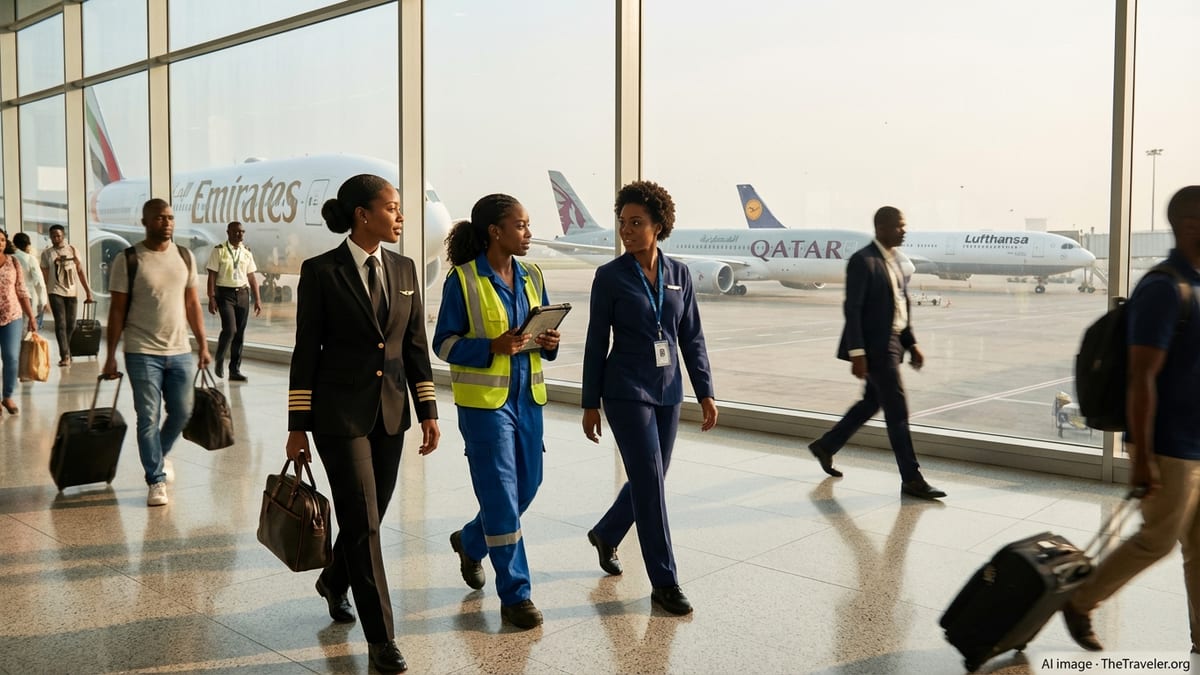
From Doha to Dubai and Lagos to Paris, a new generation of Nigerian women is quietly transforming the African skies, taking key roles with global carriers such as Emirates, Qatar Airways, Lufthansa, Turkish Airlines and Air France while reshaping what is possible for women in aviation across the continent.
Global Carriers Look to Nigeria’s Growing Talent Pool
Major international airlines have stepped up recruitment and training across Africa in recent years, and Nigerian women have become some of the most visible beneficiaries of that shift. Once largely confined to ground roles or cabin crew, they are now entering cockpits, operations centres and engineering hangars with some of the world’s most influential carriers, including Emirates, Qatar Airways, Lufthansa, Turkish Airlines and Air France.
Industry analysts point to demographic and market trends driving this change. Nigeria is Africa’s most populous country, with a rapidly expanding middle class and growing demand for international travel. Global airlines see the country not only as a lucrative market but also as a source of highly motivated, English speaking aviation professionals who can help them serve West and Central Africa more effectively.
Executives at the big Gulf and European carriers have also adopted diversity and inclusion targets that explicitly seek to bring more women and more African nationals into technical and leadership roles. That combination has opened a pathway for Nigerian women, particularly in flight operations, maintenance, safety management and commercial planning. The result is a small but steadily growing cadre of professionals whose careers span Lagos, Abuja and some of the busiest hubs in the world.
For Nigerian regulators and training institutions, the presence of their graduates at marquee airlines has become a point of pride and a lever to argue for more investment in local aviation education. Each high profile appointment, whether on the flight deck of a wide body aircraft or in an airline headquarters, reinforces the idea that Nigerian talent can compete at the very top of the global aviation industry.
Pioneers in the Cockpit: From Zaria to Doha and Dubai
Few stories capture this transition better than that of Captain Adeola Ogunmola Sowemimo, who trained at the Nigerian College of Aviation Technology and a flight academy in the United States before joining a domestic carrier and later earning a position at Qatar Airways. She became the first Nigerian female pilot to work for the Doha based airline and one of the first Nigerian women to fly the Boeing 787 Dreamliner on long haul routes, including services across the Atlantic.
Her achievement reverberated far beyond a single flight deck. In Nigeria, aviation students and young professionals followed her rise on social media, where images of a Nigerian woman in the uniform of one of the world’s most prestigious airlines circulated widely. In aviation schools from Zaria to Abuja, instructors now cite her career as evidence that disciplined training and international certifications can lead directly to jobs with the biggest global carriers.
Other Nigerian women have quietly taken their places in cockpits with Emirates, Lufthansa, Turkish Airlines and Air France, either through direct recruitment or after building experience with regional African and Middle Eastern airlines. Their names may not yet be widely known to the public, but within professional networks they are becoming reference points for younger pilots looking beyond national borders for opportunities.
These pioneers are operating in a field where women remain under represented. Global industry bodies estimate that women account for only a small share of airline pilots worldwide, and the percentage is often lower in Africa. That context makes each Nigerian woman who reaches the left or right seat of a long haul aircraft both a statistical outlier and a symbol of what could become more common if training and hiring practices continue to change.
Beyond Pilots: Engineers, Controllers and Ground Innovators
The most visible changes tend to be on the flight deck, but Nigerian women are also advancing in less public yet strategically vital areas of aviation. In maintenance, repair and overhaul facilities that service aircraft for Emirates, Qatar Airways and other carriers operating into Lagos and Abuja, Nigerian female engineers are taking on more responsibility for inspections, avionics troubleshooting and reliability programmes.
At major African gateways, including Murtala Muhammed International Airport in Lagos and Nnamdi Azikiwe International Airport in Abuja, air traffic controllers, safety inspectors and airport operations managers from Nigeria increasingly work alongside teams from Lufthansa, Turkish Airlines and Air France. Several Nigerian women now coordinate turnaround operations for wide body flights, oversee security and passenger handling standards, and liaise directly with network control centres in Europe and the Gulf.
Digital transformation is another area where Nigerian women are shaping the future of aviation. Carriers and ground handling companies are deploying new tools for biometric processing, baggage tracking and real time operations monitoring. Nigerian women trained in information technology and data analytics are joining joint projects with global airlines to improve on time performance and passenger experience on West African routes, helping bridge local knowledge with international standards.
These roles, while far from the spotlight, are essential for positioning African airports as reliable nodes in global networks. As Nigerian women rise through technical and managerial ranks, they are bringing a mix of local insight, international training and collaborative leadership styles that global partners increasingly rely on.
Partnerships Driving Training, Scholarships and Cadet Programmes
The growing presence of Nigerian women at leading airlines has not happened by accident. Over the past decade, a web of partnerships has been built between global carriers, Nigerian aviation colleges and scholarship foundations to identify and support female candidates with the aptitude for demanding aviation careers.
Airlines like Emirates and Qatar Airways have regularly participated in career fairs and recruitment missions in Lagos and Abuja, offering information on cabin crew, engineering and pilot pathways. While competition for pilot cadet slots remains fierce, outreach programmes specifically encourage women to apply and to pursue the required science, technology, engineering and mathematics subjects at secondary and tertiary level.
European carriers, including Lufthansa and Air France, have meanwhile expanded technical cooperation with Nigerian institutions, ranging from maintenance training to safety management and airport operations. These initiatives often include short courses or attachments in European hubs, where Nigerian women gain exposure to complex operations and return home with skills that can feed into airline partnerships or local carriers that code share with major global brands.
Scholarship schemes backed by multilateral organisations, corporate sponsors and Nigerian diaspora networks are filling some of the financial gaps that have traditionally kept women out of aviation training. Flight school remains expensive, but more aspiring female pilots and engineers now report receiving targeted financial support, mentoring and guaranteed internships that give them a credible route into the profession.
Breaking Barriers at Home: Regulators and Trailblazers
Inside Nigeria, women who broke barriers decades ago laid the groundwork for today’s international careers. Figures such as Chinyere Kalu, the country’s first female commercial pilot, and Blessing Liman, the first female military pilot, proved that Nigerian women could master complex aircraft and lead in demanding operational environments long before global airlines began targeting the country’s talent pool.
Nigerian regulators have been under pressure to address historic gender imbalances in aviation, particularly in technical and leadership positions. While progress is uneven, the Nigerian Civil Aviation Authority and related agencies have taken steps to promote female participation, including highlighting success stories during international aviation days and collaborating with professional associations to run outreach campaigns in schools.
These local efforts intersect with international frameworks promoted by organisations that have urged member states to incorporate gender equality into aviation policies. For Nigerian women, alignment between domestic initiatives and global best practice has helped open doors, including secondments and joint training with airlines such as Turkish Airlines and Lufthansa that operate daily services into the country.
The presence of Nigerian women in regulatory, safety and investigative roles is especially significant. Their involvement helps build trust in the system, strengthens oversight and provides role models for young women who may be more aware of public service careers than of opportunities at foreign airlines.
Economic and Social Impact Across the Continent
The rise of Nigerian women in aviation is not just a matter of personal ambition or corporate diversity goals. It also has tangible economic and social implications for Nigeria and the wider region. Aviation is a catalyst industry, supporting tourism, trade and investment. When more women occupy critical roles in that ecosystem, the benefits ripple through families, communities and supply chains.
Remittances from Nigerian professionals working for foreign airlines, including Emirates, Qatar Airways, Lufthansa, Turkish Airlines and Air France, support education, healthcare and small business ventures back home. Many of these women also invest in local initiatives, from sponsoring girls in science and technology programmes to supporting entrepreneurship among relatives.
Socially, their visibility helps to recalibrate assumptions about gender and work. In a country where young women are still frequently steered away from technical fields, the image of a Nigerian woman in pilot uniform or leading an airport operations team sends a powerful message. It suggests that careers in aviation are compatible with family life and cultural expectations, provided that institutional support and community understanding are in place.
For Africa’s aviation market, which is expected to grow as connectivity increases and new routes are launched, drawing on the full talent pool is also a matter of competitiveness. Airlines and airports that embrace diversity, including gender diversity, are better positioned to innovate and to understand the needs of a varied customer base across the continent and beyond.
Mentorship, Networks and the Next Generation
As the first significant wave of Nigerian women gains experience in international aviation, mentorship and networking have emerged as critical tools for sustaining momentum. Informal groups on messaging platforms connect female pilots, engineers and air traffic controllers across different airlines, allowing them to share advice on licensing, type ratings and career planning.
Several Nigerian aviators now participate in global women in aviation associations, where they interact with counterparts from Europe, the Middle East and North America, including colleagues at Emirates, Qatar Airways, Lufthansa, Turkish Airlines and Air France. These networks facilitate speaking engagements, school visits and media interviews that raise the profile of aviation careers among Nigerian girls.
At the same time, grassroots programmes encourage hands on exposure. Girls in Lagos, Abuja and regional cities are invited to airport open days, simulator demonstrations and science camps that emphasise flight, engineering and navigation. Nigerian women currently working abroad often schedule such visits during holidays at home, using personal stories to bridge the gap between a child’s curiosity and the technical realities of an aviation career.
With African air traffic projected to grow, industry leaders warn that the continent will need thousands of additional pilots, engineers and controllers in the coming decades. Nigerian women who have already navigated the system are increasingly seen as vital guides for the next generation, helping to ensure that future demand is met with a more balanced and inclusive workforce.
Challenges That Remain on the Runway Ahead
Despite notable progress, Nigerian women in aviation still face structural and cultural obstacles. Training remains expensive, and many families are reluctant to support daughters in fields that involve long absences from home or perceived safety risks. Some female pilots and engineers report encountering scepticism from colleagues or passengers, particularly on routes where female cockpit crew are still a novelty.
Working for international airlines can also mean juggling complex schedules, commuting between Nigeria and foreign bases, and navigating immigration and licensing requirements in multiple jurisdictions. While carriers such as Emirates, Qatar Airways, Lufthansa, Turkish Airlines and Air France offer established support systems, Nigerian women must often build informal networks of childcare, financial planning and emotional resilience to sustain their careers.
On the institutional side, advocates argue that more can be done to harmonise licensing, create flexible training finance schemes and embed anti discrimination protections in aviation workplaces across Africa. They also call for better data collection, noting that reliable statistics on the number of Nigerian women in different aviation roles are still scarce, making it harder to track progress and design targeted interventions.
Even so, the trajectory is clear. Each year brings new stories of Nigerian women joining cadet programmes, completing type ratings on advanced aircraft and taking on leadership roles in operations and safety. For the global airlines that have invested in Nigerian talent, and for Africa’s fast evolving aviation market, their ascent is reshaping expectations of who owns the future of flight on the continent.