

More news on this day
As Gulf neighbours compete to build ever-larger skylines and mega-resorts, Oman is taking a different route, betting that affluent travelers now value sustainability, silence and space as much as five-star service.
Get the latest news straight to your inbox!
From Mega-Projects to “High-Value, Low-Impact” Tourism
Publicly available information on Oman’s Vision 2040 strategy shows tourism positioned as a core pillar of economic diversification, with an emphasis on sustainable growth rather than mass-market volume. Instead of pursuing dense entertainment districts and supersized hotel clusters, plans highlight nature-based, heritage-focused and adventure experiences designed to attract high-spending visitors while limiting pressure on fragile ecosystems.
Recent analysis by international consultancies and multilateral tourism bodies indicates that Oman aims to raise travel and tourism’s contribution to gross domestic product into double digits by 2040, but through a “high-value, low-impact” model. That approach prioritizes revenue per visitor and local value creation over headline arrival numbers, in contrast to regional hubs that promote record-breaking tourist counts.
Reports on planned sector investments suggest that Muscat is targeting billions of dollars for projects aligned with this vision, including coastal and mountain resorts built to strict environmental standards, cultural districts, and sustainable urban communities. The objective is to create a network of differentiated destinations, each scaled to its surroundings, rather than a single dominant mega-zone.
This strategy is resonating in a global market where luxury travelers are increasingly sensitive to overtourism and environmental footprint. Industry research shows that affluent guests are willing to pay premiums for privacy, authenticity and clear sustainability credentials, placing Oman’s model squarely in line with emerging demand.
A Luxury Portfolio Built Around Landscape and Heritage
Oman’s geography is a key asset in this repositioning. The country’s tourism map stretches from the fjord-like khors of Musandam in the north to the monsoon-soaked green hills around Salalah in the south, with the Al Hajar mountains, Sharqiyah Sands desert and hundreds of kilometres of relatively undeveloped coastline in between. New and planned high-end properties are being woven into these landscapes rather than dominating them.
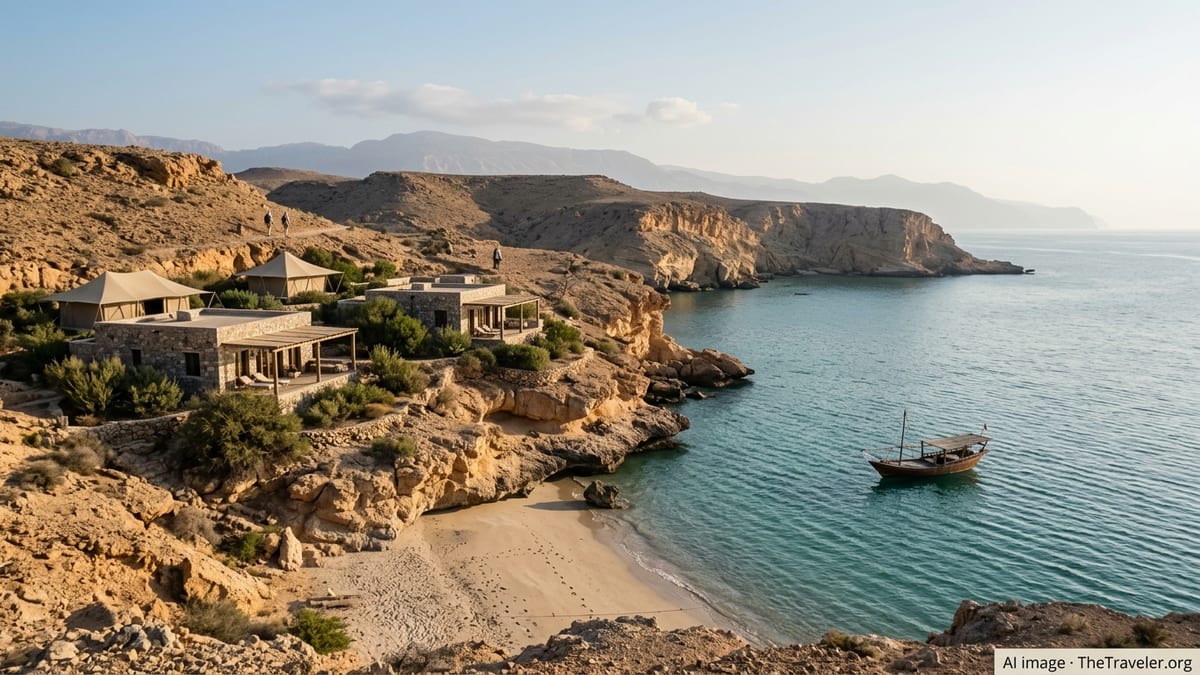
Sector overviews from regional media and investment briefings highlight a pipeline of luxury and ultra-luxury resorts that combine low-rise architecture, tented or villa-style accommodation and extensive use of local stone and materials. Many of these projects are positioned as gateways to protected reserves, turtle nesting beaches, wadis and mountain trails, where visitor numbers can be moderated.
Heritage development is advancing in parallel. Published coverage of government plans points to ongoing restoration and adaptive reuse of forts, old towns and archaeological sites as anchors for cultural itineraries. These initiatives are framed not only as visitor attractions, but also as tools to support local crafts, traditional music, foodways and storytelling, which are increasingly packaged into premium guided experiences and small-group journeys.
Compared to some of the region’s headline luxury projects, Oman’s offer is deliberately understated. Marketing materials from operators and tourism bodies emphasize stargazing instead of skyline views, mountain villages instead of mega-malls, and guided hikes in wadis instead of indoor theme parks, presenting the country as a “green gem” alternative within the Gulf for travelers seeking quiet sophistication.
Protected Areas, Ecotourism and Community Partnerships
A central component of Oman’s pitch to sustainability-minded travelers is its expansive network of protected lands. Research by investment and policy analysts notes that more than a fifth of the country’s landmass has been designated as nature reserves and conservation areas, ranging from marine sanctuaries to desert and mountain ecosystems. New ecotourism projects are being structured within or adjacent to these zones.
National media reports in 2024 and 2025 describe multi-million-rial partnerships between the Ministry of Heritage and Tourism, the state-backed Omran Group and private investors to create eco-lodges, visitor centres and low-impact attractions inside several nature reserves. Typical features include strict building footprints, reliance on renewable energy where feasible, and caps on daily visitor numbers to match carrying capacity.
Authorities are also encouraging models that keep communities at the centre of tourism growth. Published information about emerging initiatives in reserves and rural areas points to local guides, homestays, handicraft cooperatives and community-run camps as integral parts of new offerings. This approach is presented as a way to share tourism revenue more widely, discourage outmigration from remote regions and enlist residents in conservation efforts.
For high-end travellers, these policies translate into curated but grounded experiences: bird-watching with locally trained experts, multi-day trekking with village-based guides, or carefully managed desert camping that prioritizes minimal impact. The result is a form of luxury that is less about marble lobbies and more about exclusive access to intact nature under clear sustainability rules.
Vision 2040 Targets and the Global Luxury Market
Oman’s long-term tourism ambitions are tightly linked to Vision 2040 benchmarks. Official strategy documents and independent assessments reference goals to attract millions more visitors annually by 2040 while lifting tourism’s share of GDP and creating tens of thousands of jobs. Achieving those targets without overburdening coastlines, cities and heritage sites has made sustainable planning a necessity rather than a branding exercise.
Economic reports suggest that visitor spending in Oman is forecast to grow steadily over the next decade, supported by sustained infrastructure investment, improved air connectivity and rising global interest in off-the-beaten-path destinations. International rankings of travel and tourism competitiveness indicate that the country is targeting a move into the upper tier of global destinations, with sustainability performance as one of the levers.
In the wider Middle East, the luxury travel segment is becoming increasingly crowded, with mega-developments on Saudi Arabia’s Red Sea coast and established urban hubs in the United Arab Emirates competing for high-net-worth visitors. Oman’s differentiation lies in its willingness to cap scale, embed environmental safeguards and foreground cultural continuity, positioning the sultanate as a complement rather than a direct rival to its neighbours.
As affluent travellers look beyond traditional hotspots in search of quieter, lower-impact experiences, market observers note that Oman’s steady, conservation-led strategy is starting to pay reputational dividends. Awards at major industry events for adventure, cultural and sustainable tourism, along with double-digit annual growth in international arrivals in recent years, suggest that the country’s decision to “ditch the crowds” is helping to redefine what high-end travel in the Middle East can look like.