

More news on this day
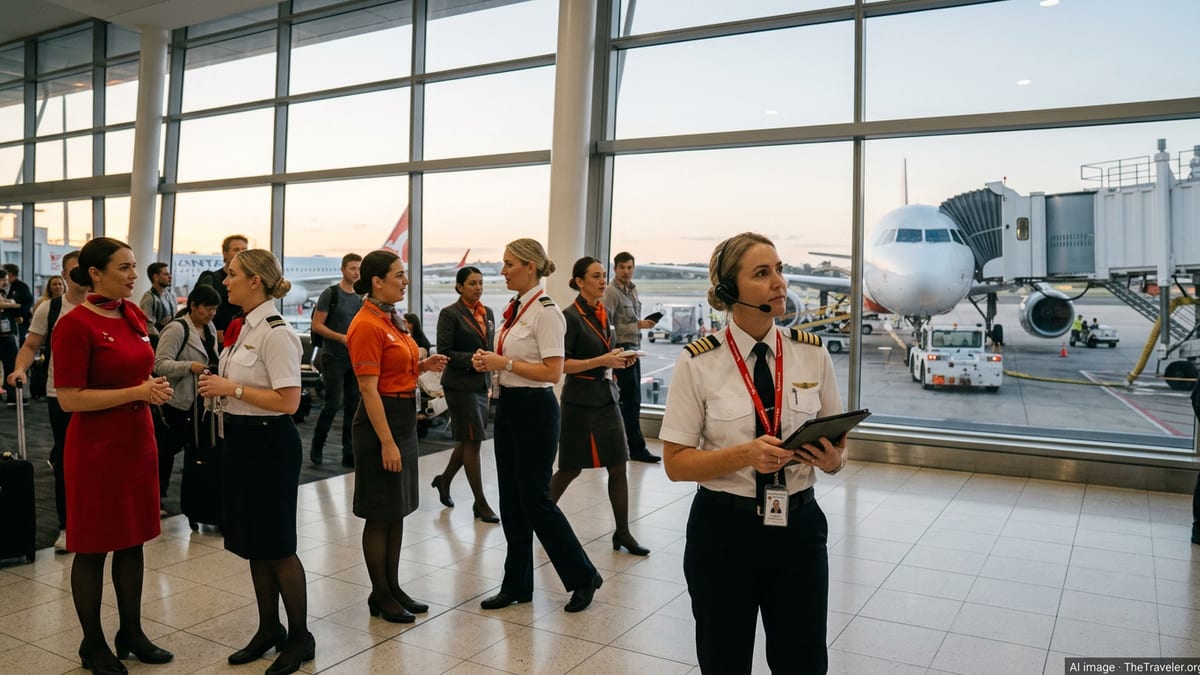
Across Australian skies, Qantas and Jetstar are deploying all-female crews not just as a symbolic gesture for International Women’s Day, but as a strategic testbed for what a more gender-balanced future in aviation could look like.
From One-Off Stunts to a Coordinated Network of Flights
In March 2025, the Qantas Group marked International Women’s Day with more than 50 flights operated entirely by women, spanning Qantas, Jetstar and QantasLink services on domestic and short-haul routes. Pilots, cabin crew, engineers, dispatchers and ground handlers were all rostered from the company’s female workforce, turning aircraft and terminals into moving showcases of women’s roles across the operation.
The scale of the initiative was a step change from earlier one-off services. A year earlier, Qantas highlighted an all-female operated QF401 between Melbourne and Sydney, while ground services provider Swissport staffed dedicated all-women ramp and passenger teams for Qantas and Jetstar flights between Sydney and the Gold Coast. Those early efforts demonstrated the logistical feasibility of such operations and laid the groundwork for a more ambitious program.
By 2025, the network of all-female crew flights stretched across peak business and leisure corridors, ensuring that thousands of passengers encountered women in roles that have long been dominated by men. Qantas executives framed the program as both a celebration and a diagnostic exercise, revealing where the pipeline of female talent is healthy and where it remains thin, especially in technical and leadership positions.
The visibility of women on the flight deck is particularly significant in Australia, where only about 10 percent of pilots are female, still higher than the global average but far from parity. Placing women in highly visible operational roles on dozens of flights in a single day sends a clear message to passengers, industry peers and potential recruits that the cockpit is not a male-only domain.
Inside the Operation: Women on the Flight Deck, in the Cabin and on the Ramp
Behind each all-female service sit months of planning and a finely tuned roster. At Qantas and Jetstar, schedulers work closely with operational managers to line up pilots, cabin crew and engineers while still maintaining safety margins, duty-time limits and overall network resilience. The design is to prove that all-female crews can be deployed within standard operating frameworks, rather than as fragile showpieces.
On board, passengers experience a flight that is operationally indistinguishable from any other, which is precisely the point. Safety briefings, turbulence management, technical decision-making and customer care unfold according to company procedures, led entirely by women. The effect is subtle but powerful, especially for young passengers who see women commanding the aircraft or supervising the turnaround on the tarmac.
Crucially, the “all-female” label extends beyond the visible cabin. Licensed engineers sign off maintenance, operations controllers oversee flight paths and fuel loads, and airport teams coordinate boarding and baggage. For some sectors, even air traffic control sectors were staffed by women for the occasion, underscoring that aviation is an ecosystem in which gender diversity must reach far beyond the aisle of the aircraft.
The integrated approach has resonated internally. Many Qantas and Jetstar staff describe all-female crew days as moments of pride and solidarity, but also as prompts to discuss career progression, mentoring and the barriers that still exist. By stitching these flights into normal operations, the airlines are working to normalize the presence of women in every segment of the operation, rather than relegating them to a single annual photo opportunity.
Beyond Symbolism: Tackling Pay Gaps and Pipeline Problems
While the optics of all-female flights are striking, Qantas Group leaders are under pressure to ensure they are matched by structural change. Recent data from Australia’s Workplace Gender Equality Agency show that the group still carries a sizable median gender pay gap, driven in large part by the scarcity of women in high-paid pilot and engineering roles.
In response, Qantas has set a target for women to make up 40 percent of new cadet pilot intakes by 2028, up from around 20 percent in recent years. Scholarship programs, outreach campaigns and partnerships with schools and universities are being scaled up, building on initiatives such as Girls in Aviation Day at Qantas facilities, which bring students into hangars and simulators to meet female pilots, engineers and operations specialists.
The group has also signed on to the International Air Transport Association’s 25by2025 initiative, committing to improve female representation in senior roles and on key governance bodies. Internally, Qantas has revamped its inclusion and diversity strategy, updated uniform and grooming policies that were previously gender-based, and introduced more flexible rostering to help retain experienced women who might otherwise exit mid-career.
For Jetstar, where gender pay gaps have historically been wider, the challenge is particularly acute. Executives at the low-cost carrier have signalled plans to expand mentoring networks, transparent promotion pathways and leadership development programs for women in technical and operational roles. The all-female flights serve as a public benchmark against which progress on these deeper reforms will be judged.
Jetstar Japan and a Growing Regional Wave
The ripple effects of these initiatives extend beyond Australia. In March 2024, Jetstar Japan operated a domestic service with an all-female cockpit and cabin crew to mark International Women’s Day, joining a growing list of carriers in Asia, Europe and the Middle East that are experimenting with similar flights.
In Japan, where cultural expectations and industry structures have long constrained women’s participation in technical aviation roles, the sight of an all-female crew on a commercial service carried particular weight. Jetstar Japan’s operation tapped into the Qantas Group’s broader gender strategy while responding to local debates about work, family and women’s career progression.
Across the region, airlines from full-service flag carriers to low-cost operators have piloted comparable initiatives. All-female freighter rotations, maintenance shifts and ground-handling teams are increasingly common around International Women’s Day, signalling that the conversation has shifted from whether women can perform these jobs to how quickly companies can rebalance their workforces.
Within this landscape, Qantas and Jetstar’s multi-flight, multi-airline approach stands out for its scale and integration. Rather than highlighting a single historic flight, the group is framing all-female operations as a recurring, network-wide feature that points toward a new normal across the Asia-Pacific aviation market.
Passenger Reactions and the Risk of Tokenism
Reactions from travelers encountering all-female crews on Qantas and Jetstar have ranged from quiet approval to enthusiastic support. Social media posts from passengers often describe a sense of pride, especially among Australian women and girls, at seeing female pilots and engineers in charge of large aircraft and complex turnarounds.
Some passengers report that they only learned about the initiative when the captain introduced the crew over the public address system, emphasizing that their presence is a function of skill and experience, not a novelty. For parents, particularly those traveling with daughters, these flights have become teachable moments about career possibilities and the importance of representation in high-skilled professions.
At the same time, industry observers and some employees caution that such initiatives risk being perceived as tokenistic if they are not anchored to hard targets and transparent reporting. Critics argue that one-day events cannot on their own dismantle structural barriers such as biased hiring pipelines, inflexible rosters, or limited access to training for women returning from career breaks.
Qantas and Jetstar executives acknowledge those concerns and increasingly frame all-female operations as part of a broader continuum of change that includes pay-gap disclosure, recruitment reforms and leadership accountability. For the airlines, the true measure of success will be whether the sight of a woman in command of a widebody aircraft, leading a line maintenance shift or running an operations control room becomes so routine that it no longer warrants a headline.