

More news on this day
From fully enclosed suites to biometric boarding and chef-driven tasting menus, Qatar Airways and a tight circle of global rivals are rapidly transforming long-haul business class into an experience that increasingly rivals private aviation, with 2026 shaping up as a decisive year in the race for premium travelers.
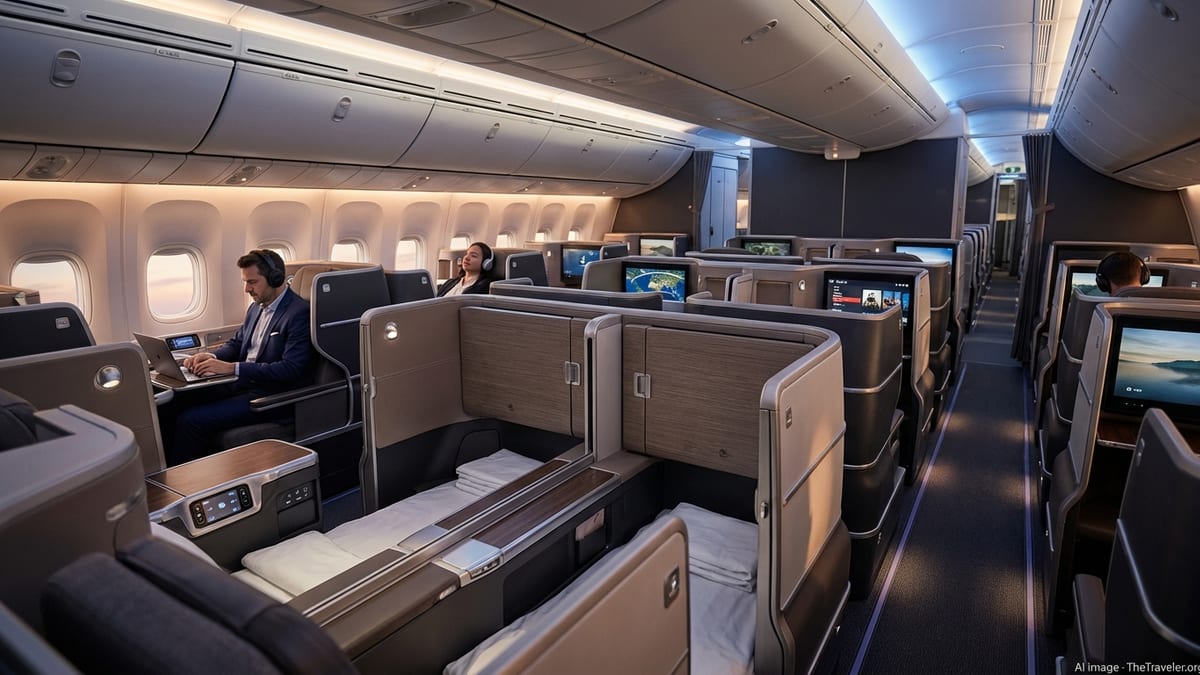
Qatar Airways Signals a New Phase in the Business Class Arms Race
Qatar Airways built its modern premium reputation on the Qsuite, the 1-2-1 business class cabin with sliding doors and configurable “quad” seating that effectively reset the industry benchmark when it debuted in 2017. Nearly a decade later, the carrier is preparing its next move, using 2026 as a launchpad for a wider premium ecosystem that stretches from curbside to cruise altitude.
The Doha-based airline has been steadily expanding Qsuite coverage across its long-haul fleet, while quietly refining details such as upgraded bedding, enhanced turndown service, and new menu partnerships on key routes. Industry executives and analysts expect the airline’s next-generation business product to build on that foundation rather than replace it outright, focusing on smarter personalization, higher privacy and better integration with digital tools that travelers already use.
Qatar Airways’ planned New Terminal One lounge at New York JFK, set to open with the terminal’s first phase in 2026, underlines how seriously the carrier now treats the ground side of the premium journey. The 15,000-square-foot space is being positioned as an extension of the business cabin, with VIP check in, quiet zones, prayer rooms, children’s play areas and premium dining designed to mirror onboard service and create a seamless narrative from city to seat.
For corporate buyers, this emerging “total journey” philosophy matters as much as the hard product. Negotiated contracts increasingly look beyond seat maps to consider reliable sleep, privacy for work, and time savings at congested hubs, making Qatar Airways’ investment in integrated ground and air experiences a strategic bet on what premium travelers will value most by 2026.
Emirates, Etihad and the Gulf Carriers Double Down on Privacy and Space
Across the Gulf, rivals Emirates and Etihad Airways are also sharpening their premium propositions for the second half of the decade. Emirates has embarked on a major retrofit of its Boeing 777-300ER fleet, introducing a new 1-2-1 business cabin that finally eliminates middle seats and gives every passenger direct aisle access, a clear shift away from its older 2-3-2 configuration. The latest seats offer fully lie-flat beds, staggered for greater personal space and privacy, signaling a quiet but important reset of expectations on the airline’s workhorse widebody.
Emirates is complementing those changes with refreshed soft products, including updated menus and drinks lists, deeper integration of its inflight entertainment platform with passengers’ own devices, and more tailored lighting scenes to support sleep and circadian rhythms. While the carrier has kept sliding doors largely confined to first class, it is edging closer to a suite-like feel in business, banking on refined finishes and clever cabin zoning to deliver privacy without fully enclosing each seat.
Etihad Airways is following a similar trajectory from its Abu Dhabi base, leveraging its newer Airbus A350 and Boeing 787 fleets to showcase a more residential design language in business class. The airline has been rolling out seats with higher privacy shields, direct aisle access and increased storage, echoing its “apartment” concept from first class in a more space-efficient form. As with Qatar Airways, the emphasis is on creating a sense of calm and control, reducing visual clutter and ambient noise rather than adding conspicuous luxury for its own sake.
Together, the Gulf carriers are pivoting away from the spectacle of onboard bars and oversized public spaces toward a more individualized model of luxury. High-spending passengers now appear more interested in quiet corners, sleep quality and private workspaces than in socializing at 35,000 feet, and the hard products being readied for 2026 reflect that shift.
Asian Flagships Push Tech-Driven Comfort and Hyper-Personalization
In Asia, Singapore Airlines, Cathay Pacific and EVA Air remain central players in the contest for the world’s most coveted business class travelers, particularly on trunk routes linking Southeast Asia, Greater China, North America and Europe. Singapore Airlines has already trended toward ever larger, more private business seats, with wide, forward-facing pods that convert into fully flat beds and emphasize personal storage, work surfaces and shoulder room.
The carrier has been teasing an “all-new travel experience” slated for 2026, expected to incorporate updated soft furnishings, refreshed amenity kits and new serviceware in premium cabins. While concrete details remain under wraps, analysts expect the airline to double down on tasteful, understated luxury, likely adding more advanced seat controls, improved lighting schemes and greater integration of wellness and nutrition science into the inflight dining program.
Cathay Pacific, rebuilding after years of pandemic-era disruption and regional travel restrictions, has signaled that premium cabins will anchor its recovery strategy. The Hong Kong-based carrier has leaned into a calmer, residential aesthetic, with high-walled business suites, dual closing doors on some aircraft and discreet, directional lighting that supports work and rest without flooding the cabin. As long-haul demand to and from mainland China returns, Cathay’s ability to offer quiet, office-like spaces with reliable connectivity will be a key differentiator.
Taiwan’s EVA Air, long a favorite of seasoned frequent flyers for its consistent service and comfortable hardware, is also iterating on its Royal Laurel business product. The airline is expected to introduce further refinements to seat cushioning, storage and privacy elements, while modernizing inflight entertainment and connectivity to better match the ambitions of newer premium entrants. Collectively, these Asian carriers are focusing less on theatrical features and more on quiet, technologically assisted comfort that can carry a traveler from late-night conference call to deep sleep in minutes.
European and North American Rivals Race to Catch Up
Across the Atlantic, European and North American airlines are pushing through multibillion-dollar cabin renewal programs that increasingly place business class at the center of their long-haul strategies. Air France has introduced a new business suite featuring sliding doors, fully flat beds of around two meters in length, and a herringbone layout that points each passenger away from the aisle for added privacy. The cabin design emphasizes French materials and detailing, with full-grain leather, aluminum trim and subtle lighting meant to evoke boutique hospitality more than a traditional airliner.
The French flag carrier is progressively rolling out this new standard across its Boeing 777 and Airbus A350 fleets, aligning its product more closely with the likes of Qatar Airways and Singapore Airlines. Paired with upgraded lounges at Paris Charles de Gaulle and a renewed focus on curated dining and French wines, the airline aims to position itself firmly in the top tier of global business class offerings by the late 2020s.
In the United States, the competitive picture is also shifting. United Airlines has unveiled its next-generation Polaris Studio suites, scheduled to debut in 2026 on new Boeing 787-9 aircraft. The cabins feature lie-flat seats with privacy doors, companion ottomans for face-to-face dining or meetings, wireless charging, Bluetooth audio and extra-large high-definition screens. The airline is also reinforcing its partnership with Saks Fifth Avenue for bedding, pairing upgraded hard product with more luxurious sleep amenities and expanded pre-order dining on key routes.
Other US and European carriers, including Delta Air Lines, American Airlines, British Airways, Lufthansa and Iberia, continue to introduce or refine business suites with doors, improved cushioning and new lighting, reflecting a broad industry recognition that long-haul profitability increasingly hinges on winning and retaining premium travelers. By 2026, travelers on many major intercontinental routes can expect that a business ticket will almost automatically mean a fully flat bed, direct aisle access and at least some form of enhanced privacy.
From Seats to Ecosystems: Lounges, Terminals and the Curb-to-Cabin Journey
The new competition in business class is no longer just about the seat. Qatar Airways’ forthcoming flagship lounge at New York JFK’s New Terminal One encapsulates a broader trend in which airlines are redesigning entire airport journeys around their elite passengers. The Doha carrier’s space will offer direct gate access, dedicated check-in, quiet and family zones, high-end dining and curated retail, framed as an extension of its inflight brand rather than a separate experience.
Emirates, Singapore Airlines, Cathay Pacific and others are pursuing similar strategies at their home hubs, investing heavily in expanded and redesigned lounges with more natural light, dedicated rest zones, private work booths and improved shower and spa facilities. These spaces are increasingly optimized for shorter but more productive visits, reflecting tighter connection windows and the growing share of business travelers who need to squeeze in video calls or focused work between flights.
At the infrastructure level, new or upgraded terminals at Doha, Dubai, Abu Dhabi, Singapore, Hong Kong, Paris and New York are baking premium pathways into their blueprints. Features such as dedicated security lanes, biometric border processing and more intuitive wayfinding are aimed at compressing the stress of international transit, turning what was once idle or frustrating time into an extension of the business-class promise.
For airlines like Qatar Airways, which compete fiercely for connecting traffic between Europe, Africa, the Americas and Asia, the ability to offer a reliably smooth, quiet and premium-feeling connection has become a commercial imperative. As more carriers elevate their onboard offerings, the ground experience is emerging as the next major frontier of differentiation.
Innovation at the Seat Level: Doors, Layouts and New Cabin Concepts
At the core of the 2026 race is the question of what, exactly, constitutes a state-of-the-art business class seat. Snapped into sharp relief by Qatar Airways’ Qsuite and similar products, the emerging consensus combines four elements: direct aisle access from every seat, a fully flat bed long enough for tall travelers, some form of physical or visual privacy and sufficient space to work comfortably with a laptop and personal items.
Qatar Airways and a growing list of competitors have embraced doors, transforming business seats into mini-suites that allow passengers to fully retreat from the cabin. Air France’s suites, United’s upcoming Polaris Studio, select Cathay Pacific configurations and evolving products at carriers such as Delta and British Airways all reflect this push toward enclosure. Even airlines that stop short of full-height doors, such as Emirates in its latest 777 business cabin, now rely on higher partitions, staggered layouts and carefully angled sightlines to achieve a similar feeling of seclusion.
Cabin geometry is also evolving. Traditional straight-row layouts are giving way to more complex herringbone and staggered patterns designed to optimize the balance between density and comfort. Carriers are experimenting with “honeymoon” pairs for couples, alternating forward- and rear-facing suites, and a mix of throne-style seats with extra surface area and more compact options, sometimes sold at different price points within the same cabin.
New entrants and smaller premium-focused airlines are adding further pressure. In Asia, boutique carriers have begun to showcase long-haul cabins with elements such as personal closets, overhead-bin-free ceiling lines, and open-concept premium zones that borrow design cues from luxury hotels. For incumbents like Qatar Airways, Emirates and Singapore Airlines, this competition reinforces the need to keep their flagship business cabins at the cutting edge in both function and emotional appeal.
Tech, Wellness and Sustainability: The Next Layer of Differentiation
Beyond hardware, the leading airlines are investing heavily in digital and wellness features that they believe will matter just as much in 2026 as seat pitch and wine lists. Qatar Airways, Singapore Airlines, Cathay Pacific, Emirates and their peers are rolling out faster and more reliable onboard connectivity, with many targeting near-home bandwidth levels that support video conferencing, cloud-based work and real-time collaboration tools.
Inflight entertainment systems are being upgraded with larger 4K screens, Bluetooth connectivity for personal headphones and more responsive interfaces. Seat controls are becoming smarter, allowing passengers to select presets that adjust lighting, recline, lumbar support and temperature for work, dining or sleep. Airlines are layering in wellness content, guided stretching, soundscapes and tailored lighting programs that gradually shift color temperature to ease jet lag on ultra-long sectors.
Food and beverage programs are also evolving, with a pivot toward lighter, fresher dishes, more plant-forward menus and greater emphasis on hydration. Many carriers are working with nutritionists and chefs to design meals that help stabilize energy levels rather than simply impress on presentation. Premium passengers can expect expanded pre-order options, on-demand dining windows and more precise accommodation of dietary requirements, all supported by updated digital ordering tools.
Sustainability, once a marginal concern in premium cabins, is moving closer to the center of the narrative. Airlines are trialing new materials for seat shells and soft furnishings, reducing single-use plastics in amenities and upgrading galley equipment to be more energy efficient. While the environmental impact of long-haul flying remains substantial, carriers argue that more modern cabins can at least cut waste and improve fuel efficiency through lighter-weight seat structures and smarter cabin design.
What 2026 Will Look Like for the Elite Business Traveler
For travelers booking top-tier business class in 2026, the result of this global competition will be a noticeably different experience from just a few years ago. On leading carriers such as Qatar Airways, Emirates, Singapore Airlines, Air France, Cathay Pacific, Etihad and EVA Air, the expectation will be a fully flat bed with excellent bedding, robust privacy, intuitive storage and dependable high-speed connectivity across most long-haul routes.
The journey will begin well before boarding. At key hubs and major outstations, passengers will move through streamlined, often biometric-enabled checkpoints into lounges that feel closer to members’ clubs or boutique hotels than traditional airport waiting areas. They will have more options to work in quiet, take a shower, rest in semi-private pods or sample menus that preview the onboard service, all while keeping an eye on boarding through real-time app updates.
Once on board, the cabin will feel more like a collection of individual cocoons than a shared space. Sliding doors or high privacy walls will make it easier to sleep through neighboring movement, while seat controls, lighting and inflight entertainment will respond more like consumer tech devices than legacy aircraft equipment. For many travelers, especially those on ultra-long-haul flights that can stretch past 15 hours, the difference between arriving rested and drained will hinge on these details.
For airlines, the stakes are high. Premium cabins represent a disproportionate share of long-haul revenue, and corporate contracts are increasingly sensitive to the nuances of comfort, privacy and productivity. As Qatar Airways joins its peers in unveiling the next wave of enhancements leading into 2026, the battle for the world’s most coveted business travelers is poised to intensify, reshaping expectations of what it means to travel “business class” for years to come.