

More news on this day
As jet fuel prices spike on the back of the Iran war and broader geopolitical tensions, Ryanair, Scandinavian Airlines (SAS), and United Airlines are stress-testing very different strategies to contain costs, protect fragile balance sheets, and keep passengers flying through the 2025–2026 fuel shock.
Get the latest news straight to your inbox!
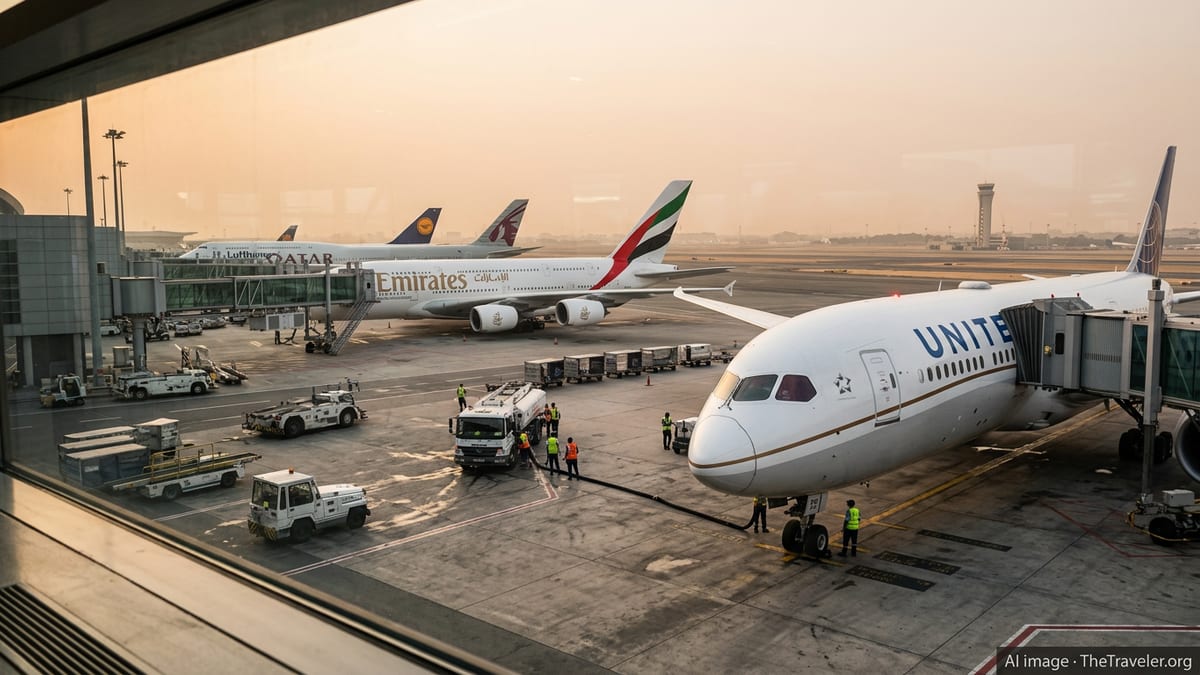
Jet Fuel Turns From Tailwind to Turbulence
Global aviation entered 2025 expecting relatively stable energy costs, but by early 2026 jet fuel had become one of the industry’s sharpest headwinds. International benchmarks tracked by industry bodies show average jet fuel prices climbing to multi‑year highs in February and March, with some weekly spot prices nearly doubling within a month as shipping lanes and crude exports were disrupted by the conflict involving Iran and Israel. Reports from market analysts describe a swing from gradual post‑pandemic normalization to what many now frame as an outright fuel crisis.
In the United States, transport statistics and airline disclosures point to a squeeze on margins as cost per gallon rises even while fuel consumption falls, a sign that carriers are trimming capacity but still paying more for each ton of fuel they burn. Investor briefings from major U.S. airlines in March 2026 describe strong passenger demand, but also highlight fuel as the single most volatile line item in their income statements, with some executives warning that higher airfares and surcharges are likely to follow as the summer travel peak approaches.
In Europe, the jet fuel shock is colliding with regulatory changes that are raising the cost of carbon. The progressive tightening of emissions trading rules and the introduction of sustainable aviation fuel blending mandates are increasing non‑fuel operating costs even as the underlying price of kerosene surges. This combination is particularly challenging for legacy flag carriers still restructuring after the pandemic, while low‑cost operators with aggressive fuel hedging and newer fleets are trying to turn the disruption into a competitive advantage.
Ryanair Leans on Hedging and a High‑Density Fleet
Ryanair entered the 2025–2026 period with one of the most extensive fuel‑hedging programs among European airlines, and that position has become central to its response to the jet fuel crisis. Regulatory filings and European press reports indicate that by March 2025 the group had locked in roughly three‑quarters of its expected fuel needs for the 2025–2026 financial year, at a price significantly below current market levels. More recent coverage from early 2026 in Spanish financial media suggests that about 80 percent of the carrier’s estimated consumption through March 2027 remains hedged at around 67 dollars per barrel, providing a sizable cushion against spot market volatility.
That hedging book builds on a long‑running strategy the airline has described in earlier annual reports, where management repeatedly pointed to favorable oil hedges as a key factor behind rising profits and a widening unit cost gap versus European rivals. The current crisis is testing that thesis in real time. With jet fuel prices now significantly higher than the levels embedded in its forward contracts, Ryanair can keep ticket prices comparatively low, at least in the near term, while competitors more exposed to the spot market may have to move faster on fare increases or capacity cuts.
Ryanair is also leaning on hardware. Company disclosures over the past year highlight accelerated deliveries of Boeing 737 Max “Gamechanger” aircraft and the retrofit of split‑scimitar winglets to its older 737‑800 fleet. The airline estimates that these changes cut fuel burn per seat by around 1.5 percent to 16 percent depending on the aircraft type, while adding extra seats that spread fuel costs across more passengers. In an environment where fuel can rapidly erase thin margins, even low‑single‑digit efficiency gains are becoming more material, particularly on dense intra‑European routes where Ryanair competes directly with less fuel‑efficient rivals.
However, the hedging shield is temporary. Ryanair’s own risk warnings note that if oil prices fall back sharply, the airline could face hedging losses, and if prices stay elevated beyond the term of existing contracts, its cost advantage will narrow as new hedges are struck at higher levels. For now, though, the airline’s combination of forward cover, a young fleet, and a high‑utilization model is allowing it to frame the crisis as an opportunity to consolidate market share rather than a threat to its expansion plans.
SAS Balances Restructuring With Fuel and Climate Pressures
Scandinavian Airlines enters the fuel shock from a very different position. After emerging from court‑supervised restructuring in 2024, SAS has been working through its SAS FORWARD transformation plan, which targets multi‑billion‑krona cost reductions and a shift toward a more efficient narrow‑body fleet. Company documents and annual reports describe an effort to bring unit costs down by 2026, in part by concentrating operations around its key hubs in Copenhagen, Oslo, and Stockholm, and by growing the share of Airbus A320neo aircraft in its short‑haul network.
The jet fuel spike has intersected with this restructuring at a delicate moment. SAS’s latest integrated report underscores that fuel and emission rights already made up a large portion of its operating expenses in fiscal 2024, and the airline has limited room to pass on additional costs in a highly competitive Nordic market. At the same time, the carrier is bound by Scandinavian governments’ climate ambitions, which push it toward lower‑emission operations, sustainable aviation fuels, and eventually alternative propulsion technologies from the second half of the decade.
Publicly available information shows that SAS has been using hedging within defined limits to manage short‑term volatility, while focusing structurally on fuel efficiency. The airline has been phasing out older aircraft, deepening partnerships with regional operators, and exploring options such as hydrogen and electric aviation through industrial collaborations announced in recent years. These initiatives are not a direct response to the 2026 fuel shock, but they shape how the airline can react: every older, thirstier aircraft retired reduces the amount of expensive fuel SAS must buy in the first place.
The broader Scandinavian policy environment is also relevant. Sweden and its neighbors have shifted from the “flight shame” debate of the late 2010s to targeted public investments in cleaner aviation, including support for sustainable fuels and new technologies. For SAS, this aligns financial necessity with regulatory direction. The crisis has not removed the urgency of completing its restructuring or resolving ownership questions, but it has reinforced the logic of betting on efficiency and climate‑aligned growth rather than relying on across‑the‑board capacity cuts.
United Adjusts Capacity While Doubling Down on SAF
Among major U.S. carriers, United Airlines has been one of the most vocal about the implications of sustained high oil prices. Recent business press coverage describes United modeling scenarios in which crude climbs as high as 175 dollars per barrel in 2026 and remains above 100 dollars into 2027. Under those assumptions, executives have signaled that there is little sense in operating marginally profitable routes that cannot absorb much higher fuel costs, hinting at selective capacity reductions in the near term while maintaining long‑run growth plans.
United’s strategy relies less on traditional fuel hedging and more on a mix of fleet renewal, network flexibility, and long‑term bets on sustainable aviation fuel. Financial analysis published in 2025 highlighted record quarterly results supported by deliveries of newer, more efficient mainline jets that replaced aging aircraft. Around the same time, the airline pointed to investments in next‑generation fuel providers, including projects that aim to synthesize jet fuel from captured carbon and renewable power. Public sustainability materials and subsequent news coverage describe these SAF partnerships as a hedge against both carbon regulation and conventional fuel price spikes.
That positioning has become more visible as the fuel crisis unfolds. News reports in March 2026 note that U.S. airlines, including United, are still seeing strong booking trends even as jet fuel costs rise, suggesting that there is room to lift fares and ancillary charges if needed. In earlier comments cited by U.S. media, United’s chief executive warned that airfare increases would probably emerge quickly if fuel costs continued to climb, signaling that the carrier is prepared to use pricing power on core routes rather than resort immediately to drastic cost‑cutting measures such as staff furloughs or deferred aircraft orders.
United is also trying to tie its fuel strategy to a broader sustainability narrative. The airline was among the first major U.S. carriers to set a public net‑zero target and to emphasize SAF in its decarbonization roadmap. While sustainable fuels still represent a tiny fraction of United’s overall consumption and trade at a steep premium to kerosene, the current crisis has highlighted the strategic value of diversifying away from pure exposure to crude markets. Investors and environmental groups will be watching whether the carrier maintains these long‑term commitments if high fuel prices begin to erode profitability over several quarters.
Global Turmoil Widens the Gap Between Business Models
The 2025–2026 fuel crisis is unfolding against a backdrop of geopolitical instability, from conflict in the Middle East to energy market swings in Europe and Asia. For airlines, the result is not only higher costs but also shifting demand patterns as travelers weigh safety perceptions, ticket prices, and alternative modes of transport. Network carriers with global footprints must constantly re‑route traffic around conflict zones and adapt schedules as governments update overflight restrictions, while point‑to‑point low‑cost carriers concentrate on cost control and price‑sensitive leisure demand.
Within this landscape, Ryanair, SAS, and United illustrate how divergent business models shape the response to the same external shock. Ryanair’s ultra‑low‑cost structure and aggressive hedging give it near‑term protection and the chance to press its advantage on intra‑European routes. SAS, emerging from restructuring amid ambitious climate policy, is using the moment to accelerate a shift toward efficiency and lower‑carbon operations, but remains constrained by its balance sheet and the economics of a relatively small home market. United, as a global network player, is steering between protecting profitability in the face of surging fuel prices and preserving investment in sustainable fuels and fleet renewal that it views as essential to long‑term competitiveness.
Industry analysts broadly agree that fuel will remain a dominant variable for airlines at least through 2026, and that the crisis is likely to deepen the divide between carriers with robust finances, flexible fleets, and credible energy strategies and those without. If oil prices stay elevated into 2027, the playbooks being tested today by Ryanair, SAS, and United could become templates for how different segments of the global airline industry navigate an era of persistent energy and geopolitical turbulence.