

More news on this day
From facial recognition lanes in U.S. hubs to liquid rules easing at Europe’s biggest airports, a wave of smart security technology is beginning to change what it feels like to stand in an airport line in 2026.
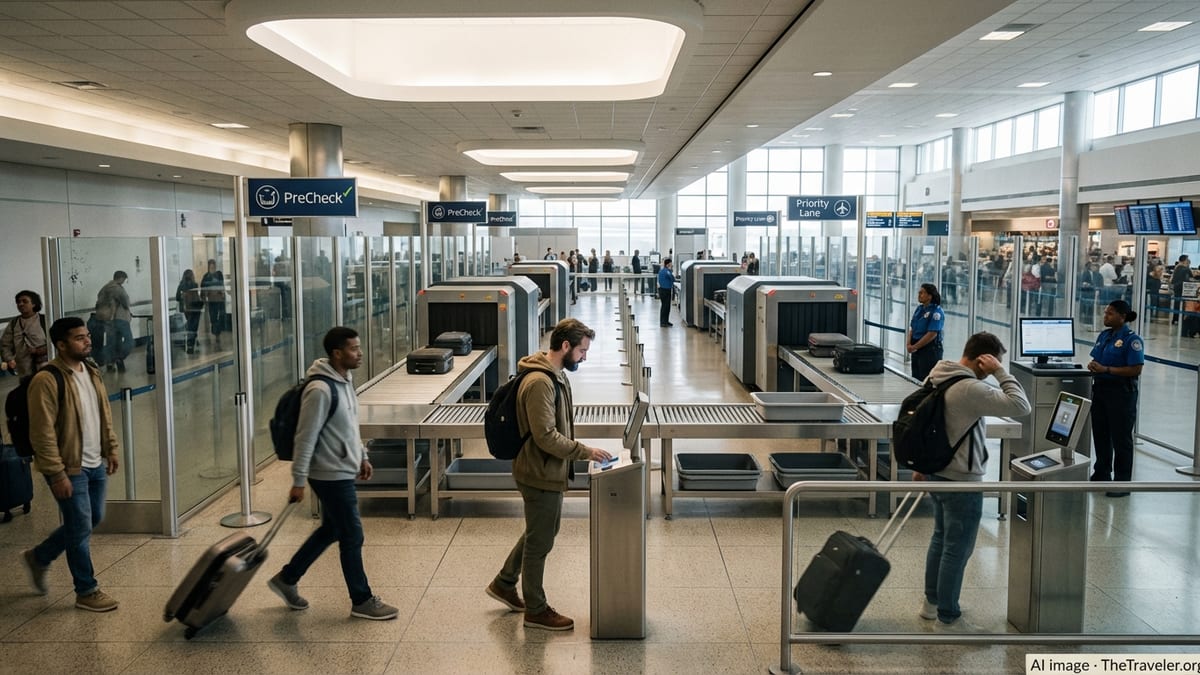
Facial Recognition Moves From Pilot to the Mainstream
After years of small trials, biometric screening is entering the airport security mainstream in 2026. The U.S. Transportation Security Administration is expanding its TSA PreCheck Touchless ID program to 65 airports this spring, allowing eligible travelers to clear the initial checkpoint by having their face scanned instead of showing a physical ID. TSA officials describe the system as an additional convenience layer for PreCheck members, particularly in major hubs preparing for crowds tied to events such as the 2026 World Cup.
Touchless ID builds on the agency’s second-generation Credential Authentication Technology, known as CAT-2, which compares a real-time facial image to the photo stored in a traveler’s passport or government-issued ID. The machines, already in use at airports including Seattle-Tacoma, automatically confirm that the person standing at the podium is the same one booked to travel and flag fraudulent documents, while officers step in only when the system cannot make a match.
For passengers, the most visible change is at the podium: no more juggling phones, wallets and boarding passes. In enabled lanes, PreCheck members with a valid passport linked to their airline profile can simply pause in front of a camera before being waved toward bag screening. TSA stresses that the program remains optional, with signage advising travelers that they can opt out and undergo traditional ID checks instead.
The rapid deployment is being closely watched by privacy advocates, who have long questioned biometric data collection in public spaces. TSA says photos captured at the podium are used only for real-time identity verification and are not stored, but civil liberties groups continue to press for independent oversight, clear deletion standards and meaningful alternatives for travelers who do not wish to participate.
CT Scanners Quietly Rewrite the Rules on Liquids and Laptops
While cameras at the podium grab headlines, the biggest shift in how passengers pack their carry-ons is happening inside the x-ray machines themselves. Across Europe and, increasingly, in North America, airports are installing computed tomography scanners that generate high-resolution 3D images of bags, giving security officers a far more detailed view of what is inside without requiring passengers to unpack electronics and liquids.
European regulators have formally approved these scanners for liquid explosive detection, paving the way for airports equipped with the technology to relax the long-standing 100-milliliter liquid limit. A growing list of hubs, including major airports in Germany, Italy, the Netherlands, Spain and the United Kingdom, now allow passengers to leave laptops and tablets in their bags and, in some cases, carry liquids in containers up to two liters through security.
The transition is far from uniform. Some airports have CT scanners only in certain lanes, while others are still waiting for software upgrades or deliveries, creating a patchwork of rules that can confuse travelers on multi-leg itineraries. Aviation officials caution that installing hundreds of new scanners, reconfiguring checkpoints and retraining staff is a multi-year project, and older lanes often continue to operate under the familiar restrictions.
Industry analysts say the payoff could be significant once the rollout is complete. By reducing the number of trays, repacks and secondary searches triggered by overstuffed bins, CT scanners are designed to cut wait times at busy checkpoints while improving threat detection. For airlines and airports, that translates into smoother peak operations and fewer delayed departures linked to long security queues.
Digital IDs, ConfirmID Fees and the New Identity Paradigm
The move toward smart security is not limited to cameras and scanners. Identity itself is going increasingly digital. TSA now accepts certain mobile driver’s licenses and digital IDs stored in smartphone wallets at many checkpoints, with officials arguing that encrypted, device-based credentials are harder to forge and can reveal only the minimum information necessary for identity checks.
On February 1, 2026, the agency added another digital-era wrinkle with the launch of TSA ConfirmID, a paid verification option for travelers who arrive at the airport without acceptable identification. For a $45 fee, passengers can attempt to verify their identity through an online process and, if successful, receive confirmation valid for a limited period to present at the checkpoint. TSA emphasizes that approval is not guaranteed and that the process can add 10 to 30 minutes to screening.
The new fee has drawn criticism from some consumer advocates, who argue that it effectively penalizes travelers in stressful or emergency situations and could disproportionately affect infrequent fliers. Supporters say the policy reflects the real costs of the technology and staffing required to vet passengers who cannot present standard documents, and note that the vast majority of travelers already comply with ID rules.
For airports, the shift toward digital identity presents both opportunities and new coordination challenges. Carriers are racing to integrate digital ID options into their own apps and loyalty profiles, while ensuring compatibility with TSA systems and keeping front-line staff trained on what is and is not acceptable at the podium. As more functions, from boarding passes to passports, migrate into phones and wearables, ensuring resilience when devices run out of power or networks fail is emerging as a critical design concern.
Smart Checkpoints Arrive in New Terminals Worldwide
The spread of smart security is reshaping airport infrastructure as much as it is changing procedures. New and expanded terminals are increasingly being designed around automated lanes, larger CT scanners and biometric corridors that tie check-in, security and boarding into a single, largely touchless flow.
In the United States, airports from Austin to Denver and Las Vegas are building or retrofitting checkpoints with more room for technology, installing wider conveyors, automated tray return systems and power supplies capable of handling bulky scanners. Many of these projects were accelerated by pandemic-era federal funding and are now coming online just as passenger numbers rebound toward record levels.
Elsewhere, hubs such as Singapore’s Changi Airport and several Gulf-region mega-airports are positioning themselves as showcases for end-to-end biometric journeys, where a single face scan at check-in can carry a traveler through bag drop, security and boarding. These systems rely on close cooperation between airports, airlines and border agencies, and often sit alongside more traditional lanes for passengers who prefer not to enroll.
Airport planners say the checkpoint of the near future will be less about single-file lines and more about parallel processing, with kiosks, biometric gates and adaptive software directing travelers to the fastest available lane. The result, if the technology works as promised, is a security experience where bottlenecks are managed dynamically and peak surges are smoothed before they spill into terminal concourses.
Balancing Speed, Privacy and Trust
As smart security spreads, regulators and operators are under pressure to show that faster lines do not come at the expense of civil liberties or fairness. Privacy groups have urged transportation agencies to publish clear information on how biometric data is handled, how long it is kept and who can access it, as well as to provide easily accessible opt-out options that do not punish travelers with excessive delays.
Questions of equity are also rising to the forefront. Many of the most advanced options, from PreCheck Touchless ID to fast-track liquid rules in premium terminals, are currently concentrated in wealthier markets and often tied to paid membership programs. Travel advocates warn that this could entrench a two-tier system in which those who can afford fees or fly frequently enjoy seamless journeys while others remain in slower, more intrusive lines.
Security officials counter that new technology can ultimately benefit all passengers by making threat detection more accurate and by reducing the workload on front-line staff, who can then focus attention where it is most needed. They point to early data suggesting that automated identity checks and 3D bag imaging can spot fraudulent documents and prohibited items that might slip through in a rushed visual inspection.
In the near term, travelers can expect a period of mixed experiences: a touchless facial-recognition lane at one end of a terminal, a conventional metal detector and 100-milliliter liquid limit at the other. For now, the revolution in airport security is less a single breakthrough than a gradual layering of systems that, taken together, promise to push the worst of the old security queue further into the past.