

More news on this day
Spirit Airlines built its brand on ultra-cheap fares and à la carte fees, but a wave of quieter policy shifts and aircraft tweaks now means many travelers’ next “cheap” trip may look and cost different than expected.
Get the latest news straight to your inbox!
From No-Fee Flexibility Back to Penalties on the Cheapest Tickets
One of the most significant recent changes at Spirit Airlines centers on flexibility. In May 2024, the carrier promoted a headline-grabbing move to drop change and cancellation fees across all fares, positioning itself as more consumer-friendly while still charging separately for bags, seats, and extras, according to publicly available company statements and subsequent coverage. The policy briefly made Spirit stand out among ultra-low-cost rivals that typically lean heavily on penalties for itinerary changes.
That leniency has now been scaled back. Travel industry reports indicate that as of early February 2025, Spirit reinstated change and cancellation fees for its lowest-tier Go fares, reversing the short-lived era of universal no-fee changes. Passengers booking the rock-bottom Go fare now face a fee if they need to adjust plans closer to departure, with the exact charge varying by timing. Limited flexibility remains, including the standard 24-hour post-booking window in which travelers can cancel without a penalty, usually in exchange for a credit rather than cash.
The result is that a ticket which appears dramatically cheaper in a search result may carry far higher downside risk if plans are uncertain. Travelers accustomed to the more generous 2024 rules may not immediately notice the fee shift unless they read the fine print at checkout. Observers note that this change aligns Spirit more closely with other ultra-low-cost competitors that use their most restrictive fare types to drive revenue from last-minute alterations.
Spirit has also carved out exceptions that make the policy more complex. Documentation on the airline’s support site indicates that Go bookings made between mid-August 2024 and early February 2025 remain exempt from modification or cancellation fees, although any fare difference still applies. That means two customers holding similarly priced tickets could face very different rules depending on when they originally purchased their flights.
New Bundles and Fine Print That Can Reshape a “Cheap” Total Price
Alongside the reversal on change fees, Spirit has been restructuring how it packages extras such as bags, seat selection, and flexibility. Prior to these shifts, the airline leaned heavily on bare-bones base fares and separate add-ons. More recently, investor presentations and industry analyses describe a strategy focused on selling bundled products at higher upfront prices while subtly adjusting individual ancillary fees.
Travelers now encounter a more layered product lineup when booking. Above the lowest Go fare, Spirit promotes higher-priced options that may include benefits such as reduced or waived change fees, included bags, or preferred seating. For some customers, those bundles could yield better value than piecing together add-ons later. For others, especially those traveling light with fixed plans, the new structure can make it harder to quickly compare the true cost of one itinerary against another airline or even another Spirit fare.
Frequent flyers who previously relied on elite status perks also report that some benefits have effectively shifted into paid bundles. Online discussions and consumer commentary describe situations in which travelers accustomed to complimentary changes or access to premium-style seating now find those perks gated behind new fare families. This evolution mirrors a broader industry trend in which loyalty benefits are increasingly tied to fare type rather than status alone.
The practical impact for budget-conscious passengers is that Spirit’s advertised lead-in price is only the starting point. Under the new model, a traveler might need to pay more upfront to secure flexibility that was briefly standard in 2024, or accept a lower fare with higher potential fees later. The bargain still exists, but it is more conditional on disciplined planning and careful reading of fare details.
Cabin Overhauls, Extra-Legroom Seats, and a Changing Onboard Experience
Changes are not limited to the booking screen. Spirit is in the middle of a multi-year overhaul of its cabins that will subtly reshape how much comfort travelers can expect once onboard. In 2024 the airline began promoting upgrades to its onboard experience, including steps toward free Wi-Fi for certain higher-tier fares or elite members, according to company announcements. These improvements were framed as part of a broader effort to move beyond a purely bare-bones reputation.
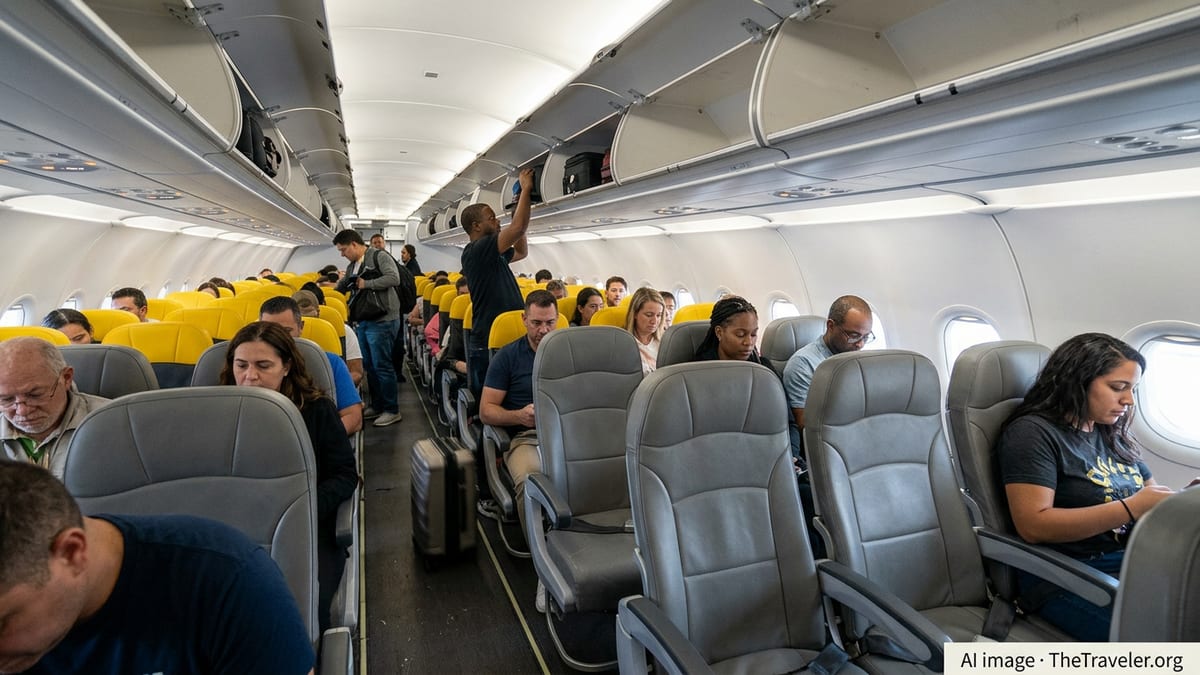
In 2025, attention has shifted to the physical layout of Spirit’s Airbus fleet. Industry coverage indicates that the airline is rolling out new extra-legroom seating across much of its aircraft, marketed as a more comfortable option for those willing to pay above the base fare. Reports describe a dedicated section with several dozen seats featuring increased pitch compared with standard economy, effectively creating a clearer, tiered cabin within what was once a more uniform layout.
At the same time, Spirit has been refining its long-running premium-style “Big Front Seat” product, which offers wider seats at the front of the aircraft but typically without traditional first-class service elements. Travelers commenting on recent changes suggest that access to these seats is now more closely tied to specific bundles and fare types, reducing the ability to secure them at modest add-on prices late in the booking process.
For passengers chasing the lowest advertised fare, the cabin changes may be felt most indirectly. More distinct seat categories create greater opportunity for Spirit to segment pricing, charging increasingly granular premiums for extra legroom, preferred locations, or wider seats. On a practical level, that can mean more pop-up offers throughout the purchase path, and a wider range of price points between the cheapest seat and the most comfortable one.
Bankruptcy Exit, Route Cuts, and What It Means for Finding a Deal
Spirit’s latest wave of changes is unfolding against a backdrop of financial turbulence. Public filings and news coverage show that after a federal judge blocked JetBlue’s proposed acquisition of Spirit in early 2024, the carrier struggled with high debt, intense price competition, and soft demand on some leisure routes. The company ultimately filed for Chapter 11 bankruptcy protection in November 2024 and, according to recent reports, emerged from bankruptcy in March 2025 following a court-approved debt restructuring and new equity investment.
As part of its recovery plan, Spirit has been shrinking and reshaping its network rather than relentlessly adding capacity, a contrast with its expansion strategy earlier in the decade. Industry data compiled by airline trade groups and analysts highlights substantial year-over-year cuts to domestic capacity in late 2025, signaling a pivot toward focusing on routes and markets where the airline believes it can sustain higher revenue per seat.
For travelers, that means Spirit’s cheapest fares may become harder to find on certain city pairs, especially smaller or more seasonal destinations. Some routes that once supported multiple daily frequencies may now see fewer options, while others disappear from schedules entirely. In larger markets, however, Spirit may concentrate more flights where demand is deepest and competition with legacy carriers is fiercest, potentially preserving headline-grabbing deals on select routes.
The financial reset has also reinforced Spirit’s reliance on ancillary revenue. As the airline works to stabilize its balance sheet, analysts expect continued pressure to fine-tune fees and fare structures that maximize income from every seat. That dynamic helps explain why seemingly small policy shifts, such as the return of change fees on the cheapest tickets or the introduction of new bundles, can have an outsized effect on how budget travelers experience the brand.
How Travelers Can Protect Themselves on Their Next Spirit Booking
With so many moving pieces, the biggest risk for travelers is assuming that yesterday’s Spirit rules still apply. The same carrier that briefly removed change and cancellation fees in 2024 is once again charging penalties on its lowest fares in 2025. Cabin layouts are evolving, bundles are changing what is included in each fare, and the network is being trimmed in ways that can limit alternative options if a flight is disrupted.
Consumer advocates and travel analysts consistently emphasize the importance of reading the fare conditions on the checkout page before purchasing an ultra-low-cost ticket. On Spirit, that means checking whether the fare type carries any fee-free changes, how much it will cost to adjust plans within a week of departure, and what portion of the total trip cost will come from baggage and seat selection rather than the base fare itself. Travelers should also pay attention to whether travel credits rather than cash refunds are issued when itineraries change.
It is equally important to factor route dynamics into planning. On thinner Spirit routes or at smaller airports where capacity has been cut, a cancellation or major delay can leave fewer same-day alternatives. Some passengers may decide that paying slightly more for a fare with better flexibility, or choosing a route with multiple daily options, provides worthwhile insurance against disruption.
Spirit’s evolving model shows how quickly the definition of a “cheap flight” can change. The airline still offers some of the lowest base fares in the United States, but the path to keeping the overall trip cost low now requires more homework. For travelers willing to scrutinize fare rules, plan bags and seats in advance, and accept limited flexibility on the lowest tiers, Spirit can still deliver a bargain. Those who assume the old rules are still in place may find that their next ultra-low fare comes with new, and sometimes costly, surprises.