

More news on this day
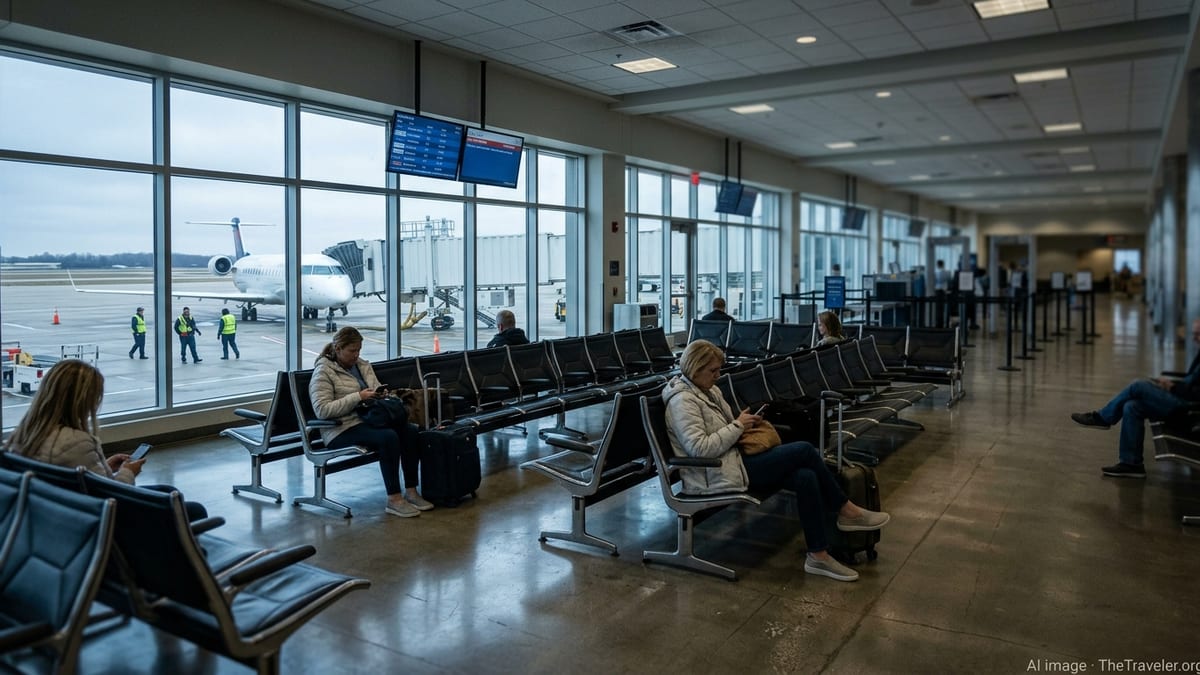
As a partial U.S. government shutdown stretches through March 2026 and another funding cliff looms, regional air travelers are facing a familiar, uneasy question: when politics hit federal paychecks, do small-city flights become the first collateral damage?
Get the latest news straight to your inbox!
A Shutdown Era That Keeps Hitting Aviation
The current funding lapse follows a series of shutdown disruptions over the past year, turning air travel into a recurring pressure point in budget standoffs. Publicly available timelines show that a full federal shutdown in late 2025 triggered Federal Aviation Administration traffic reductions at dozens of major airports, spilling over into regional schedules as airlines trimmed frequencies and downgraded aircraft.
In early 2026, Congress allowed Department of Homeland Security funding to lapse, producing a partial shutdown that directly affects airport security checkpoints. Transportation Security Administration officers are continuing to work without pay, a familiar pattern from previous impasses. Recent coverage from major outlets describes long lines, sporadic checkpoint closures and warnings that continued missed paychecks could prompt more workers to seek other jobs.
Airlines and aviation groups have responded with a coordinated push on Capitol Hill, releasing open letters and policy briefs urging lawmakers to pass full-year transportation and homeland security appropriations. Trade associations point to the 2025 shutdown, when millions of passengers were disrupted and daily economic losses mounted, as evidence that repeated funding crises are chipping away at already strained aviation staffing and infrastructure.
While essential FAA personnel such as air traffic controllers are required to work through shutdowns, prior episodes showed that unpaid shifts, suspended training and furloughed support staff can still force capacity cuts. When that happens, airlines have historically prioritized protecting core hub-to-hub and long-haul services, leaving regional operations exposed.
Why Regional Flights Are Uniquely Vulnerable
Regional routes depend on a thin margin of profitability and a complex web of federal support that makes them particularly sensitive to policy shocks. Many small communities rely on contracts under the Essential Air Service program, which subsidizes flights that would not otherwise be commercially viable. Analyses from previous shutdowns highlighted concerns that prolonged funding lapses could delay reimbursements and prompt carriers to scale back or suspend covered routes.
Even outside formal subsidy programs, regional flying often operates on smaller aircraft with higher per-seat costs and limited redundancy. During the 2025 shutdown, internal scheduling memos reported in business coverage showed major airlines cutting a disproportionate share of regional and short-haul frequencies when the FAA ordered traffic reductions at 40 high-volume airports. Hub connections to smaller cities were trimmed to preserve long-haul and high-yield routes.
Labor dynamics compound the risk. Regional airlines continue to face pilot and mechanic shortages that predate the current political impasse. Industry testimony and academic commentary have stressed that uncertainty over government operations adds another layer of instability, making it harder for carriers to plan training pipelines, open new bases or commit aircraft to marginal markets.
For travelers, this can translate into thinner schedules, fewer same-day options and greater vulnerability to cascading delays. When a weather system or air traffic restriction squeezes capacity at a major hub, small-city spokes are often where airlines pull aircraft first, because there are fewer passengers per flight and alternative ground options exist for at least some trips.
Paycheck Pressure on TSA and FAA Staff
The politics behind the 2026 shutdown center on broader budget and policy disputes, but for frontline aviation workers, the most immediate issue is pay. Reports in national media describe TSA officers missing full paychecks in March, the third shutdown-related disruption to their income in less than a year. Union leaders and worker advocates have warned that attrition is accelerating as employees leave for more stable private-sector security and logistics jobs.
Similar concerns surround FAA staffing. Although many controllers and technical specialists are classified as essential and kept on the job, they depend on appropriations for ongoing training, technology upgrades and overtime funding. Industry analyses note that most air traffic control centers already operate below recommended staffing levels, so even modest increases in sick leave or attrition during a shutdown can force the agency to cap traffic in certain airspace sectors.
While those caps primarily affect congestion-prone hubs, regional travelers feel the ripple effects. When the FAA slows arrivals or departures into major airports to match staffing, airlines face slot and gate constraints that push them to consolidate frequencies. That often means reducing smaller inbound flights that serve as feeders to the national network, particularly at off-peak times.
The result is an uneven experience: a big-city traveler may only notice a longer security line or a slight delay, while a passenger in a small community could see an entire daily flight dropped from the schedule or a connection window shrink to the point where missed flights become far more likely.
Signals From Airlines and Airports on What Comes Next
In recent weeks, airline executives have used earnings calls and public letters to warn that continued brinkmanship over federal funding could force a reassessment of capacity plans for the spring and summer. Several large carriers have publicly urged Congress to insulate aviation workers from future shutdowns by guaranteeing pay for key FAA and homeland security staff, arguing that predictable staffing is essential to maintaining schedules.
Regional operators, which often fly under major-brand liveries via capacity-purchase agreements, have been more restrained in public. However, trade groups representing smaller carriers and regional airports have pointed to past shutdowns as evidence that they are first in line when schedule cuts arrive. Policy briefs circulated in Washington emphasize that rural communities lack alternative commercial options and can suffer outsized economic harm from even temporary suspensions of service.
Some airports have begun issuing traveler advisories tailored to the current shutdown, explaining that facilities remain open but warning that federal operations are under strain. Guidance generally encourages passengers to arrive earlier than usual for screening and to monitor airline communications closely, particularly for early-morning and late-evening regional departures that are more susceptible to staffing-related adjustments.
So far, there has not been a nationwide wave of regional cancellations directly attributed to the 2026 shutdown, but historical patterns suggest that prolonged funding uncertainty increases the risk. As the next deadline approaches, aviation groups are framing the debate around reliability for smaller communities rather than only around headline delays at big-city hubs.
What Travelers on Regional Routes Can Do Now
For passengers already booked on regional flights this spring, the situation is not yet one of mass grounding, but it does call for closer attention than usual. Travel experts and consumer advocates who follow aviation have been advising flyers during recent shutdowns to build extra buffer time into connections, especially when itineraries rely on a single daily flight into or out of a small airport.
Because airlines retain operational control during a shutdown, most schedule changes will appear first in carrier apps and email alerts rather than in government announcements. Travelers on essential-air-service routes or thinly served regional spokes may benefit from checking schedules regularly in the days before departure and considering alternative dates or nearby airports if signs of broader capacity cuts emerge.
Longer term, aviation policy groups are using the current episode to renew calls for structural changes that would shield critical aviation functions from partisan spending battles. Proposals range from multi-year funding for key agencies to specific statutes ensuring that air traffic control and aviation security personnel are paid on time, even when appropriations lapse.
Whether Congress adopts those changes will shape the answer to the question hanging over every small-city departure board in 2026: when the next shutdown hits Washington, will regional flyers once again be the first to feel it at the gate?