

More news on this day
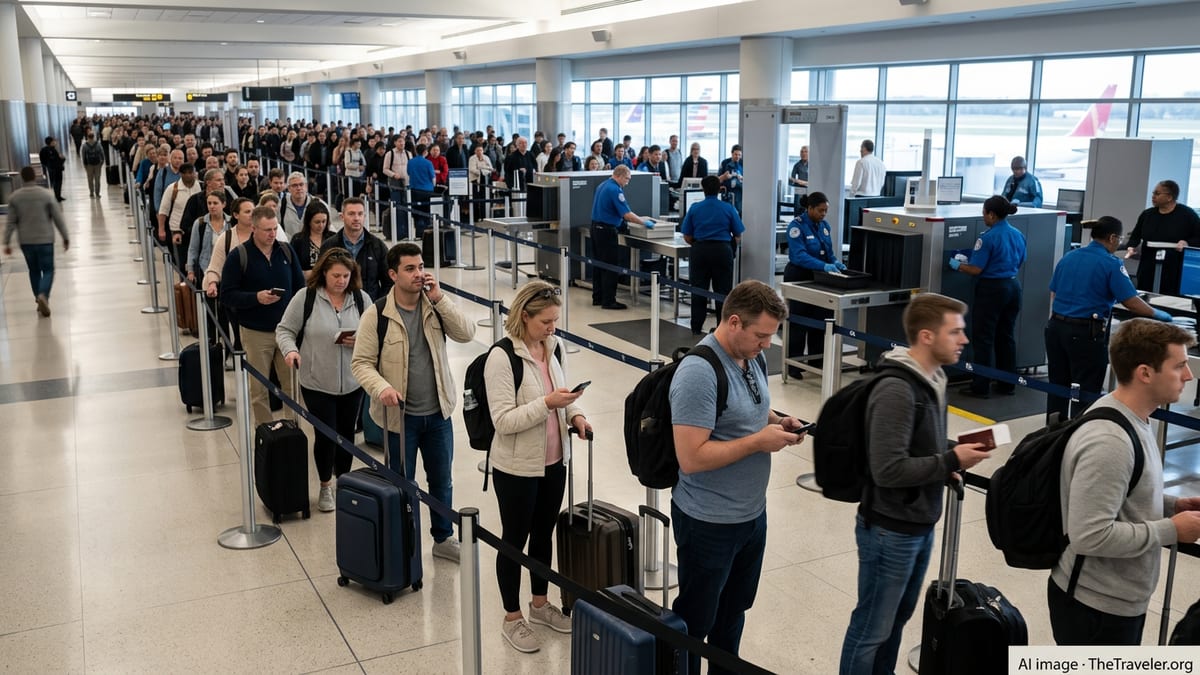
As the 2026 federal government shutdown drags into its second month, security bottlenecks are rippling through U.S. airports, with reported wait times ballooning to ninety minutes and beyond at some of the country’s busiest checkpoints just as the spring travel rush builds.
Get the latest news straight to your inbox!
Shutdown Politics Hit the Security Checkpoint
The latest federal funding standoff has left the Department of Homeland Security operating under a partial shutdown since mid-February, disrupting pay for Transportation Security Administration staff and creating fresh uncertainty at airport checkpoints. TSA officers are among the essential federal workers required to remain on the job even when paychecks are delayed, a dynamic that past shutdowns have shown can quickly erode staffing levels as financial strain mounts.
Publicly available information shows that the Homeland Security funding lapse is already visible in front-line operations. Airline leaders have warned of a growing risk to the wider aviation system if the shutdown continues, emphasizing that security screening is highly sensitive to even modest staffing gaps. Industry groups tracking passenger flows say the impact has emerged just as leisure demand climbs for spring break, magnifying the effect of each closed lane or unstaffed checkpoint.
Reports from multiple outlets indicate that airports serving large volumes of domestic leisure traffic have been hit hardest, particularly during early-morning and late-afternoon peaks. At some locations, airport social media feeds have progressively increased their guidance, first advising passengers to arrive two hours early, then three, and in some cases four to five hours before departure as the shutdown’s effects deepened.
Although not every terminal is seeing extreme delays, the uneven nature of the disruption is contributing to a sense of unpredictability. A traveler departing from one concourse may clear security in under half an hour, while another in a different terminal or city faces a ninety-minute queue or longer, with little warning before reaching the airport.
Ninety-Minute Lines Become the New Normal at Some Hubs
Travel media, local newsrooms and airport authorities are documenting security lines that snake into ticketing halls and, at times, toward parking structures at several large U.S. airports. Coverage out of Houston describes wait times surpassing three hours at peak periods and repeated advisories urging passengers to arrive four to five hours before departure. Similar reports from other large hubs and popular spring break gateways cite security waits of ninety minutes to two hours as increasingly common during the busiest windows of the day.
The pattern aligns with what aviation analysts observed during earlier shutdowns. When TSA officers work extended shifts without timely pay, callouts and resignations tend to rise, and checkpoint throughput declines. Even a partial reduction in available screeners can quickly turn a routine thirty-minute line into a grinding ninety-minute wait when combined with full aircraft loads and seasonal peaks in family travel.
Some mid-sized airports have, for now, avoided the worst of the crunch. Local coverage from Richmond, for example, notes that TSA operations there remain relatively stable despite the broader shutdown, underscoring how local staffing levels, flight schedules and terminal layouts can buffer or amplify national trends. Still, experts caution that conditions can shift quickly if absences increase or if airline schedules ramp up into the late-March and April holiday periods.
Travel organizations focused on the business and meetings sector are also flagging the risk that prolonged security delays could ripple into missed connections, disrupted conferences and lost productivity. Their advisories urge companies and individual travelers alike to treat current posted checkpoint times as a floor rather than a ceiling while the funding impasse remains unresolved.
How Travelers Are Beating the Madness at Security
With line lengths stretching far beyond normal expectations at some airports, seasoned travelers are leaning on a mix of planning, technology and flexibility to keep trips on track. Travel publications and airport advisories increasingly emphasize the importance of building in extra time, suggesting that flyers temporarily treat three hours as a minimum for domestic departures and even more when connecting through known hotspots.
Published guidance from travel industry groups points to real-time wait time tools as one of the most effective defenses. Many airport and airline apps now display estimated TSA checkpoint queues by terminal, helping passengers pick the least congested entry point where options exist. Some hubs also push checkpoint alerts through social media feeds, giving travelers a snapshot of conditions before they leave home.
Another common recommendation is to streamline carry-on baggage to move faster through whichever lanes are open. Packing light, organizing electronics and liquids so they can be quickly removed, and wearing simple, slip-on footwear can shave crucial minutes in a stressed system where every additional bag check or secondary screening compounds the delay for those behind.
Travel advisors are also encouraging flyers to rethink connections and flight times. Early-morning departures, once prized for their relative calm, are currently among the most strained at several shutdown-affected airports, prompting some passengers to shift to midday flights when possible. Others are padding their itineraries with longer layovers, accepting extra time in terminals as insurance against an unexpectedly slow first checkpoint.
The Uneven Geography of Shutdown Disruption
The 2026 shutdown’s impact on airport security is highly uneven across the country, shaped by local staffing levels, airline schedules and the presence or absence of alternative screening arrangements. Some airports that rely heavily on Transportation Security Administration screeners are experiencing the sharpest spikes in wait times, while a handful with private contractors under federal oversight, or with more flexible staffing models, have seen more moderate effects so far.
Coverage of the current situation points out that even within a single metropolitan area, travelers can face dramatically different experiences. One airport may post social updates warning of ninety-minute waits and urging arrival four hours early, while a smaller nearby field reports near-normal processing times. This patchwork environment is prompting some travelers to shift their departure airport entirely, even if it means a longer drive, in exchange for more predictable screening.
Observers note that the rollout of trusted traveler programs in recent years had previously helped blunt security congestion by diverting frequent flyers into dedicated lanes. However, publicly available information indicates that parts of this system, including Global Entry enrollments, were temporarily paused as Homeland Security grappled with the funding shortfall. That pause has limited one of the tools airports typically rely on to keep regular lanes from becoming overwhelmed during peak periods.
The result is a travel landscape where geography matters more than ever. Passengers are increasingly consulting local news and airport advisories not just about weather, but about staffing and shutdown-related disruptions before committing to routes, connections and even vacation destinations.
Travel Habits May Shift Long After Funding Is Restored
As Congress continues to debate Homeland Security funding, analysts suggest that the current wave of long security lines could leave a lasting mark on traveler behavior. Research on earlier shutdowns and aviation disruptions indicates that passengers who endure missed flights or multi-hour queues often change their habits for years afterward, gravitating toward nonstops, alternative airports or other modes of transport where practical.
Industry research circulated by travel trade groups prior to the 2026 standoff underscored how security delays effectively impose a time and economic tax on air travel, especially for domestic trips of only a few hundred miles where driving or rail can be a viable substitute. Prolonged ninety-minute checkpoint waits, combined with the time required to reach the airport and clear the gate area, may push some travelers to reconsider whether short-haul flights are worth the uncertainty.
At the same time, travel experts point out that the current disruption is not uniform and that many airports are working aggressively, within the limits of federal staffing constraints, to keep passengers moving. Local campaigns to support unpaid TSA workers with donated food or gift cards, widely reported in recent days, highlight both the strain on front-line staff and the desire among travelers and airport communities to keep operations functioning during the shutdown.
For now, air travelers face a paradoxical mix of record demand and constrained security capacity. Until a funding agreement restores stability for the transportation security workforce, the prudent assumption for anyone heading to the airport is that a ninety-minute security line is no longer an outlier but a possibility that must be factored into every itinerary.